Friterie Viroquoise
In the Ardennes border country of northern France, Friterie Viroquoise represents the kind of everyday fry-house that anchors small-town life along the Meuse valley. A friterie in this part of France is not a footnote to the dining scene — it is the dining scene, serving a community where Belgian frying traditions meet French rural appetite. Sit-down or takeaway, this is local eating at its most direct.
 Discover on Pearl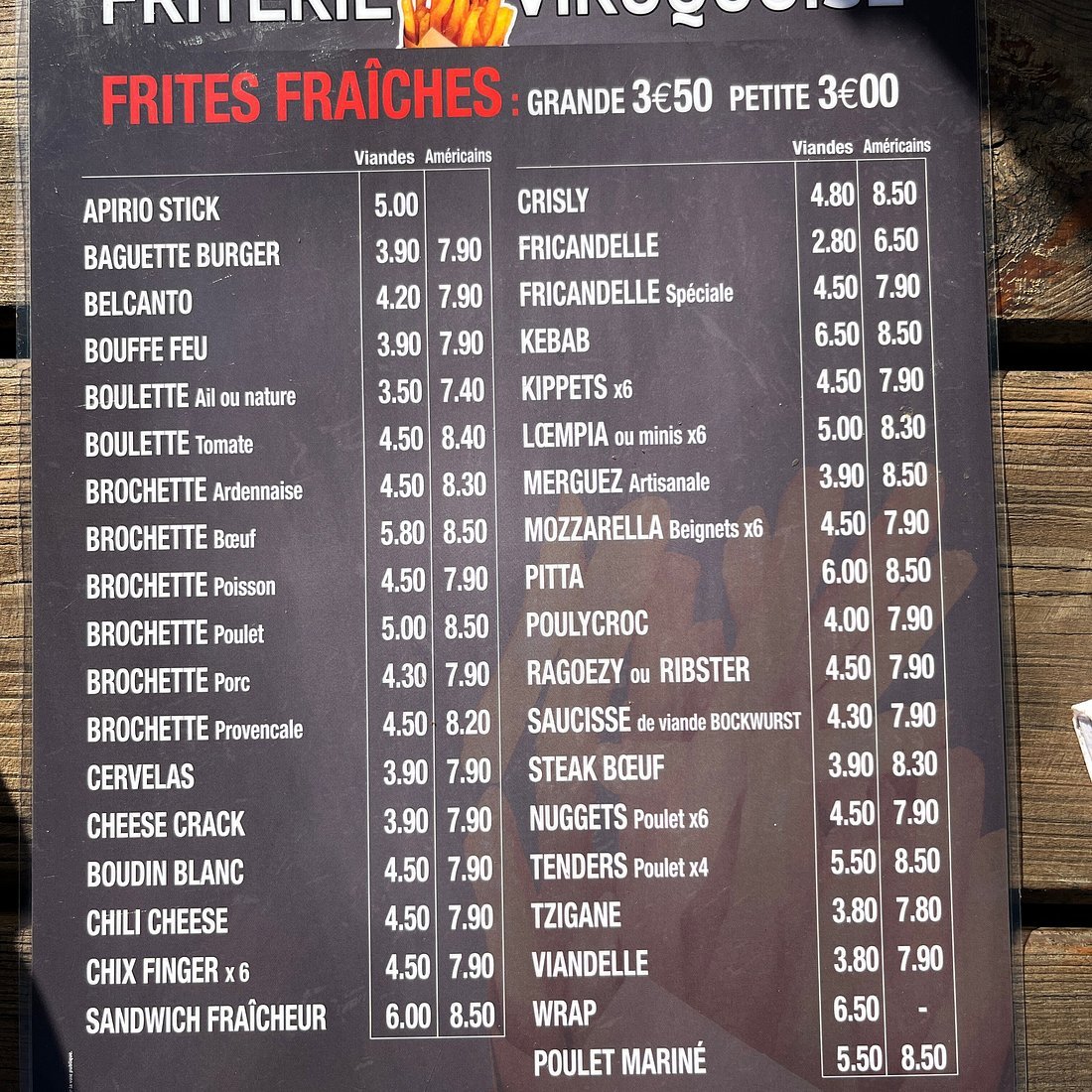
Frying at the Edge of the Ardennes
Vireux-Molhain sits at the northern tip of the French Ardennes, pressed against the Belgian border where the Meuse river bends through limestone cliffs and dense forest. In a town of this scale and geography, the friterie is not a convenience — it is an institution. The fry-house tradition in this corridor of northern France draws from both sides of the border: Belgian frying culture, with its insistence on double-frying in animal fat for a specific texture and colour, has long crossed the frontier and settled into the fabric of Ardennes towns. Friterie Viroquoise, on Avenue Roger Posty, operates within that tradition.
The Ardennes has historically been one of the least food-touristed regions of France. While three-Michelin-star destinations like Flocons de Sel in Megève or Mirazur in Menton draw international reservation lists months in advance, the north's culinary identity has been built on something more utilitarian: the brasserie, the estaminet, the friterie. That quietness is not a deficit. It means the region's food culture has developed without the distortions of prestige tourism, staying close to what people here actually eat.
The shortlist, unlocked.
Hard-to-book tables, cellar releases, and concierge-planned trips.
Get Exclusive Access →The Ingredient Logic of a Friterie
A serious friterie is not defined by its menu complexity but by the quality of its raw material and the discipline of its frying process. In the Belgian-influenced tradition that shapes this part of the Ardennes, potato sourcing is foundational. The preferred varieties for frites in this region — Bintje historically, though other floury cultivars have entered the rotation , are grown for high starch content and low moisture. The Ardennes and the adjacent Belgian plains have long produced these varieties, and the proximity of Vireux-Molhain to that agricultural zone makes local or near-local supply a practical reality rather than a marketing position.
The double-fry method, standard in this tradition, first blanches the potato at a lower temperature to cook through, then finishes at high heat to create the exterior crust. The fat medium matters: the shift away from beef tallow in many commercial operations over recent decades has been contested in artisan circles, where tallow is argued to produce a flavour profile and texture that vegetable oils replicate imperfectly. Where individual friteries sit on that question tells you something about their relationship to the older tradition. France's most celebrated kitchens , from Alléno Paris au Pavillon Ledoyen to Troisgros in Ouches , have each grappled with questions of ingredient sourcing and process discipline; the friterie tradition asks the same questions at a different price point and scale.
The Border Tradition and What It Produces
The Franco-Belgian border cuisine that shapes Vireux-Molhain is distinct from the food cultures of Provence, Alsace, or the Atlantic coast. There are no olives, no foie gras, no oysters. The proteins are more likely to be andouillette, merguez, or a brochette, all standard companions to frites in the northern French fry-house format. Sauces , andalouse, américaine, samouraï, the local variants of mayonnaise-based condiments , are as much a part of the offering as the frites themselves, and regional loyalty to specific sauce combinations is real.
This is a different culinary register from the grand maisons of French gastronomy. Paul Bocuse's Auberge du Pont de Collonges, Bras in Laguiole, Auberge de l'Ill in Illhaeusern , these are expressions of haute cuisine's relationship with French terroir. The friterie expresses something else: the everyday appetite of a working community in a landscape defined more by the river, the forest, and the border than by agricultural abundance or gastronomic ambition. Both are legitimate readings of what French food is.
Situating the Visit
Vireux-Molhain is accessible by road from Charleville-Mézières, the Ardennes departmental capital, roughly 40 kilometres to the south. The town is also reachable by rail on the Charleville-Mézières to Givet line, which follows the Meuse. For travellers arriving from Belgium, Dinant is approximately 30 kilometres to the north along the same river corridor. The town sits within the Ardennes natural park zone, and visitors combining a stop here with the valley's walking and cycling routes will find the friterie format , quick, filling, affordable , well-suited to that kind of day.
The fuller architecture of French fine dining, from Les Prés d'Eugénie in Eugénie-les-Bains to La Table du Castellet or Georges Blanc in Vonnas, operates at a remove from this register, geographically and conceptually. But the distinction worth holding onto is that French food culture has always contained both poles. The friterie is not a lesser version of the gastronomic restaurant; it is a different answer to the same question of what to eat and where to come from. Auberge du Vieux Puits in Fontjoncouse and Le 1947 in Courchevel represent one answer. The fry-house on the Meuse represents another.
For context on how France's broader dining spectrum maps out, L'Oustau de Baumanière in Les Baux, Maison Lameloise in Chagny, and La Vague d'Or in Saint-Tropez are covered in detail on EP Club alongside destinations as far afield as Le Bernardin in New York and Lazy Bear in San Francisco. The full Vireux-Molhain restaurants guide covers what else the town and its immediate surroundings offer.
Planning a Stop
A friterie visit requires no reservation, no dress consideration, and no extended time commitment. The format is counter service, typically with seating available either inside or at exterior tables depending on the season and layout. In Ardennes towns, friteries often operate afternoon into evening, with Saturday trade particularly strong given the market and leisure rhythms of small French communes. Specific hours for Friterie Viroquoise are not confirmed in our records and are worth checking locally before a journey is planned around the stop.
Frequently Asked Questions
- Is Friterie Viroquoise suitable for children?
- Friteries in northern France are, structurally, among the most family-accessible formats in the country. The food is familiar, the prices are low relative to sit-down alternatives in the region, and the counter-service model removes the formality that can make conventional restaurants difficult with young children. Vireux-Molhain is a small town with no significant fine-dining price pressure, making the friterie a practical default for families moving through the Ardennes.
- What is the overall feel of Friterie Viroquoise?
- The feel is unreservedly local. This is not a destination venue drawing visitors from Charleville-Mézières or across the Belgian border for a specific experience , it is the kind of place that serves the community it sits in. There are no awards in the record, no press recognition, and no premium pricing signals. What that produces is an atmosphere shaped entirely by regular custom rather than by hospitality performance.
- What is the signature dish?
- No specific signature dish is confirmed in our records for this venue. In the friterie format generally, and in this border region specifically, frites are the anchor of any order , the quality of the potato, the frying medium, and the cook temperature are what differentiate one house from another. Sauce selection is the secondary point of interest, with the northern French and Belgian condiment range typically running to a dozen or more options. Any protein accompaniment , merguez, brochette, fricandelle , is ordered around the frites rather than instead of them.
- How does Friterie Viroquoise fit into the broader food culture of the French Ardennes border region?
- The friterie format in towns like Vireux-Molhain reflects a specific Franco-Belgian culinary overlap that has little equivalent elsewhere in France. The Ardennes north of Charleville-Mézières shares frying traditions, potato varieties, and condiment culture with the Belgian province of Namur directly across the border. In that sense, a visit to Friterie Viroquoise is as much a read on a cross-border food tradition as it is on any individual establishment , the cuisine here does not stop at the national frontier, and the town's position on the Meuse corridor makes that continuity visible.
How It Stacks Up
These are the closest comparables we have in our database for quick context.
| Venue | Cuisine | Price | Awards | Notes |
|---|---|---|---|---|
| Friterie Viroquoise | This venue | |||
| Mirazur | Modern French, Creative | €€€€ | Michelin 3 Star | Modern French, Creative, €€€€ |
| Alléno Paris au Pavillon Ledoyen | Creative | €€€€ | Michelin 3 Star | Creative, €€€€ |
| Kei | Contemporary French, Modern Cuisine | €€€€ | Michelin 3 Star | Contemporary French, Modern Cuisine, €€€€ |
| L'Ambroisie | French, Classic Cuisine | €€€€ | Michelin 3 Star | French, Classic Cuisine, €€€€ |
| Le Cinq - Four Seasons Hôtel George V | French, Modern Cuisine | €€€€ | Michelin 3 Star | French, Modern Cuisine, €€€€ |
Need a table?
Our members enjoy priority alerts and concierge-led booking support for the world's most difficult tables.
Get Exclusive AccessThe shortlist, unlocked.
Hard-to-book tables, cellar releases, and concierge-planned trips.
Get Exclusive Access →