Our verdict
Frankowitsch serves Austrian Deli Brötchen and open-faced sandwiches in a historic building, with quick-bite pacing for breakfast, brunch, or lunch.

Pearl is the En Primeur Club membership app, where members save venues, book tables and use the concierge.
Graz's Bread Counter and What It Represents
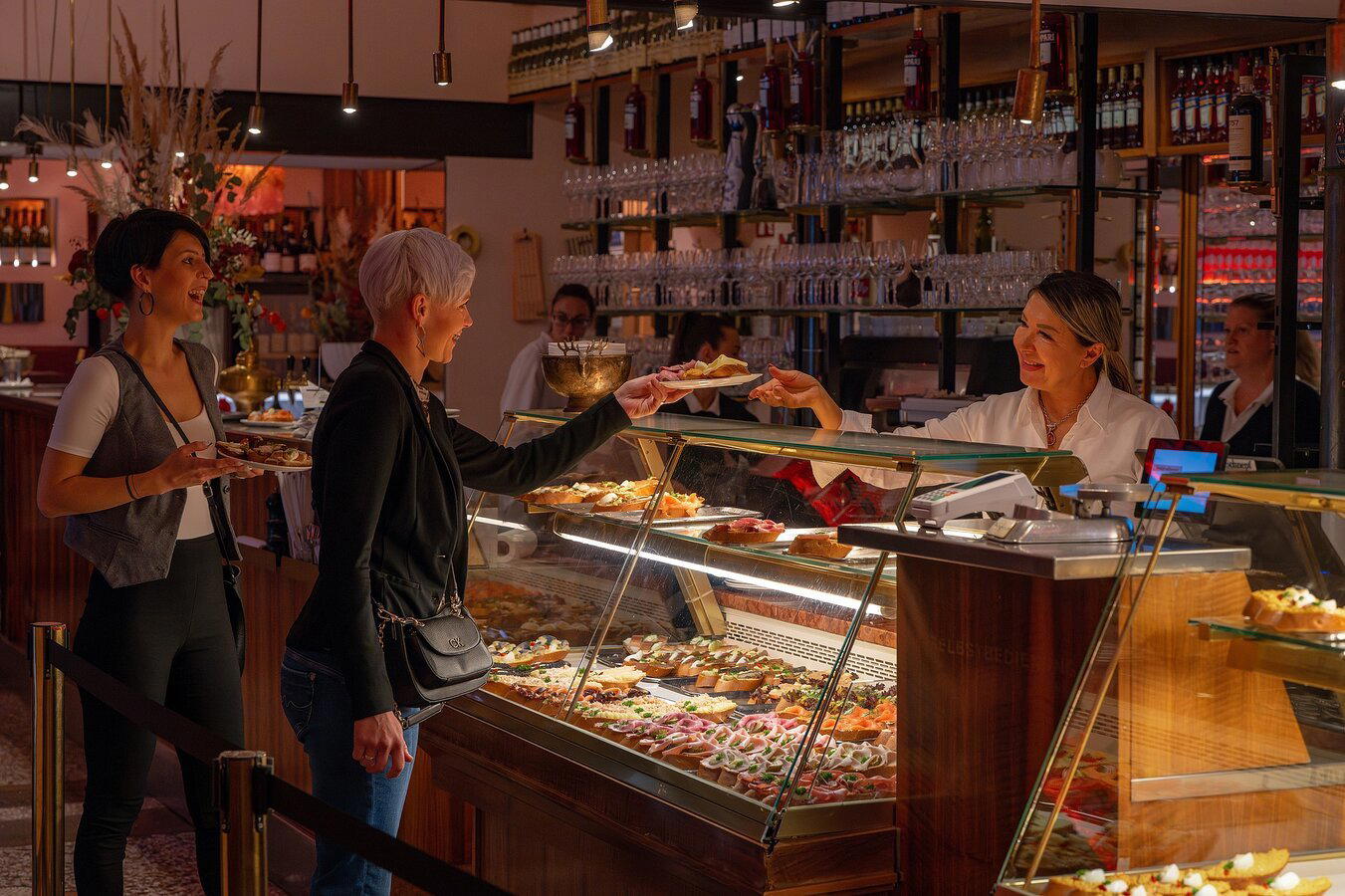
On Stempfergasse, a narrow lane in Graz's old town, there is a particular kind of quiet ceremony that plays out most mornings. Customers stand at the counter, study the open-faced sandwiches arranged in rows, and order by pointing. The transaction is brief, the protocol understood by everyone in the room. Frankowitsch is one of those addresses that locals treat as infrastructure rather than destination, which is usually the more reliable recommendation.
The format belongs to a Central European tradition that predates modern dining categories: the Buffet or stand-up sandwich counter, where bread, quality toppings, and speed coexist without any of the theatre associated with sit-down restaurants. Vienna has its own versions; Graz, with its stronger Styrian identity, has maintained the tradition in a slightly less self-conscious register. Frankowitsch sits at Stempfergasse 2, within walking distance of the Hauptplatz and the old town's main pedestrian axes, which places it in the flow of both commuters and tourists without being shaped by either audience.
The Kulturkultur of the Open-Faced Sandwich
Austria's sandwich culture is worth understanding on its own terms before arriving. The open-faced format, known locally as a Butterbrot in its simpler incarnation or dressed as a belegte Brote when topped with cured meats, smoked fish, or spreads, has historically been the domain of delicatessens and specialty purveyors rather than restaurants. The quality signal comes from sourcing: the bread supplier, the charcuterie provenance, the freshness of the fish. In this context, venues like Frankowitsch operate closer to a premium deli than a restaurant in the conventional sense, and should be assessed accordingly.
Styria adds its own layer. The region's food culture, well-documented in the way places like Steirereck im Stadtpark in Vienna have built international profiles by leaning into Styrian ingredients, runs on pumpkin seed oil, local cured meats, freshwater fish from regional rivers, and a preference for acidic, mineral-forward flavours that cut through rich fats. Even a counter format in Graz is touched by this regional specificity. It is not the same as a Vienna Würstelstand or a Munich deli; the sourcing references a different agricultural tradition.
Where This Fits in Graz's Dining Map
Graz has developed a more stratified dining scene than its size might suggest. At the formal end, addresses like Aiola im Schloss and aiola upstairs trade on the city's architectural backdrop and regional produce in a restaurant format. Artis, sitting at the €€€€ tier, operates in creative territory. Adelphia and Arravané offer further alternatives across different price registers.
Frankowitsch occupies a different position in that map entirely. The relevant comparison is not with formal restaurants but with the question of what midday eating looks like for people who actually live and work in the old town. In that peer group, the counter-service sandwich address with a reputation for quality sourcing has a specific and durable value. It is not competing with tasting menus at Obauer in Werfen or with the precision of Döllerer in Golling an der Salzach; it is competing with every other fast lunch option in the Altstadt, and it does so on the premise that the bread and the ingredients are worth seeking out specifically.
That competitive position matters for how a visitor should think about the visit. Come here for late morning or midday, not for dinner. Come for the standing-counter experience that is a direct expression of Central European urban food culture, not for a sit-down meal. The value proposition is specificity and quality within a tight format, not breadth or occasion dining.
The Broader Austrian Counter Tradition
The stand-up counter format has survived in Austria partly because the architecture of old-town buildings supports it and partly because urban working culture has historically favoured brevity at midday. Across Austria's food scene, from the Landhaus Bacher in Mautern an der Donau at the formal end to simpler regional addresses, there is a consistent thread: the leading ingredient sourcing is not always found at the most elaborate format. Sometimes it is the deli counter, the bakery, or the sandwich stand that is doing the most interesting procurement work because the margin for error is smaller when there is nowhere to hide behind technique or presentation.
This is the logic that makes addresses like Frankowitsch worth noting in any serious account of eating in Graz. Not because it belongs in the same conversation as Michelin-recognised kitchens such as Gourmetrestaurant Tannenhof in Sankt Anton am Arlberg or Kräuterreich by Vitus Winkler in Sankt Veit im Pongau, but because the format itself is culturally significant and the old-town location makes it practically relevant for any visitor spending time in central Graz.
The tradition also connects outward. Counter-service formats centred on sourcing quality have found renewed interest in cities globally, from the focused seafood work at Le Bernardin in New York City to community-driven formats like Lazy Bear in San Francisco, though the Austrian version predates those movements by generations and carries no awareness of being a trend. It is simply what lunch has looked like in these towns for a long time.
Planning the Visit
Frankowitsch is located at Stempfergasse 2 in Graz's 8010 postcode, in the heart of the Altstadt and reachable on foot from the main square in a few minutes. The format is suited to a late morning stop or a working lunch; neither a formal reservation process nor a lengthy time commitment is expected in counter-service contexts of this kind. Visitors to Graz combining this kind of address with a broader exploration of the city's dining should consult our full Graz restaurants guide for a structured view of the scene across formats and price tiers. For those travelling more widely through Austria and seeking context on how regional food culture expresses itself at different levels of formality, addresses like Schwarzer Adler in Hall in Tirol, Ois in Neufelden, Stüva in Ischgl, and Restaurant 141 by Joachim Jaud in Mieming offer useful reference points across different regions and registers.
Frequently asked questions
Where do I go for Frankowitsch?
Frankowitsch is located at îStempfergasse 2, 8010 Graz, Austria, Graz.
What makes Frankowitsch different from other lunch spots in Graz's old town?
Frankowitsch on Stempfergasse 2 operates on a format that most of Graz's old town has moved away from: a stand-up bread counter with no seating, no table service, and a menu built entirely around the open-faced sandwich tradition. In a city where Graz's dining scene now runs from casual trattorias to multi-course restaurants like Aiola im Schloss, Frankowitsch represents the older urban working model where a few minutes at a counter constituted a complete meal.
What do people recommend at Frankowitsch?
Frankowitsch is known for its selection of open-faced sandwiches, sliced bread topped with combinations of cured meats, cheese, fish, and spreads, assembled to order and served at the counter. The format follows the Austrian Butterbrot tradition, where the toppings carry more weight than the bread itself. Regulars tend to order multiple pieces rather than treating one as a full meal.
Can I walk in to Frankowitsch?
Frankowitsch operates as a stand-up counter on Stempfergasse 2 in Graz's Altstadt, which means there are no tables to reserve and no booking process. You walk in, choose from what is on offer, and eat standing. During peak morning hours the space fills quickly, so arriving early gives you more choice and more room at the counter.
What's the defining dish or idea at Frankowitsch?
The open-faced sandwich is both the menu and the concept. Austria has a long counter tradition built around bread topped with savoury ingredients rather than enclosed in a roll, and Frankowitsch is one of Graz's clearest expressions of that format. The point is not a single signature item but the act of standing at a narrow counter in a medieval lane and eating something assembled within arm's reach.
Is Frankowitsch allergy-friendly?
Because the menu at Frankowitsch centres on cured meats, fish, dairy-based spreads, and bread, common allergens including gluten, lactose, and fish are present across most of the selection. The counter format means options are visible before you order, which helps with quick assessment. Anyone with serious allergies should ask staff directly at Stempfergasse 2, as no allergen information is published centrally.
Is eating at Frankowitsch worth the cost?
Frankowitsch sits in the daytime counter category rather than the restaurant tier, which means pricing is calibrated for a mid-morning or lunchtime stop rather than a full sit-down meal. By Graz standards, this type of counter eating represents good value relative to the quality of ingredients involved. Compared to the formal end of Graz's dining scene, the spend is modest and the commitment is minimal.
Fast Comparison
| Venue | Cuisine | Price | Awards | Notes |
|---|---|---|---|---|
| FrankowitschThis venue (the venue you are viewing) | Austrian Deli Brötchen | $20–30 | Not listed | Not listed |
| Artis | Creative International Seafood Fine Dining | Not listed | 1 Michelin Star · Star Wine List | Creative |
| Kehlberghof | Modern Austrian Fine Dining | $50–100 | Michelin Plate · Star Wine List | Not listed |
| Mohrenwirt | Organic Austrian Wirtshaus | $30–50 | Michelin Bib Gourmand | Not listed |
| Restaurant Scheucher | Central European | Not listed | Michelin Plate | Not listed |
| Schmidhofer im Palais | Modern Austrian-International Fine Dining | $100–150 | Michelin Plate | Not listed |