On Favoritenstraße in Vienna's tenth district, Ferhat Döner occupies the everyday end of the city's eating spectrum, where a single, focused product is made and sold without ceremony. The address places it squarely in Favoriten, a working-class neighbourhood that has long been home to Vienna's Turkish and Balkan communities, giving the döner tradition here a different cultural grounding than the tourist-facing stands of the first district.
Pearl is the En Primeur Club membership app — saves, bookings, and concierge access live there. Same editors, same standards.
- Address
- Favoritenstraße 94, 1100 Wien, Austria
- Phone
- +4369911425842
- Website
- xn--ferhat-dner-yfb.at
- Directions
- Get directions
 Saves & bookings on Pearl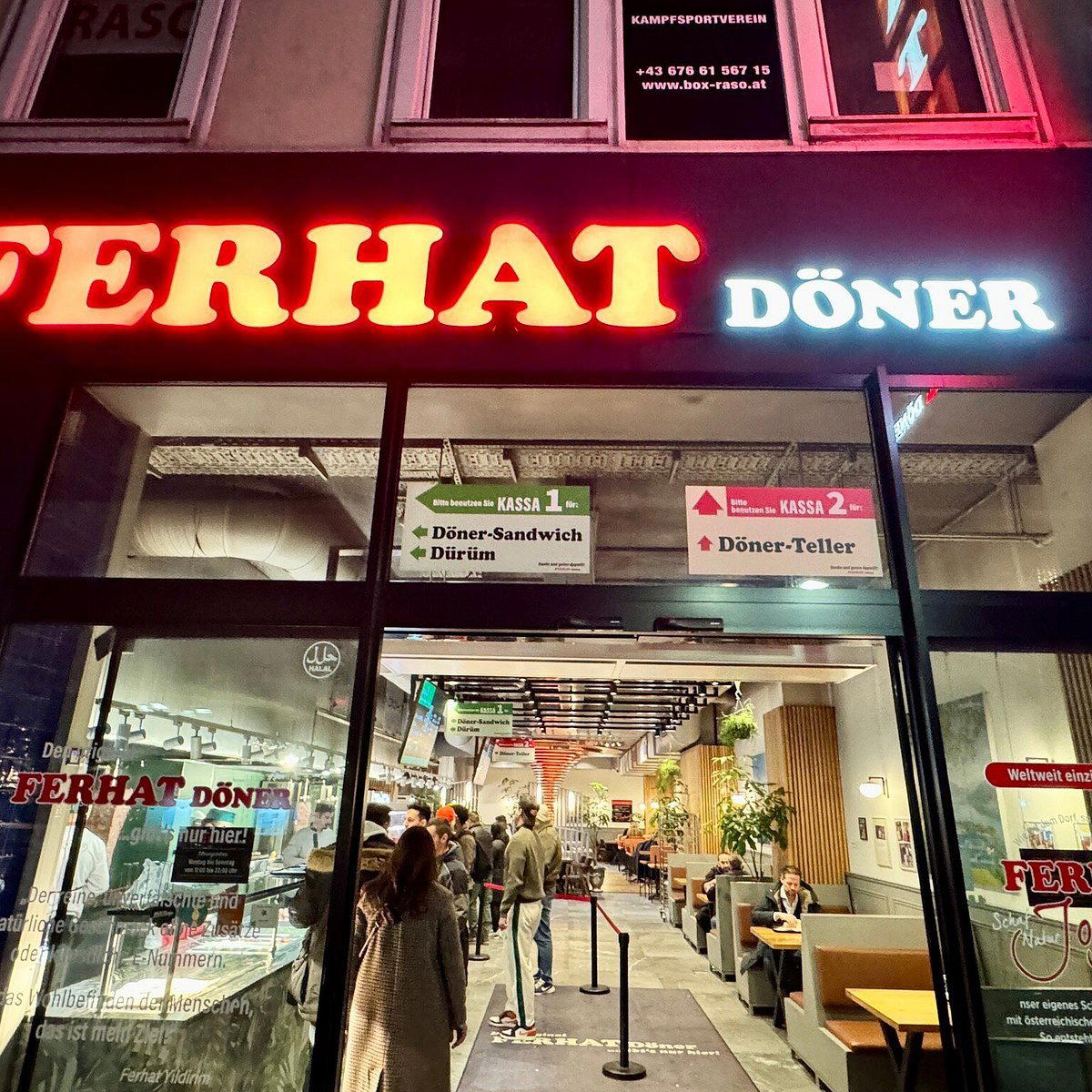
Favoriten and the Döner Tradition It Sustains
Vienna's döner culture does not live in the Innere Stadt. It lives in the tenth district, along Favoritenstraße, in the stretch of shops and cafés that serve the large Turkish, Arabic, and Balkan communities that settled in Favoriten from the 1970s onward. The döner kebab arrived in Vienna through those communities rather than through tourist infrastructure, which means the versions found here tend to be calibrated for a regular, informed clientele rather than for passing traffic. Ferhat Döner, at number 94, sits inside that tradition rather than alongside it.
The distinction matters when thinking about ingredient sourcing. Döner at this end of the market is not a convenience product assembled from frozen meat logs. The quality of a neighbourhood döner operation depends almost entirely on the meat blend, the bread supply chain, and the consistency of the vegetable preparation, because there is no technique or presentation layer to compensate for weak inputs. In this format, the product is the sourcing.
What the Tenth District Tells You About the Food
Favoriten is one of Vienna's most densely populated districts and has a higher proportion of residents with Turkish and Balkan heritage than almost any other part of the city. That demographic concentration has supported a supply ecosystem: Turkish butchers, bread suppliers, and wholesale produce operations that do not exist in the same density elsewhere in Vienna. A döner operation on Favoritenstraße has access to that supply chain in a way that a comparable stand in the third or seventh district does not.
The practical consequence is that the meat available to operators in this corridor tends to be fresher, sourced from suppliers who understand the specific cut blends and fat ratios that produce the right texture on a vertical rotisserie. The bread, typically a soft white roll or a flatbread variant, is more likely to come from a bakery supplying multiple local businesses daily rather than from a centralized catering distributor. None of this is guaranteed, but the structural conditions in Favoriten favour it.
This is the context in which Ferhat Döner operates. The address is not incidental to the product; it is part of the reason the product has the character it does. Vienna's higher-end dining scene, represented by addresses like Steirereck im Stadtpark, Amador, and Konstantin Filippou, makes its sourcing decisions explicit through menus and press materials. At the everyday end of the spectrum, sourcing is implicit in the product itself.
The Format and What It Demands of the Reader
A döner counter operates on different logic than a sit-down restaurant. There is no reservation system, no tasting menu sequence, and no sommelier to structure the experience. The entire transaction happens at the counter, in under three minutes, and the result is eaten standing or walking. What this format demands from the customer is a clear sense of what they want: meat type, bread format, sauce selection, and vegetable additions. Indecision at the counter of a busy döner stand is the equivalent of arriving late to a timed omakase seating.
For visitors more familiar with Vienna's formal dining tier, which includes tasting-menu operations like Mraz and Sohn and Doubek, the döner counter represents a different kind of discipline: the kitchen has one product, optimized over time, and the customer's role is to receive it efficiently. Across Austria more broadly, this kind of focused single-product operation appears in various regional formats, from the smoked fish counters at Landhaus Bacher in Mautern an der Donau to the precise alpine cooking at Obauer in Werfen. The ambition differs enormously, but the logic of a kitchen built around a single defining product is consistent.
Placing Ferhat Döner in Vienna's Eating Spectrum
Vienna's restaurant scene at the upper end is well-documented. The city has a concentration of creative and modern Austrian cooking that draws serious food travellers, from the long-established reputation of Ikarus in Salzburg to the alpine precision of Griggeler Stuba in Lech and the herb-driven work at Kräuterreich by Vitus Winkler in Sankt Veit im Pongau.
The restaurant occupies the opposite end of that spectrum without any tension. Cities that sustain serious high-end dining cultures also tend to sustain strong everyday eating cultures, and the two are not in competition. New York's most serious diners move between Le Bernardin and a slice counter on the same day without cognitive dissonance. The same principle applies in Vienna: the existence of formally recognized creative restaurants in the first and third districts does not diminish what a well-run döner counter in the tenth delivers on its own terms.
The broader Austrian dining network, which includes operations like Döllerer in Golling an der Salzach, Schwarzer Adler in Hall in Tirol, Ois in Neufelden, and Restaurant 141 by Joachim Jaud in Mieming, reflects how seriously Austria treats food across price points and formats. A döner counter that serves a working neighbourhood daily, with consistent product and appropriate sourcing, fits that picture more honestly than a tourist-facing approximation of the same thing would.
For visitors to Vienna whose itinerary is weighted toward the formal dining tier, a trip to Favoritenstraße offers a direct look at how the city eats outside the centre.
Know Before You Go
- Address: Favoritenstraße 94, 1100 Wien, Austria
- District: Favoriten (10th district)
- Transport: U1 to Reumannplatz, then a short walk south along Favoritenstraße
- Bookings: Walk-in only; no reservation system operates at this format
- Price range: About $7 per person.
- Hours: Mon-Sun 11 AM-10 PM
A Pricing-First Comparison
Comparable venues nearby, for context on price, style, and recognition.
| Venue | Cuisine | Price | Notes |
|---|---|---|---|
| FERHAT DÖNERThis venue — the venue you are viewing | Favoriten, Authentic Turkish Döner Kebab | $ | Not listed |
| Sems Inegöl Köfte | Prater, Traditional Turkish Inegöl Köfte | $$ | Not listed |
| Kent | Josefstadt, Authentic Turkish | $$ | Not listed |
| Die Döneria | Inner City, Turkish Döner Kebab | $ | Not listed |
| Duran | Not listed | $ | Favoriten, Austrian Open-Faced Sandwiches |
| Zum Goldenen Würstel II | Innere Stadt, Viennese Sausage Stand | $ | Not listed |
Continue exploring
More in Vienna
Restaurants in Vienna
Browse all →
Bars in Vienna
Browse all →
Hotels in Vienna
Browse all →
At a Glance
- Modern
- Lively
- Trendy
- Casual Hangout
- Solo
- Group Dining
- Family
- Open Kitchen
- Local Sourcing
Current opening hours
- Monday
- 11 AM–10 PM
- Tuesday
- 11 AM–10 PM
- Wednesday
- 11 AM–10 PM
- Thursday
- 11 AM–10 PM
- Friday
- 11 AM–10 PM
- Saturday
- 11 AM–10 PM
- Sunday
- 11 AM–10 PM
Hours can change for holidays and private events. Last verified .
Modern, clean, and hygienic interior with high-volume counter service; consistently busy with long queues reflecting popularity despite minimal decor.