
Enak Enak puts Thai, Indonesian and curry cooking into Ichikawa’s everyday dining circuit rather than the destination-restaurant lane. Its Tabelog 100 Asian cuisine / Ethnic cuisine EAST 2024 selection gives the small Chiba room a clear quality signal, while the format remains casual, compact and useful for diners tracking regional Southeast Asian cooking beyond central Tokyo.
Pearl is the En Primeur Club membership app — saves, bookings, and concierge access live there. Same editors, same standards.
- Address
- Japan, 〒272-0033 Chiba, Ichikawa, Ichikawaminami, 1 Chome−10−1 ザタワーズウエスト 1F
- Phone
- +81 47-712-5767
- Website
- enakenak.owst.jp
 Saves & bookings on Pearl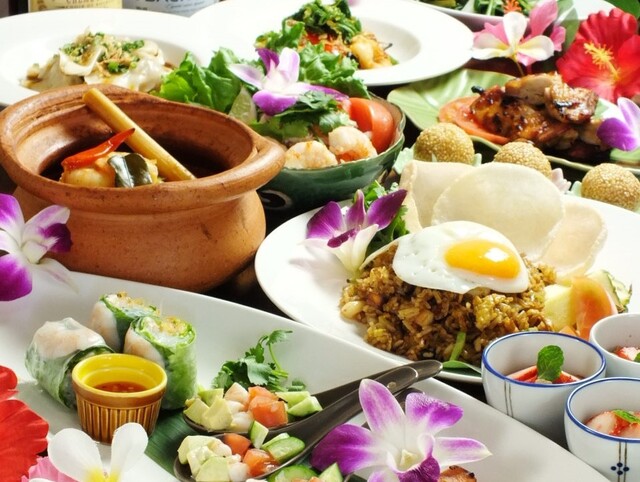
Approaching the south side of Ichikawa Station, the dining rhythm changes quickly from commuter flow to small-room restaurants built for regular use. This is not the stagecraft of central Tokyo’s tasting-menu economy. The pleasure here is more local: compact rooms, repeat customers, and menus that let Southeast Asian cooking sit beside ramen, curry, bakeries and izakaya without being treated as a novelty.
Enak Enak belongs to that useful middle ground. Its categories, Thai, Indonesian and curry, point to a broader Japanese appetite for Southeast Asian food that has moved well beyond a narrow pad-thai-and-green-curry shorthand. In suburban Chiba, that matters. The strongest ethnic-cuisine rooms outside Tokyo’s core often win loyalty not through spectacle, but through consistency, approachability and enough specificity to separate them from generic pan-Asian dining.
Thai, Indonesian and curry cooking in a station-side Ichikawa setting
Japan’s Southeast Asian restaurant culture has long been shaped by adaptation: lunch sets, spice levels calibrated for mixed groups, and menus that make room for both first-timers and diners who already know what they want. That does not make the cooking less serious. It makes the format culturally legible in a city where weekday lunch, family dining and after-work meals have to coexist in the same address.
The Thai-Indonesian-curry axis is the point. Thai food in Japan tends to be better represented in urban dining than Indonesian cooking, while curry provides a bridge category familiar to Japanese diners. A restaurant that holds those three lanes together has to do more than assemble a tourist-board checklist. It has to make heat, herbs, coconut, rice, fried aromatics and curry structure work within the expectations of a neighbourhood meal.
That context explains why the Tabelog 100 Asian cuisine / Ethnic cuisine EAST 2024 selection is meaningful. The EAST scope pulls from a competitive field that includes Tokyo and surrounding prefectures, so a 20-seat Ichikawa restaurant appearing on that list signals more than local fondness. It places the room inside a regional conversation about which Asian and ethnic restaurants are earning sustained diner attention.
Ichikawa’s broader food map gives the comparison sharper edges. China Soba Komuro reflects the area’s ramen depth, while Gyotoku Biryani House shows how South Asian cooking also has a foothold in the city. Jagaimo sits in a different price bracket and social mode, and Open Oven reads as a lower-cost everyday stop. Enak Enak is useful because it adds Southeast Asian range to that mix without asking diners to make a formal occasion of it.
Why the recognition matters more than the room's scale
Small capacity changes the reading of a restaurant like this. Twenty seats means the room operates closer to a neighbourhood dining room than a high-volume canteen, and that scale usually rewards regulars, small groups and diners who value a controlled kitchen pace. Private use is available for up to 20 people, which also tells a story about the format: the whole restaurant can function as a compact gathering space rather than a sprawling banquet hall.
The family-friendly signals are equally important. Children are welcomed across age groups, and strollers are accepted, which puts the restaurant in a different category from the adult-only counter culture that dominates much of Japan’s premium dining coverage. Southeast Asian food in Japan often succeeds when it works for groups with mixed tolerances and appetites. The note that menu items can be made without cilantro is a small but telling accommodation, since cilantro remains divisive among Japanese diners despite its association with Thai and regional Southeast Asian cooking.
There is also a practical cultural point in the drinks and meal structure. Wine and cocktails are available, and parties over 2.5 hours are supported, so the room can stretch from lunch into longer social meals. That matters in Ichikawa, where restaurants often serve both commuters and residential diners in the same week. The restaurant is not chasing the omakase grammar of scarcity; it fits a city where access, repeatability and group utility carry weight.
For travellers staying in or passing through Chiba, the appeal is not that this replaces Tokyo’s deeper Southeast Asian scene. It does not need to. The editorial case is narrower and more useful: a recognised ethnic-cuisine address in Ichikawa, with Thai and Indonesian cooking under one roof, priced and formatted for ordinary dining rather than ceremony. That makes it a strong counterpoint to ramen-led itineraries and a useful stop for readers mapping food beyond the capital’s obvious districts.
How to place it on an Ichikawa food itinerary
Ichikawa rewards diners who think in clusters rather than single destinations. A day can move from noodles to curry, from bakeries to small izakaya-style rooms, without forcing the tempo of central Tokyo dining. For a wider local plan, start with our full Ichikawa restaurants guide, then use our full Ichikawa hotels guide, our full Ichikawa bars guide, our full Ichikawa wineries guide and our full Ichikawa experiences guide to build the rest of the stay.
Within the city, Chonan Montaichio offers another point of comparison for local dining decisions, while the broader Japan list can take readers from -Grilled beef Sukiyaki- KAMAKURA TANUKIAN 鎌倉 たぬき庵 in Kamakura to. 鮪と炭火焼き うお炭 秋葉原店 in Tokyo.cafe in Osaka.know in Kumamoto, (Shoku) Vietnam in Kawasaki and [Curry Senmon Ten] Maruyama Kyoju. in Sapporo. For transpacific context, Jōdo Saké Bar in Los Angeles and Onigiri Time in Pasadena show how Japanese and Asian casual formats travel differently outside Japan.
The right expectation is precision without ceremony. Enak Enak is for diners who want a credible Southeast Asian meal in Ichikawa, not a prestige performance. Its award selection, compact scale and mixed Thai-Indonesian-curry identity make it one of the city’s more interesting answers to a question that matters more each year: where, outside the capital’s central wards, does Asian cooking earn serious local attention?
Cost Snapshot
Nearby venues at a similar price tier for orientation.
| Venue | Cuisine | Price | Notes |
|---|---|---|---|
| Enak EnakThis venue — the venue you are viewing | Not listed | $$ | Not listed |
| Tomino Ya Motoyawata honten | Not listed | $$ | Ichikawa, Authentic Korean home cooking & offal hot pot |
| Pizzeria Canto Della Terra | Not listed | $$ | Minamiyawata / Motoyawata, Neapolitan Pizzeria & Italian |
| Shokudo Otsuka | Not listed | $ | Gyotoku, Japanese cafeteria set-meal (shokudo) |
| Steak Ishii | Not listed | $$ | Gyotoku, Casual Japanese Steakhouse & Hamburg |
| Open Oven | Ichikawa, Artisanal Bakery & Cafe | $ | Not listed |
Recognition history
Dated appearances from independent guides and award organizations, with the underlying list record or original source where available.
Tabelog 100 #28 · No. 28
Tabelog · Tabelog 100 - Asian cuisine / Ethnic cuisine - EAST - 2024







At a Glance
- Cozy
- Lively
- Casual
- Casual Hangout
- Group Dining
- Family
- After Work
- Late Night
- Solo
- Standalone
- Beer Program
Current opening hours
- Monday
- Closed
- Tuesday
- 11:30 AM–10 PM
- Wednesday
- 11:30 AM–10 PM
- Thursday
- 11:30 AM–10 PM
- Friday
- 11:30 AM–10 PM
- Saturday
- 11:30 AM–10 PM
- Sunday
- 11:30 AM–9 PM
Hours can change for holidays and private events. Last verified .
Warm, casual, and homey with a small, cozy dining room; reviewers describe a relaxed neighborhood atmosphere where groups and families share generously portioned Southeast Asian plates over drinks.