Diporto sits in the Theatrou Square area of central Athens, operating as one of the city's most discussed old-school tavernas. With no printed menu and a roster of daily-market dishes, it positions itself against Athens' growing fine-dining tier not through competition but through deliberate contrast. For Athenians and visitors who find tasting menus unconvincing, it functions as a reference point for how the city has always actually eaten.
Pearl is the En Primeur Club membership app — saves, bookings, and concierge access live there. Same editors, same standards.
- Address
- Σωκράτους 9 και, Theatrou 10552, Athina, Greece
- Phone
- +302103211463
- Website
- greekgastronomyguide.gr
- Directions
- Get directions
 Saves & bookings on Pearl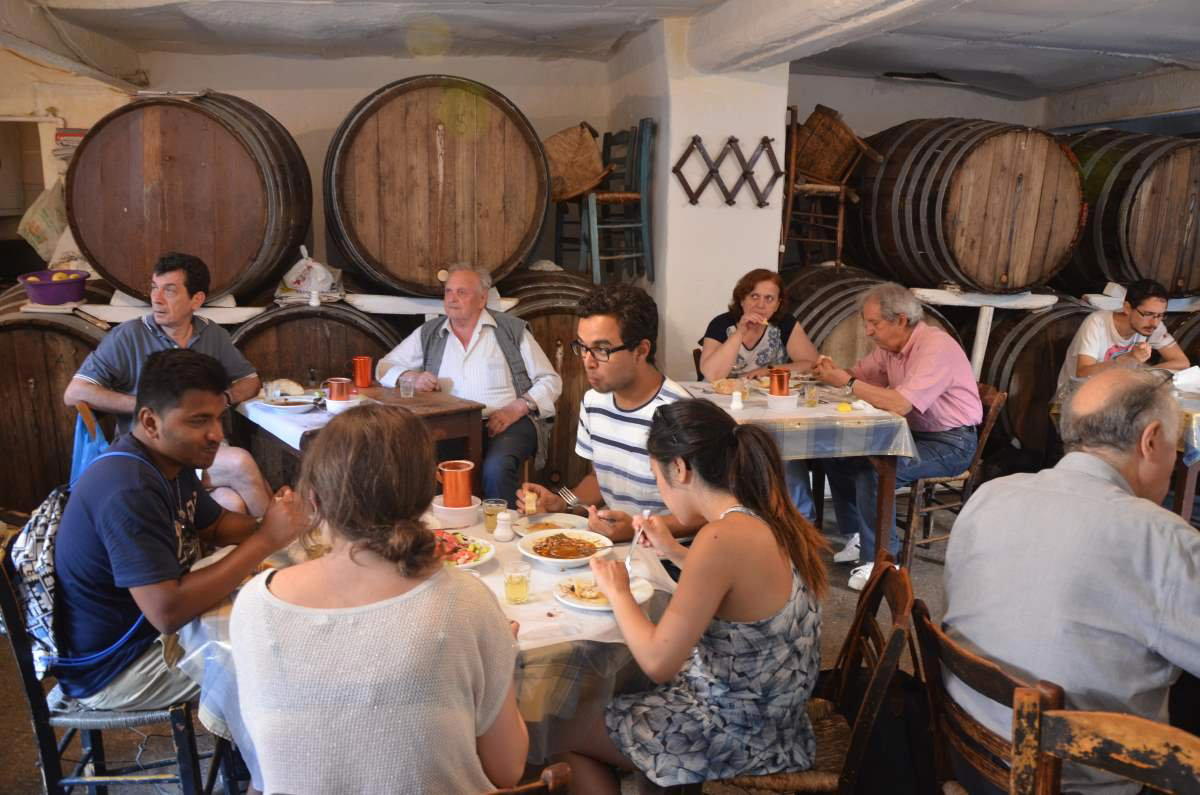
Where Athens Still Eats the Way It Always Has
Theatrou Square sits at the older, less polished edge of central Athens, where the tourist-facing restaurants thin out and the neighbourhood reasserts itself in the form of small workshops, wholesale traders, and the occasional kafeneio operating on its own logic. On Sokratous Street, at the corner where foot traffic slows, Diporto has occupied the same basement space for decades, a taverna so unchanged in format and intention that its continued existence reads as a kind of editorial comment on the direction the city's dining scene has taken. It goes down a few steps from street level, which is not incidental: the underground positioning contributes to a temperature and atmosphere that no amount of design intervention in a modern restaurant can reproduce.
A Menu That Does Not Exist on Paper
The clearest thing Diporto reveals about Athenian dining tradition is how the menu functions, or rather, how the absence of one functions. There is no printed card, no QR code, no specials board. What is available depends on what came in that morning, and it is relayed verbally. This format is not a gimmick borrowed from contemporary tasting-menu culture, where the lack of a written menu signals a chef’s control and narrative. Here, it signals the opposite: control belongs to the market, and the kitchen’s job is to respond to it rather than impose a fixed architecture on the day’s ingredients.
That distinction matters when reading Diporto against Athens’ current fine-dining tier. Restaurants like Hytra and Botrini’s operate with highly constructed menus that use Greek ingredients as the basis for modern technique and plating. Delta and Hervé push further still into creative frameworks where the dish is as much concept as plate. Diporto sits at the other end of that spectrum entirely: legumes cooked low and long, fish from the central market, wine poured without labels discussed. The menu architecture here is the absence of architecture, and that itself communicates something about the tradition the taverna belongs to.
The Grammar of a Greek Taverna at Its Source
Greek taverna cooking, at its most functional level, is organised around the kitchen’s relationship to whatever is freshest and cheapest that week. This is not poverty cooking, though it has roots there. It is a cuisine that developed its logic around seasonal availability and the social expectation that eating is something done in the middle of a conversation about something else entirely. The table is not the event. The event is happening around the table.
Diporto operates within that grammar. Dishes arrive when they are ready. Wine arrives because you are there and it is what you drink. The pace is set by the kitchen, not by a timed tasting sequence. Compared to the calibrated progression of a meal at Makris Athens or the structured courses at Aleria, this feels less like a different style and more like a different philosophy of what a restaurant is for. Athens has both, which is one of the things that makes it a more interesting dining city than its Michelin star count alone would suggest.
Where It Sits in the Athens Dining Picture
Athens has developed two dining cultures in parallel over the past fifteen years. One tracks international fine-dining conventions: tasting menus, wine pairing, modernist Greek cooking informed by Nordic and Japanese technique. The other is older, more stubborn, and operates out of basements and covered markets and family-run rooms in Monastiraki and Psyrri. Diporto belongs firmly to the second group, which is a smaller and more endangered category as central Athens property values push older businesses toward the margins.
The comparison set that matters for Diporto is not Spondi or Tudor Hall. It is the handful of tavernas in similar neighbourhoods that operate without reservations, without fixed hours reliably communicated in advance, and without any meaningful online presence. That category has been shrinking, and Diporto’s reputation among both Athenians and certain categories of international visitor is tied directly to the sense that it represents something the city is slowly losing. For readers who have eaten their way through Lake Vouliagmeni on the Riviera coast or the polished seafood at Alykes in Palaio Faliro, Diporto represents a different register of Greek eating entirely, one where the sea is not on the plate but in the memory of the dish.
Planning Your Visit
Diporto operates on its own schedule, which is the central logistical fact a visitor needs to absorb before arriving. It opens for lunch, typically closes when the food runs out, and does not operate in the evening in the way a modern restaurant would. No website, no published phone number, and no booking infrastructure exist in any formal sense. The approach that works is to arrive early in the lunch service, accept the verbal description of what is available without negotiating around it, and treat the meal as a fixed price of admission to something that cannot be replicated through a booking platform. The address, Sokratous 9 at the corner of Theatrou Square, places it within walking distance of the central market on Athinas Street, which gives useful context for the kind of cooking you will find.
For visitors building a broader Athens itinerary, Diporto pairs logically with the more formal end of the city’s scene rather than competing with it. Eat here at lunch and return for dinner at one of the city’s tasting-menu restaurants for a more complete picture of what Greek cooking is doing across its full range. Our full Athens restaurants guide covers both ends of that spectrum in detail.
Readers exploring beyond Athens will find useful regional contrasts at Lure Restaurant in Oia, Aktaion in Firostefani, and Cacio e Pepe in Thira Municipality. For seafood-focused alternatives closer to Athens, Jimy’s Fish in Piraeus offers a different but equally direct approach to Greek coastal eating. For international comparisons in a similar no-frills-but-serious register, Le Bernardin in New York City and Atomix in New York City represent how the market-driven approach translates into entirely different culinary contexts.
Continue exploring
More in Athens
Restaurants in Athens
Browse all →
Bars in Athens
Browse all →
Hotels in Athens
Browse all →


At a Glance
- Rustic
- Classic
- Cozy
- Well Known
- Casual Hangout
- Historic Building
- Open Kitchen
Current opening hours
- Monday
- 8 AM–7 PM
- Tuesday
- 8 AM–7 PM
- Wednesday
- 8 AM–7 PM
- Thursday
- 8 AM–7 PM
- Friday
- 8 AM–7 PM
- Saturday
- 8 AM–7 PM
- Sunday
- Closed
Hours can change for holidays and private events. Last verified .
Rustic underground setting with massive wine barrels, open kitchen, and lively communal atmosphere.