Dean Fryer
Our verdict
Dean Fryer brings the British seafood pub format to New York City, occupying a niche that sits well outside the tasting-menu circuit dominated by Per Se and Le Bernardin. The format trades ceremony for ritual: pints, paper, and properly cooked fish in a city that has historically underserved the genre. An address worth knowing for anyone tracking how British pub culture translates across the Atlantic.

Pearl is the En Primeur Club membership app — saves, bookings, and concierge access live there. Same editors, same standards.
- Address
- New York City, United States
A Different Register of Seafood Dining in New York
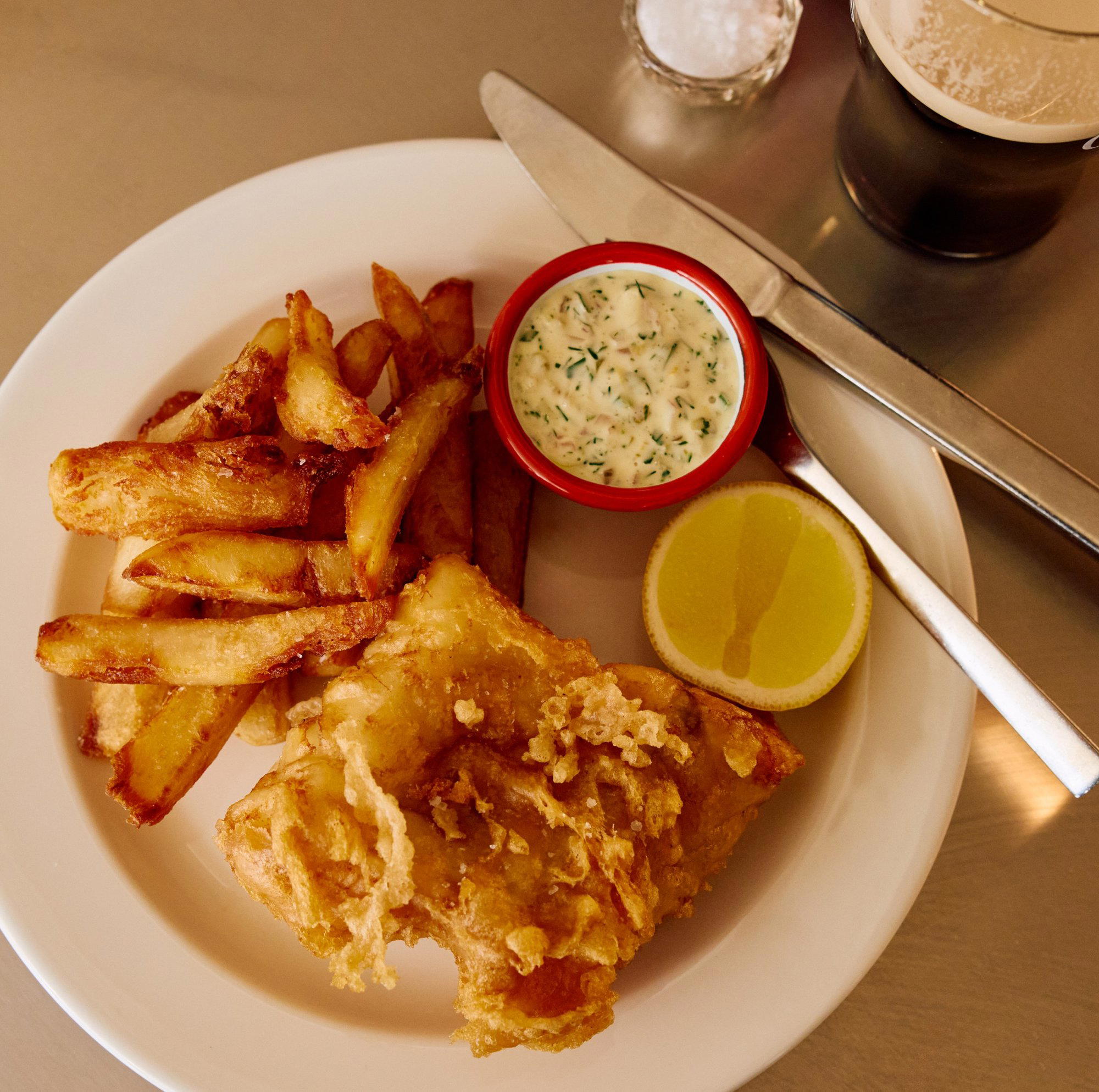
New York's seafood dining has long been sorted into two categories: the white-tablecloth French tradition anchored by places like Le Bernardin, where precision and price are both extreme, and the casual raw-bar scene that lines up oysters and little else. The British seafood pub occupies a third register that New York has historically left almost entirely unclaimed. It is a format built around ritual rather than ceremony: the ordering at the bar or counter, the pint arriving before the food, the absence of a sommelier hovering to upsell. Dean Fryer addresses that gap directly, placing a specifically British hospitality logic inside a city that prizes novelty but often overlooks the genres it has never quite tried.
The British pub model carries its own etiquette that differs sharply from the timed omakase counters at Masa or the structured progression at Per Se. There is no fixed sequence, no amuse-bouche, no chef's narrative delivered course by course. The pacing is self-directed. You eat when you want, you order another round if the mood holds, and the fish is treated as food rather than as an artistic statement. That distinction matters more than it might first appear: in a city where tasting menus of twelve courses and upward of two hundred dollars per head have normalized a certain kind of formality, a venue that refuses that frame is making a real editorial decision about what a meal should feel like.
The Ritual of the British Seafood Pub
The pub dining tradition in Britain evolved alongside the fishing industry, particularly in coastal towns where the catch arrived daily and the kitchen's job was to serve it without interference. Battered cod, dressed crab, potted shrimp, grilled plaice: these dishes are defined by the quality of the fish and the restraint of the cook, not by elaborate technique. That restraint reads differently in a New York context, where culinary ambition is often measured in inverse proportion to simplicity. A venue that commits to this format is effectively arguing that sourcing and frying discipline are their own form of expertise, an argument that has gained traction in cities like London and Edinburgh but has been slower to land in Manhattan.
Ritual begins before the food. In the British pub model, arrival means the bar first: a drink ordered and settled before you consider what to eat. That sequence reorganizes the dining experience in ways that feel unfamiliar to New Yorkers trained on the reservation-confirmation-to-table pipeline of the city's formal restaurants. At venues comparable to this format, the rhythm tends to be looser, the noise level higher, and the expectation of a two-hour table turn absent. These are features, not failures.
Where Dean Fryer Sits in New York's Current Scene
New York's restaurant conversation in 2024 and 2025 has moved increasingly toward accessible formats: counter dining, natural wine lists, share plates, and an overall retreat from the formality that defined fine dining a decade ago. The British seafood pub format fits that directional shift without being a product of it. It predates the trend by centuries and arrives with its own internal logic rather than borrowing from the casualization wave. That distinction gives venues operating in this genre a coherence that trend-driven casual spots often lack.
Against the city's French seafood tradition, represented at the highest register by Le Bernardin, the British pub model prices and positions differently. Where Le Bernardin operates at the top of the $$$$ tier with multi-course structure and a wine program built for long, expensive meals, the pub format sits in a bracket where the spend per head is controlled by the diner rather than the menu. That flexibility is part of the hospitality proposition. You can eat lightly and leave quickly, or you can stay for three hours and work through whatever the kitchen is running. Both outcomes are legitimate.
For comparison across the broader American scene, the formats that most closely parallel this ethos operate in very different cuisines: the ticketed communal dinner model at Lazy Bear in San Francisco, the farm-to-table precision of Single Thread Farm in Healdsburg, or the Southern hospitality tradition at Emeril's in New Orleans. None of these are close equivalents, which underlines the point: the British seafood pub as a serious dining format has almost no direct competition in the American market.
Planning a Visit
New York's dining scene rewards specificity in planning. If Dean Fryer follows the typical pub hospitality model, the busiest periods will be weekend evenings and Friday lunchtimes, when the format's informal character attracts groups who want the option to extend the evening without a fixed end time. Midweek visits, particularly Tuesday through Thursday, typically offer more relaxed service rhythm in venues of this type. Check directly for current booking arrangements, as pub formats vary between walk-in only and limited-reservation policies depending on season and demand. For anyone building a fuller New York itinerary, our full New York City restaurants guide maps the scene across price points and formats, and our full New York City bars guide covers the drinking side of the city in comparable depth.
Those staying in the city for several days will find the broader framework at our full New York City hotels guide, our full New York City wineries guide, and our full New York City experiences guide useful for building out time beyond the table. For context on how British-influenced dining formats have travelled across major cities internationally, it is worth looking at the precision-focused European tradition at Alain Ducasse at Louis XV in Monte Carlo and the ambitious Asian-European crossover at 8½ Otto e Mezzo Bombana in Hong Kong, both of which illustrate how specific national hospitality traditions can be transported and reframed in new urban contexts.
Other New York venues worth considering alongside Dean Fryer for a broader cross-section of the city's current moment include César and the high-end tasting format at Alinea in Chicago for those whose itinerary extends beyond New York. Providence in Los Angeles and The French Laundry in Napa round out the West Coast seafood conversation for readers tracking how the genre moves across American cities.
Frequently asked questions
How does a British seafood pub differ from a standard fish restaurant in New York City?
The British seafood pub model, which Dean Fryer represents in New York City, organises the dining experience around the pub room rather than the restaurant table: the bar is functional, the menu is fish-led rather than fish-inclusive, and the format encourages multiple visits over a single occasion. That differs structurally from New York's established fish restaurants, where the dining room and the tasting arc are the primary design. The result is a more repeat-visit, neighbourhood-anchored format than the city's French-influenced seafood tradition has historically produced.
What do regulars order at Dean Fryer?
Dean Fryer operates as a British seafood pub in New York City, so the menu logic follows the pub tradition: fish-forward dishes built around fresh catch rather than composed fine-dining plates. Regulars at venues in this format typically anchor their order around the house fish preparation — battered, grilled, or dressed simply — alongside whatever the day's catch dictates. Specific current dishes are best confirmed directly with the venue.
Do they take walk-ins at Dean Fryer?
British seafood pubs historically operate with a walk-in-friendly posture, treating the bar and pub floor as open territory rather than reservation-only territory. Whether Dean Fryer holds to that model in New York City's tighter dining environment is worth confirming before you arrive, particularly on weekend evenings when pub-format spots fill quickly. Calling ahead or checking their current booking policy is the cleaner move.
What is Dean Fryer known for?
Dean Fryer is a British seafood pub operating in New York City, a format that occupies a deliberate gap between white-tablecloth fish restaurants and casual fish counters. The concept draws on the British pub-dining tradition where seafood is the structural centre of the menu rather than a supplementary section. In a city where that specific format has no deep-rooted precedent, Dean Fryer's positioning alone gives it a clear identity.
Is Dean Fryer worth the price?
What the British seafood pub format typically offers is value relative to fine-dining fish restaurants: the same quality of sourcing without the ceremony overhead. In New York City's current market, that positioning tends to deliver strong returns for the spend, though confirming current prices with the venue directly is advisable.
What's the sweet spot for visiting Dean Fryer?
For a British seafood pub in New York City, the strongest visit window is typically mid-week lunch or early weekday evening, when pub-format dining rooms run at pace without the weekend volume that compresses service. The British pub tradition rewards unhurried eating, so arriving before peak hours gives the format room to work as intended. Specific service hours should be verified with Dean Fryer directly before planning your visit.
Budget and Context
Comparable venues nearby, for context on price, style, and recognition.
| Venue | Cuisine | Price | Notes |
|---|---|---|---|
| Dean FryerThis venue — the venue you are viewing | British Seafood Pub | Not listed | Not listed |
| Maze by Gordon Ramsay at The London | Modern British Small Plates & Grill | Not listed | Midtown-Times Square, Modern British Small Plates & Grill |
| Brooklyn High Low | Traditional Afternoon Tea | $50–100 | Prospect Heights, British Afternoon Tea |
| Lil Chef Mama | Authentic Thai Street Food | $20–30 | Financial District-Battery Park City, Authentic Thai Street Food |
| Mughlai Indian Cuisine | Authentic Mughlai Indian | $20–30 | Gramercy, Authentic Mughlai Indian |
Continue exploring
More in New York City
Restaurants in New York City
Browse all →
Bars in New York City
Browse all →
Hotels in New York City
Browse all →

Wineries in New York City
Browse all →
Details
- Lively
- Classic
- Casual
- Casual Hangout
- Group Dining
- A La Carte
- Vegetarian Friendly
Fun and noisy atmosphere with lively energy.