Tabelog 100 #98
Our verdict
CORE-CORE brings Osaka’s ramen value conversation north to Esaka, where a 10-seat, no-reservations counter has earned repeated Tabelog 100 Ramen Osaka selection. The appeal is not luxury theatre but compression: serious ramen credentials, everyday pricing, and a compact room that fits the commuter-side rhythm of Suita rather than the heavier dining circuits of central Osaka.

Pearl is the En Primeur Club membership app, where members save venues, book tables and use the concierge.
The menu
What to order
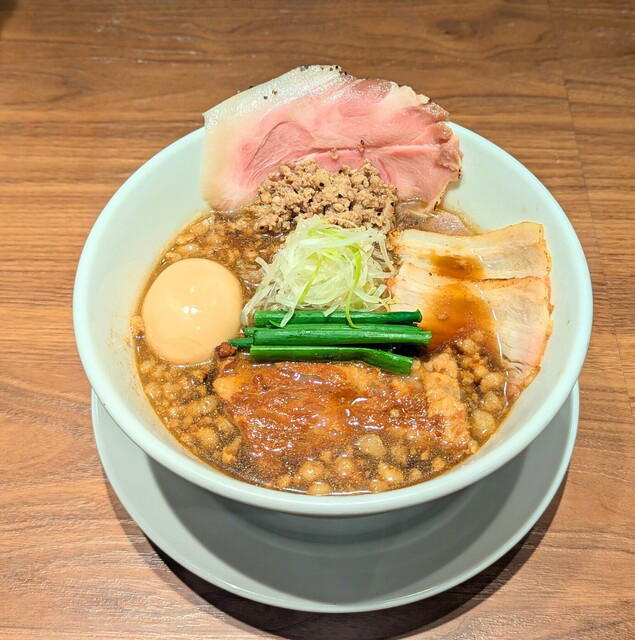
- CORE-CORE black shoyu ramen
- DORE-DORE rich miso ramen
- SORE-SORE light white shoyu ramen
Osaka’s ramen rooms work at a different tempo from the city’s brighter dining corridors and polished commercial centers. The approach is quieter: everyday movement, quick turnover, and diners who know exactly what they came for. CORE-CORE belongs to that local version of Osaka eating, where the category is familiar and the value test is severe. In ramen, reputation has to survive repeat local use, not just destination curiosity.
That matters because Osaka’s ramen culture is often read through the wrong lens. The city is famous internationally for casual specialties and late-night drinking food, but its ramen scene has become increasingly competitive at the specialist level. The strongest shops tend to prove themselves through precision and consistency rather than spectacle. A place recognized in Tabelog’s ramen coverage in 2025 sits inside that serious, local-facing tier.
Osaka ramen with a value equation, not a luxury script
The useful way to read this restaurant is through value density. Ramen in Japan has long occupied a rare position: it can be craft cooking without formal dining overhead. The format gives operators room to compete on broth, noodles, tare, toppings, pacing, and repetition while keeping the experience direct. That is why a recognized ramen restaurant can feel more revealing of a city’s eating habits than a far more expensive tasting menu.
CORE-CORE’s public signals point to that exact equation. It is listed as ramen, holds a Tabelog score of 3.69, and appears in the 2025 Tabelog Hyakumeiten ramen recognition provided for the venue. Those are not decorative facts; in Japan’s user-review culture, they indicate attention in a category where diners compare bowls across Osaka with almost forensic discipline. The format also keeps expectations clear. This is not a meal built around ceremony or a long-form luxury script. It is a ramen shop judged on the fundamentals.
The comparison inside Osaka is instructive. A meal at Osteria e Bar Geno operates with a different dining rhythm, while Shunsaiten Tsuchiya belongs to a category with another formality. Patisserie de ESAKA SIROP D'ERABLE answers a separate need entirely: sweets and bakery culture rather than a noodle-focused stop. CORE-CORE’s position is narrower and more useful for travelers who want one Osaka meal that feels local, efficient, and serious without turning dinner into a production.
A focused stop in Osaka's everyday dining orbit
Osaka dining reflects movement: commuters, office workers, residents, and people eating around the routines of the day. That geography changes the restaurant calculus. Central and neighborhood restaurants often compete for different audiences; everyday Osaka rewards places that can serve regulars repeatedly. For ramen, that is a stern environment. Novelty fades quickly when the audience can return on an ordinary weekday and compare the bowl against memory.
The direct ramen format reinforces that point. Ramen restaurants reduce the distance between cooking rhythm and the diner’s experience. They also leave little margin for a vague concept: the bowl, the pacing, and the basic execution carry the meal. CORE-CORE fits the democratic ramen tradition rather than the access-controlled dining tier. The public profile points to a practical urban shop rather than a destination restaurant designed around lingering.
The restaurant’s recognition gives the place useful context. Tabelog Hyakumeiten attention in 2025 suggests more than passing curiosity. In a city with deep casual dining habits, that kind of recognition usually tracks consistency, not only initial hype.
For travelers, the strongest signal is simplicity. The experience remains informal and category-focused, and the spend level sits in an everyday range: dinner and lunch are both listed at JPY 1,000 - JPY 1,999. That keeps CORE-CORE easy to slot into a day of Osaka eating without asking the meal to behave like a formal reservation.
How to place it in an Osaka eating itinerary
CORE-CORE makes the most sense as a focused ramen stop rather than the centerpiece of a long evening. Pairing it with Osaka’s broader food traditions can sharpen the contrast: ramen for precision and speed, then another day for other casual dining, Italian cooking, pizza, cafés, bakeries, or sweets elsewhere in the city. Osaka’s casual end can be just as revealing as its formal dining when the category is handled with care.
The broader lesson is that Osaka value is not only about low spend. It is about how directly a meal delivers its category. A serious ramen restaurant should not need luxury cues to justify attention; it should make the diner understand why a bowl and a short stay can carry a city’s craft culture. On that basis, CORE-CORE is a sharp inclusion for travelers building an Osaka list around evidence rather than hype.
For broader planning, see Our full Osaka restaurants guide, then map the trip against Our full Osaka hotels guide, Our full Osaka bars guide, Our full Osaka wineries guide, and Our full Osaka experiences guide. For a wider Japan and overseas casual-food comparison, apply the same value lens to other everyday dining rooms rather than treating price alone as the measure of seriousness.
Frequently asked questions
Would CORE-CORE be comfortable with kids?
CORE-CORE is a ramen restaurant, so it suits families who are comfortable with a straightforward dining format. Its Osaka location and everyday price range make it a practical stop rather than a long sit-down meal.
What kind of setting is CORE-CORE?
CORE-CORE is a ramen restaurant in Osaka. Its public profile points to a focused, casual format rather than a formal dining room.
What price level is CORE-CORE?
Pricing at CORE-CORE is listed as Dinner: JPY 1,000 - JPY 1,999; Lunch: JPY 1,000 - JPY 1,999.
What are the operating hours at CORE-CORE?
Specific operating hours are not provided here; confirm directly with CORE-CORE before visiting.
Where is CORE-CORE located?
Osaka.
What is CORE-CORE known for?
CORE-CORE is known for ramen and for its 2025 Tabelog Hyakumeiten recognition. The listed lunch and dinner budget is JPY 1,000 - JPY 1,999, which keeps it in the everyday Osaka ramen bracket.
Comparable Spots
Comparable venues in the metro at similar price points.
| Venue | Cuisine | Price | Awards | Notes |
|---|---|---|---|---|
| CORE-COREThis venue (the venue you are viewing) | Ramen shop with black shoyu, miso, and white shoyu bowls | $10–20 | Tabelog 100 #98 | Not listed |
| Patisserie de ESAKA SIROP D'ERABLE | Not listed | Not listed | Tabelog 100 #48 | JPY 999 - JPY 999 View spending breakdown |
| Osteria e Bar Geno | Cozy Spanish Osteria & Bar | $50–100 | Tabelog 100 #16 | JPY 6,000 - JPY 7,999 View spending breakdown |
| Shunsaiten Tsuchiya | Tempura & Kaiseki | Not listed | 2 Michelin Stars · Tabelog Bronze #482 | Tempura |
Recognition history
Dated appearances from independent guides and award organizations, with the underlying list record or original source where available.
Tabelog 100 #98 · No. 98
Tabelog · Tabelog 100 - Ramen - OSAKA - 2025