
Tabelog 100 #36
Our verdict
Chuka Soba Kaminari Wantan belongs to Osaka’s serious everyday ramen tier: counter seating, ramen and tsukemen, and a price band that keeps the meal firmly casual. Its Tabelog Ramen OSAKA 100 selections in 2023, 2024, and 2025 give it a reputation signal beyond neighbourhood convenience, especially for diners mapping Osaka’s noodle culture outside the central tourist circuits.

Pearl is the En Primeur Club membership app, where members save venues, book tables and use the concierge.
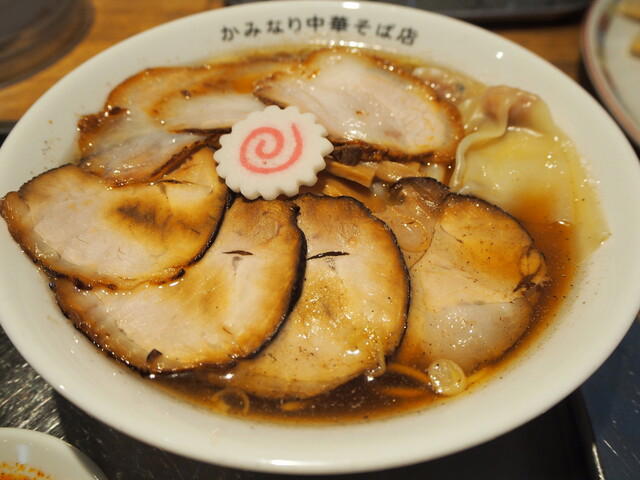
The menu
What to order
- Shoyu chuka soba
- Wonton chuka soba
- Tsukemen
- Tantanmen
- Miso ramen
Approach Osaka ramen on its own terms and the city stops looking like a single-note takoyaki capital. The more interesting pattern is how many serious noodle shops operate with almost no ceremony: counter seating, fast turnover, narrow menus, and a customer base that treats a bowl as lunch, dinner, or a solo reset rather than an event. Chuka Soba Kaminari Wantan fits that grammar. It is not built around luxury cues; its authority comes from repetition, local recognition, and the discipline expected of a ramen room where the counter is the format.
That matters in Osaka because ramen here competes against a dense field of cheap, technically specific food. Udon, curry, kushikatsu, okonomiyaki, bakeries, coffee counters, and department-store prepared food all fight for the same casual meal slot. A ramen shop has to justify itself quickly. Selection for Tabelog Ramen OSAKA 100 in 2023, 2024, and 2025 places Chuka Soba Kaminari Wantan inside a curated group of Osaka ramen addresses, and that repeated inclusion is the useful signal: not hype from a single season, but recognition across consecutive lists.
Osaka ramen judged by repeat recognition, not ceremony
In Japan, ramen reputation often travels through a different channel from fine dining. Michelin stars, chef résumés, and tasting-menu structures tell only part of the story; for ramen, rankings, local scoring platforms, queue culture, and repeat customer behavior carry more weight. Chuka Soba Kaminari Wantan’s Tabelog score of 3.68 and its 2025 Ramen OSAKA 100 selection put it in a category where the conversation is less about spectacle and more about consistency against a large citywide field.
The category also rewards restraint. Chuka soba and tsukemen sit within a vocabulary where broth clarity, noodle texture, tare balance, and topping execution matter more than decorative plating. The name points toward wantan, but the safer editorial reading is category-level rather than dish-specific: this is a ramen and dipping-noodle address whose reputation has been validated by a ramen-specific award list, not a general restaurant accolade. For a traveler, that distinction is useful. It says to expect a meal calibrated for people who already eat ramen often, rather than a venue designed to explain ramen from the beginning.
Within the comparison group, the price signal is also revealing. Kamaage Udon Isshin and Chuka Soba Sen sit in a similar sub-JPY 999 casual bracket, while Kama Hiro and Soba Kiri Oshiro move into higher everyday-noodle pricing, and Matasaburo belongs to a different dining economy altogether. Chuka Soba Kaminari Wantan therefore competes in the low-cost, high-frequency lane, where recognition has to come from execution rather than spend. That is the point: Osaka’s affordable counters can be evaluated with the same seriousness as tasting-menu restaurants, but the criteria change.
Nagai's counter culture, away from the obvious Osaka circuit
The location in Nagaihigashi, Sumiyoshi Ward, gives the meal a different context from the Namba and Umeda orbit. Central Osaka can compress dining into convenience, neon, and transport efficiency; Nagai reads more residential, more local, and less shaped by first-time visitor choreography. For ramen, that can be an advantage. A counter outside the heavy sightseeing belt has to serve regulars as much as destination diners, which usually keeps the format practical and the value proposition sharp.
Counter seating is not a minor detail in ramen. It changes the pace of the room, the way orders move, and the social contract between kitchen and diner. Solo dining is normal, families are accommodated, and the meal does not ask for the rituals attached to coursed dining. The setting belongs to the broader Japanese habit of eating precisely and efficiently without treating brevity as a compromise. A bowl can be quick and still be judged on craft.
For readers building an Osaka food itinerary, the smarter move is to place a ramen counter like this alongside other casual specialists rather than against formal restaurants. Use Our full Osaka restaurants guide to set the broader map, then compare how different formats handle everyday appetite: 551 Horai (551蓬莱) for Osaka’s mass-loved pork buns, 52CHO-ME BAKERY for the city’s bakery culture, .cafe for a quieter café register, and 99 Pizza Napoletana Gourmet or a canto (Italian) when the meal shifts toward imported forms filtered through Osaka discipline.
How to read it within a wider Japan food itinerary
Chuka Soba Kaminari Wantan is useful because it sharpens a traveler’s sense of scale. Not every important Japanese meal is expensive, reserved far ahead, or framed by a named chef. Some of the country’s more instructive dining happens in compact rooms where the menu category is familiar and the difference lies in execution. That is why ramen recognition lists matter: they sort an enormous everyday field into addresses with enough consistency to attract serious eaters.
Seen that way, this Osaka stop belongs in a broader national pattern of specialist eating. A traveler moving through Japan can compare it with [ki:] in Kyoto. 鮪と炭火焼き うお炭 秋葉原店 in Tokyo.know in Kumamoto, (Shoku) Vietnam in Kawasaki, [Curry Senmon Ten] Maruyama Kyoju. in Sapporo, and -Grilled beef Sukiyaki- KAMAKURA TANUKIAN 鎌倉 たぬき庵 in Kamakura. Outside Japan, Japanese-format casual dining takes different shapes at Jōdo Saké Bar in Los Angeles and Onigiri Time in Pasadena, but the comparison is instructive: in Japan, narrow specialization often carries its own authority without needing a grand room.
The final assessment is practical and critical at once. This is a ramen counter with repeated Tabelog Ramen OSAKA 100 recognition, a casual price position, and a neighbourhood setting that makes sense for diners willing to leave the obvious central corridor. It is strongest as part of a noodle-focused Osaka day, or as a corrective to itineraries that treat the city only through snacks and nightlife. For the rest of the trip architecture, pair the meal with Our full Osaka hotels guide, Our full Osaka bars guide, Our full Osaka wineries guide, and Our full Osaka experiences guide.
Frequently asked questions
What's the address for Chuka Soba Kaminari Wantan?
Chuka Soba Kaminari Wantan is located in Osaka.
What price level is Chuka Soba Kaminari Wantan?
Pricing at Chuka Soba Kaminari Wantan is listed as - JPY 999.
When can I go to Chuka Soba Kaminari Wantan?
Hours at Chuka Soba Kaminari Wantan: Mon: Closed; Tue: 11:30 AM–2:30 PM, 6–9 PM; Wed: 11:30 AM–2:30 PM, 6–9 PM; Thu: 11:30 AM–2:30 PM; Fri: 11:30 AM–2:30 PM, 6–9 PM; Sat: 11:30 AM–2:30 PM, 6–9 PM; Sun: 11:30 AM–2:30 PM, 6–9 PM.
What makes Chuka Soba Kaminari Wantan worth seeking out?
Its pull comes from recognition, not theatrics: the restaurant was selected for Tabelog 100 - Ramen - OSAKA in 2025, with prior selections in 2024 and 2023. It also keeps the format lean, with counter seating, no reservations, and a price range listed at under ¥999.
Is Chuka Soba Kaminari Wantan allergy-friendly?
Those details are not published. For specific allergens, the safest approach is to confirm directly before ordering. Check the venue's official channels for the latest details.
Is Chuka Soba Kaminari Wantan okay with children?
Yes, the public record says children are welcome and marks the restaurant as family friendly. The counter seating and daytime lunch hours on Tuesday through Sunday make it workable for an easy Osaka meal with children. Check the venue's official channels for the latest details.
Budget Reality Check
Comparable venues at the same tier for side-by-side context.
| Venue | Cuisine | Price | Awards | Notes |
|---|---|---|---|---|
| Chuka Soba Kaminari WantanThis venue (the venue you are viewing) | Traditional Japanese ramen / chuka soba | $1–10 | Tabelog 100 #36 | Not listed |
| Maguro Donya | Standing maguro & seafood bar | $10–20 | Tabelog 100 #13 | Abeno, Standing maguro & seafood bar |
| Udon Jojo | Casual Udon Noodle Shop | $1–10 | Tabelog 100 #71 | Higashinari, Casual Udon Noodle Shop |
| Udon Kyutaro | Standing Udon Bar | $10–20 | Tabelog 100 #44 | Chūō, Standing Udon Bar |
| Washington Shokudo | Standing Japanese bar (tachinomi izakaya) | $10–20 | Tabelog 100 #6 | Miyakojima, Standing Japanese bar (tachinomi izakaya) |
| Spice and Curry Ougon no Kaze | Japanese spice curry | Not listed | Tabelog 100 #11 | Kita, Japanese spice curry |
Recognition history
Dated appearances from independent guides and award organizations, with the underlying list record or original source where available.
Tabelog 100 #36 · No. 36
Tabelog · Tabelog 100 - Ramen - OSAKA - 2025
Continue exploring
More in Osaka
Restaurants in Osaka
All restaurants in Osaka →




Bars in Osaka
All bars in Osaka →
Hotels in Osaka
All hotels in Osaka →



Wineries in Osaka
Browse all →
Details
- Cozy
- Classic
- Solo
- Casual Hangout
- After Work
- Standalone
- A La Carte
- Counter Dining
Current opening hours
- Monday
- Closed
- Tuesday
- 11:30 AM–2:30 PM, 6–9 PM
- Wednesday
- 11:30 AM–2:30 PM, 6–9 PM
- Thursday
- 11:30 AM–2:30 PM
- Friday
- 11:30 AM–2:30 PM, 6–9 PM
- Saturday
- 11:30 AM–2:30 PM, 6–9 PM
- Sunday
- 11:30 AM–2:30 PM, 6–9 PM
Hours can change for holidays and private events. Hours as of .
Simple counter‑style ramen shop with a classic neighborhood feel; guests come for focused bowls of soy‑sauce based chuka soba and wonton noodles rather than decor, producing a bustling but relaxed, ramen‑centric atmosphere.