Tabelog 100 #44
Our verdict
Udon Kyutaro puts Osaka’s standing-counter udon culture into sharp focus: fast, low-friction, and serious about noodles without turning lunch into ceremony. Its Tabelog Udon WEST 100 selections in 2022 and 2024 place it among the region’s recognized specialists, while the compact counter format keeps the experience closer to a regulars’ stop than a destination tasting room.

Pearl is the En Primeur Club membership app, where members save venues, book tables and use the concierge.
The menu
What to order
- Hiyakake Udon
- Chicken Tempura & Tai Chikuwa Tempura with Onsen Egg Bukkake
- Beef and Maitake Mushroom Udon
- Shippoku Hot Udon
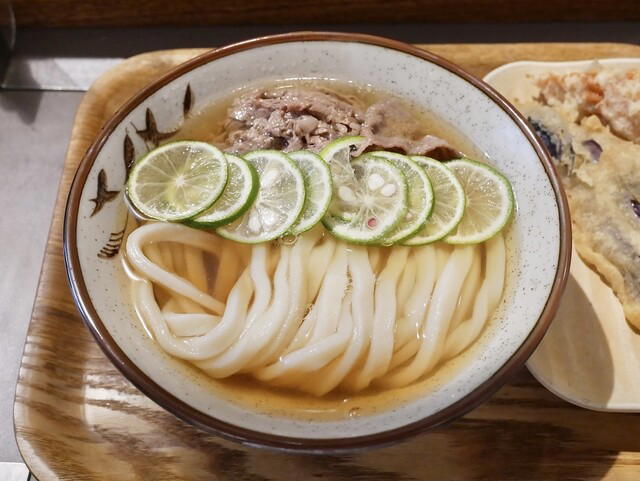
- Sudachi Udon
The room announces its priorities before any long explanation can. A focused noodle-shop rhythm sets the tone: this is Osaka eating at a practical scale, where speed does not need to mean carelessness and familiarity matters more than theatre. Udon Kyutaro belongs to a category that rewards repetition. Regulars return because the format is legible: choose, eat, and leave space for the next person.
Osaka’s casual dining reputation often gets flattened into takoyaki, okonomiyaki, and late-night neon, but its noodle culture is just as instructive. Udon shops across the city work on a different clock from special-occasion restaurants. They serve office workers, shoppers, solo diners, and families who understand the rhythm of a focused meal. In that setting, Tabelog Hyakumeiten recognition in 2024 matters because it signals consistency within a crowded regional field rather than luxury positioning.
Recognized udon with a regulars' rhythm
The compact, direct format shapes the meal as much as the noodles do. There is little reason for lingering, and that is part of the appeal. Osaka has long excelled at formats that compress pleasure into a short meal: quick counters, curry specialists such as REBEL CURRY, and everyday noodle rooms like Honmachi Seimensho Honten. Udon Kyutaro sits within that same practical grammar, but with enough specialist recognition to draw diners who usually reserve their attention for more formal rooms.
The categories tell the reader how to approach the meal: udon, tempura, and Japanese cuisine. That combination is not unusual in western Japan, but the discipline lies in restraint. The point is not a long menu performed as spectacle. It is the compact satisfaction of wheat noodles and additions that make sense for a shop built around pace.
That regulars’ perspective is useful for visitors. The unwritten menu at places like this is behavioral as much as culinary: arrive ready to decide, keep the line moving, and treat the room as shared infrastructure. Osaka rewards diners who understand that etiquette. The same logic applies across the city’s casual serious food culture, from everyday queues to compact snack and coffee stops.
Why the recognition matters in Osaka's noodle field
Tabelog Hyakumeiten recognition gives the shop a clear credential in a region where udon competition is dense and local loyalty is hard won. It also places the address in a different conversation from general Japanese casual dining: this is not simply an inexpensive meal, but a recognized specialist within a specific craft category. In Osaka, that distinction matters. A modest format can still operate at a level that draws repeat scrutiny.
Comparison also clarifies the decision. Honmachi Seimensho Honten occupies a similar everyday udon conversation, while Curry Senmonten Hakugintei Itwu biru ten and REBEL CURRY show how Osaka treats quick meals with unusual seriousness. La Pinata and Picnika point to different dining moods within the city’s wider map. Udon Kyutaro’s argument is narrower: come for a focused noodle stop, not for a long-form restaurant evening.
That focus is also why the place travels well for experienced eaters. Visitors using Our full Osaka restaurants guide can place it alongside the city’s broader food map rather than treating it as a standalone trophy. For a longer trip, the same planning logic extends beyond restaurants: Our full Osaka hotels guide, Our full Osaka bars guide, Our full Osaka wineries guide, and Our full Osaka experiences guide help separate daytime eating routes from evening drinking or cultural time.
How to read the room before you order
The better approach is to treat the meal as part of Osaka’s working-day food culture rather than as a ceremonial noodle pilgrimage. The shop’s casual format depends on flow. Regulars will not need a tutorial; visitors should watch the sequence, make decisions quickly, and avoid turning the meal into a planning desk. That small adjustment changes the experience. The reward is not exclusivity, but participation in a daily system that has been tuned by repetition.
There is a useful contrast here with contemporary destination dining, where the visitor often surrenders to a long menu and a fixed narrative. Osaka’s quick-service food culture asks for the opposite: attention without fuss. That makes it a strong meal anchor while exploring the city, and a smart corrective to itineraries built only around reservation-led dining. The same editorial pattern appears elsewhere in Japan and beyond, where focused regional rooms and casual specialists prove that a short meal can still carry a strong point of view.
International comparisons should be used carefully, but they help define the category. Japanese casual specialists abroad can translate parts of the culture; they cannot reproduce the exact pressure and pace of an Osaka weekday meal. Within the city, the better companion stops are not necessarily similar in cuisine but similar in clarity: Picnika and other Osaka dining rooms each occupy different dining moods, while the udon shop remains the efficient, craft-led choice when the day calls for noodles rather than a reservation-shaped meal.
Frequently asked questions
How do I find Udon Kyutaro?
Udon Kyutaro is located in Osaka.
What's the price range at Udon Kyutaro?
Pricing at Udon Kyutaro is listed as - JPY 999.
Should I book Udon Kyutaro in advance?
Check directly with Udon Kyutaro for current booking or walk-in details. The provided listing places it in Osaka and identifies it as an udon specialist with pricing listed up to JPY 999.
What do critics highlight about Udon Kyutaro?
The clearest marker is Tabelog Hyakumeiten recognition for 2024. The listing also gives a Tabelog score of 3.77 and a price band of up to JPY 999.
What if I have allergies at Udon Kyutaro?
The listed categories are udon, tempura, and Japanese cuisine. Check directly before ordering, especially if wheat, frying oil, or shared preparation areas are relevant to your needs.
Peers You’d Cross-Shop
Comparable venues side-by-side for orientation.
| Venue | Cuisine | Price | Awards | Notes |
|---|---|---|---|---|
| Udon KyutaroThis venue (the venue you are viewing) | Standing Udon Bar | $10–20 | Tabelog 100 #44 | Not listed |
| REBEL CURRY | Indian Curry | $1–10 | Tabelog 100 #7 | JPY 1,000 - JPY 1,999 |
| Honmachi Seimensho Honten | Not listed | Not listed | Tabelog 100 #56 | JPY 999 - JPY 999 |
| Picnika | Yoshoku / Osaka Terroir | Not listed | Not listed | Not listed |
| Curry Senmonten Hakugintei Itwu biru ten | Japanese Curry House | $10–20 | Tabelog 100 #1 | JPY 999 - JPY 999 |
| La Pinata | Southern Italian (Puglia-focused) trattoria | $50–100 | Tabelog 100 #92 | JPY 8,000 - JPY 9,999 |
Recognition history
Dated appearances from independent guides and award organizations, with the underlying list record or original source where available.
Tabelog 100 #44 · No. 44
Tabelog · Tabelog 100 - Udon - WEST - 2024