Our verdict
Café Vian occupies one of Liszt Ferenc tér's most-watched corners, where the square's pedestrian rhythm sets the pace for an all-day café that runs from morning coffee through late-evening drinks. Compared to Budapest's Michelin-tier dining rooms, it operates in a different register, accessible, unhurried, and anchored in the social life of the VII. district rather than a tasting menu format.

Pearl is the En Primeur Club membership app, where members save venues, book tables and use the concierge.
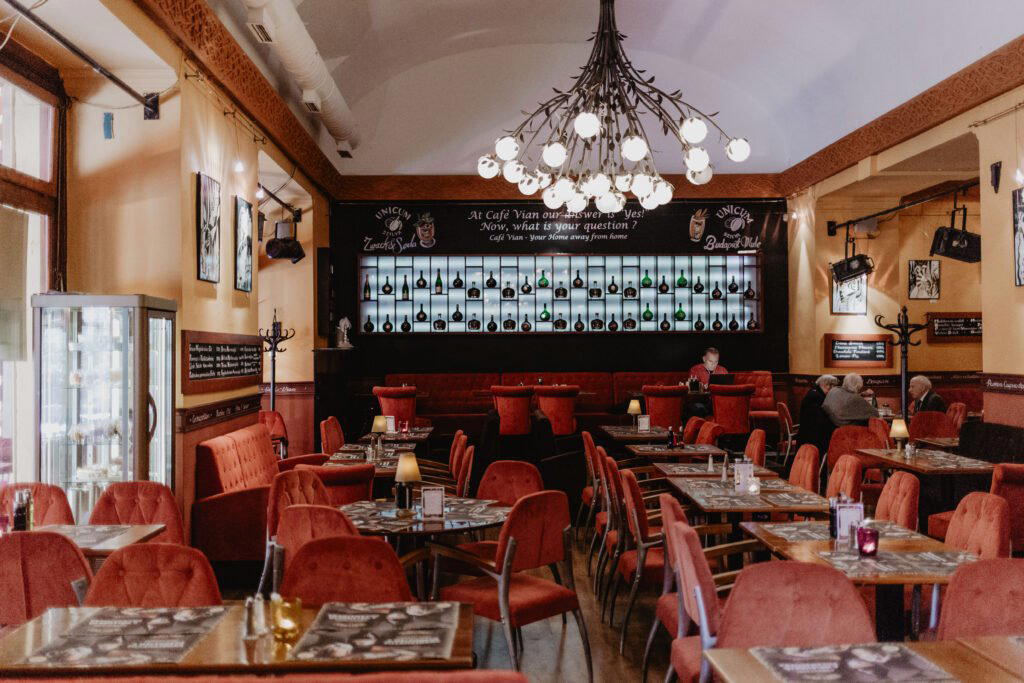
Liszt Ferenc Tér and the Café That Defines It
In Budapest, the terrace café is not a dining format so much as a civic institution. Liszt Ferenc tér, the pedestrianised square in the VII. district, named for the Hungarian composer, operates as one of the city's most consistent gathering points, running from mid-morning espresso through late-night rounds without the hard breaks that segment dining in other European capitals. The square is lined with café terraces, and the competition for pavement tables is real, but Café Vian at number 9 has held its position through years of neighbourhood change, tourist waves, and the broader gentrification of the area around Király utca and Andrássy út.
This is not the Budapest of Michelin stars and tasting menus. For that register, the city's modern cuisine rooms, Stand (€€€€ · Modern Cuisine), Babel (€€€€ · Modern Cuisine), and Costes (€€€€ · Modern Cuisine), operate in a different tier entirely. Café Vian belongs to an older and arguably more resilient Budapest tradition: the all-day café that functions as an extension of public space, where a single coffee earns you the right to sit and watch the square for an hour without social cost.
The Arc of an All-Day Café
The rhythm of a visit to Café Vian follows the rhythm of the square itself, and that progression matters. Mornings pull in commuters and local residents, the kind of crowd that has a preferred table and knows the staff by first name. By mid-morning, the terrace begins filling with the slower tempo of people with nowhere urgent to be, which in the context of Liszt Ferenc tér means a mix of students from the nearby music academy, professionals working remotely, and tourists who have figured out that this square rewards sitting still more than it rewards walking through.
Lunch represents the square's busiest hour, with multiple terraces competing for the same passing pedestrian traffic. The café format here positions itself between the quick-service end of the market and the more composed sit-down experience of a dedicated restaurant. Compared to the Borkonyha Winekitchen (€€€ · Modern Cuisine) price tier or the structured progression of essência (€€€€ · Modern Cuisine), Café Vian operates in a register that prioritises dwell time over culinary ambition.
Afternoons on the terrace represent the café's most characteristically Budapest hour. The square slows, the espresso orders continue, and the long Central European tradition of treating a café as a semi-public living room asserts itself. This is a tradition that traces back through the city's grand coffee-house era, Gerbeaud, New York Café, the vanished interwar institutions, though in a thoroughly contemporary, unpretentious form.
As evening arrives, the square shifts register again. Wine and cocktails replace coffee, the terrace fills with pre-dinner groups, and Café Vian functions more as a drinks destination than a café in any strict sense. This multi-phase structure, running continuously from open to close, is characteristic of the better-positioned Liszt Ferenc tér venues and distinguishes them from single-purpose restaurants elsewhere in the city.
The VII. District Context
The neighbourhood surrounding Liszt Ferenc tér has changed significantly over the past fifteen years. The VII. district, historically the old Jewish quarter, centred on Kazinczy utca and Dohány utca, absorbed a wave of ruin bar culture in the mid-2000s that brought international attention and, eventually, heavy tourist volume. Liszt Ferenc tér sits at the district's more composed edge, where the bohemian energy is present but filtered through a slightly more residential character.
For visitors building a Budapest itinerary that extends beyond the city, the surrounding region offers serious dining in less expected locations. Platán Gourmet in Tata and Teyföl in Szentendre both represent the kind of destination-level cooking that Hungary's smaller towns have developed over the past decade. Wine-focused travellers should note Sauska 48 in Villány and Petrányi Csopak in Csopak on Lake Balaton's northern shore as reference points for how Hungarian regional dining has repositioned itself. Further afield, Pajta in Őriszentpéter and Hosszú Tányér in Hosszúhetény demonstrate that the country's most interesting cooking is increasingly happening outside the capital. For fish-focused traditions, Old Kőrössy Fish Restaurant in Szegedin is a point of reference. Kővirág in Köveskál, Öreg Prés in Mór, and Botanica in Dánszentmiklós round out a regional picture that rewards planning. See our full Budapest restaurants guide for the complete city overview.
Internationally, the all-day café model has parallels in cities where dining culture anchors around a central square or pedestrianised street. The comparison is not with destination restaurants like Le Bernardin in New York City or the ticketed dinner-event format at Lazy Bear in San Francisco, those represent a different proposition entirely, but with the European café tradition where staying is the purpose.
Planning a Visit
Liszt Ferenc tér is a ten-minute walk from Deák Ferenc tér, Budapest's central metro interchange, and is served by the M1 yellow metro line at Oktogon, one stop along Andrássy út. The square is pedestrianised and accessed easily on foot from the central hotel belt around Andrássy and Nagymező utca. Café Vian sits at number 9 on the square's south side. Terrace tables are first-come during peak hours, summer weekend afternoons in particular see the square at full capacity across all venues, so morning or early-evening visits allow more flexibility. Phone and website details are not currently listed in our system; the café is findable directly on the square.
Frequently asked questions
What's Café Vian Liszt Ferenc tér's location?
Café Vian Liszt Ferenc tér is located at Budapest, Liszt Ferenc tér 9, 1061 Hungary, Budapest.
How does Café Vian compare to other cafés on Liszt Ferenc tér?
Liszt Ferenc tér hosts several competing terraces along its pedestrianised length in the VII. district, but Café Vian at number 9 has established a consistent presence tied to the square's identity over a sustained period. Where neighbouring venues tend toward bar-forward or restaurant-format operations, Café Vian holds the all-day café position that threads through Budapest's civic café tradition. That longevity in a competitive square setting is the most tangible differentiator.
What should I eat at Café Vian Liszt Ferenc tér?
Café Vian functions as a genuine all-day venue on Liszt Ferenc tér in Budapest's VII. district, meaning the menu spans morning pastries and coffee through to evening plates and drinks. The kitchen supports the pace of the square rather than a single meal occasion, so what you order depends largely on when you arrive.
Is Café Vian Liszt Ferenc tér reservation-only?
Café Vian operates on a walk-in basis consistent with the terrace café format it occupies on Liszt Ferenc tér. The square's pedestrianised setting draws consistent foot traffic, particularly on warm evenings, so arriving early secures the better terrace positions. Reservation policy specifics should be confirmed directly with the venue, as peak-season demand in the VII. district can shift operational practice.
What's the signature at Café Vian Liszt Ferenc tér?
The terrace itself is the signature. Positioned on Liszt Ferenc tér, one of Budapest's most recognisable pedestrianised squares, Café Vian's outdoor seating is the reason the address appears repeatedly in VII. district conversations. The café functions as a social anchor for the square, drawing a cross-section of the neighbourhood from morning coffee through late-evening drinks.
Can Café Vian Liszt Ferenc tér adjust for dietary needs?
Café Vian's all-day format, common to the Budapest café scene, typically accommodates a range of dietary requirements given the breadth of its menu across meal occasions. For specific allergen information or dietary accommodations, contacting the venue directly at Liszt Ferenc tér 9, Budapest 1061 is the reliable approach, as kitchen capabilities vary by service period.
The Minimal Set
Comparable venues nearby, for context on price, style, and recognition.
| Venue | Cuisine | Price | Notes |
|---|---|---|---|
| Café Vian Liszt Ferenc térThis venue (the venue you are viewing) | Traditional Hungarian Bistro | $20–30 | Not listed |
| Callas | Traditional Hungarian | $30–50 | Terézváros, Traditional Hungarian |
| For Sale Pub | Traditional Hungarian Gastropub | $10–20 | District V / Inner City, Traditional Hungarian Gastropub |
| Hemingway | Hungarian and International Lakeside Dining | $30–50 | Kis-Gellerthegy, Hungarian and International Lakeside Dining |
| The Great Hall | Modern Hungarian Fine Dining | $30–50 | Terézváros, Modern Hungarian Fine Dining |
| Rudas Bistro | Modern Hungarian Bistro | $20–30 | Gellerthegy, Modern Hungarian Bistro |