
50 Top Pizza Asia-Pacific #10
Our verdict
In Beijing's Chaoyang district, Bottega plants a serious Neapolitan flag at a moment when Italian dining in the Chinese capital is still sorting itself from imitation to substance. Spacious and wine-lined, the room channels the relaxed authority of a Southern Italian trattoria, while the menu anchors itself to classic soft-style pizza and pasta built on imported Italian ingredients.

Pearl is the En Primeur Club membership app, where members save venues, book tables and use the concierge.
The menu
What to order
- Beef Rib Pizza
- Slow-cooked Beef Sauce Pasta
- Four Seasons Pizza
The Room Before the Food
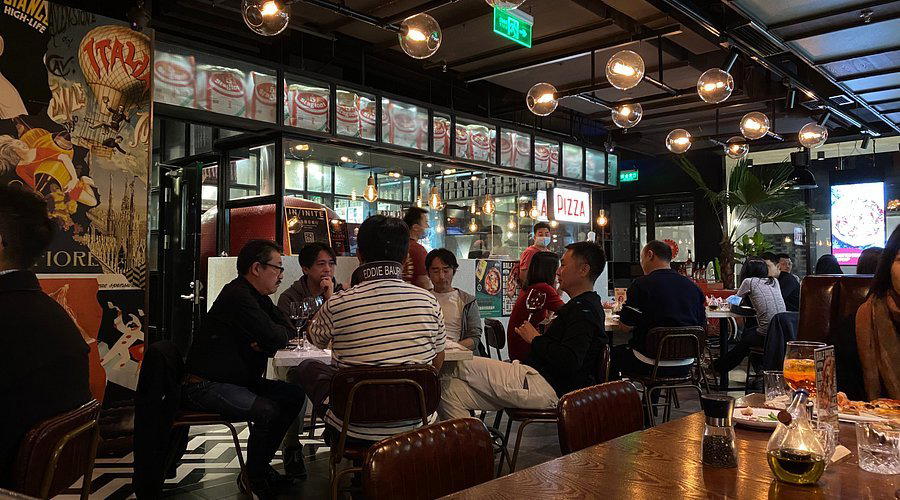
Walk into Bottega and the first thing that registers is the wine wall. Bottles line the interior in a way that signals intent before a single dish arrives: this is a room designed to communicate Italian hospitality through its physical container, not just through what lands on the table. The space is spacious and composed, the atmosphere closer to an elegant southern Italian dining room than to the compact, functional pizzerias Beijing has imported in various forms over the decades. Soft lighting, unhurried service, and the particular calm of a restaurant that has decided what it is, these are the environmental markers that distinguish it from the noisier, more transactional end of the city's Italian dining market.
The address on Xin Yuan Xi Li in Chaoyang places Bottega in one of the district's commercial-residential corridors, a part of Beijing that hosts a dense international dining circuit. The neighbourhood has seen successive waves of foreign-cuisine imports, and the question that setting poses for any Italian restaurant is the same: does this place understand the source tradition well enough to make a credible argument for it, or is it approximating a set of familiar aesthetics without the substance underneath?
Neapolitan Logic in a Chinese Capital
Italian dining in Beijing broadly splits into two operating modes. The first is the adaptation approach: cuisines retuned for local palates, sometimes successfully, sometimes not. The second, which Bottega occupies, is the proposition that the audience for an authentic, technically grounded Italian experience exists in Beijing and is underserved by the first mode. That reading of the market is not new, it has driven restaurant decisions in Shanghai and Guangzhou for years, but it still represents a specific and contested bet in the capital.
The Neapolitan pizza tradition that Bottega commits to is defined by soft, yielding dough, high-hydration fermentation, and a restrained hand with toppings. It is not the crisp Roman style, not the adapted thin-crust versions common in international hotel dining rooms, and not the thick-based interpretations that pass for pizza at the lower end of the market. Getting this right in Beijing requires sourcing Italian-origin ingredients at a consistency that the supply chain doesn't always make simple, and positioning the menu against a tier of expectations that the local dining audience is still calibrating.
Beijing's most recognised fine dining currently clusters around Chinese regional cooking at the top of the Michelin rankings. Xin Rong Ji on Xinyuan South Road and Chao Shang Chao in Chaoyang both hold three Michelin stars in the Taizhou and Chao Zhou traditions respectively, while Jingji holds two stars for Beijing cuisine. Against this, European dining, including Italian, operates in a secondary tier defined less by formal awards and more by consistency, sourcing credibility, and a loyal international and expatriate customer base. Bottega's competitive set is not the Michelin-starred Chinese table; it is the small pool of European restaurants that have built a durable reputation in the city's international dining community.
For a comparative sense of how serious imported European cooking performs in other Chinese cities, 102 House in Shanghai offers a useful reference point, as does the broader dynamic at Chef Tam's Seasons in Macau, where the conversation between imported and local culinary traditions plays out at a Michelin level. Bottega is not making that kind of claim, but it is operating in the same broader question of how foreign food traditions sustain themselves in Chinese cities over the long term.
What the Menu Argues
The menu at Bottega is not built for novelty. Classic versions of Neapolitan pizza are the centre of gravity, with pasta as a secondary anchor. The decision to keep the format conservative is itself a statement: the restaurant is not trying to reinvent the source tradition for the Beijing market but to represent it with sufficient fidelity that the comparison to an actual Neapolitan pizzeria holds up. The wine and spirits selection displayed along the walls functions both as aesthetic backdrop and as a genuine drinks program, aligning the room with the idea of a complete Italian dining occasion rather than a single-dish destination.
The team behind Bottega brings direct kitchen experience from Southern Italy, including time at Quattro Passi and Il Pellicano, two properties with significant reputations in the Italian fine dining and luxury resort circuit. Those credentials matter here not as biographical decoration but as context for the sourcing logic and technique applied in the kitchen. The difference between a pizza that reads as authentically Neapolitan and one that reads as an approximation is often found in exactly the kind of training that produces a confident hand with dough fermentation and heat.
For Beijing diners already committed to the city's Chinese restaurant circuit, from the vegetarian refinement of Lamdre and King's Joy to the regional depth of Jingji, Bottega represents a genuinely different register. It is not an attempt to compete with those tables on their own terms but to provide something those tables cannot: a credible Italian evening in a room built to sustain it.
Planning a Visit
Bottega sits at Jinshangyuan, 1F, 20 Xin Yuan Xi Li in Chaoyang. The location is accessible from the main Chaoyang expatriate and commercial corridors, making it a natural choice for international visitors staying in that part of the city. Given the limited publicly available information on advance booking, arriving with some flexibility is sensible, particularly on weekend evenings when the international dining circuit in Chaoyang tends to compress. The spacious room format suggests capacity is less of a constraint than it would be at a smaller counter-format restaurant, but the service quality noted by regular visitors implies that the kitchen and floor operate at a pace that rewards some planning.
For a wider orientation to dining in the city, our full Beijing restaurants guide maps the current range, and for accommodation planning, our Beijing hotels guide covers the key options near Chaoyang. Drinking before or after dinner fits naturally into the district, and our Beijing bars guide covers the current programme. Those curious about wider Chinese fine dining can follow the trail to Ru Yuan in Hangzhou, Xin Rong Ji in Chengdu, Imperial Treasure in Guangzhou, or Dai Yuet Heen in Nanjing. For reference points in serious European-led cooking outside China, Le Bernardin in New York and Atomix in New York illustrate what sustained culinary commitment to a national tradition looks like at its most rigorous. Additional Beijing exploration options include our Beijing wineries guide and our Beijing experiences guide.
Frequently asked questions
Which chef is Bottega associated with?
The chef associated with Bottega is Paolo Salvo, Daniele Salvo, Noriko Shinohara, David Connolly.
Is Bottega Michelin-listed?
Bottega has received recognition including: The restaurant is born from the experience of Daniele Salvo, a Neapolitan who, after traveling around the world and working in important kitchens and hotels (in Italy at Quattro Passi and at Pellicano), intercepted with his brother Paolo th….
What do regulars order at Bottega?
The menu centres on classic Neapolitan pizza, soft-base versions built around traditional Naples recipes rather than hybrid adaptations. Pasta is a reliable secondary order. Given the kitchen's Neapolitan lineage, rooted in Daniele Salvo's experience at restaurants including Quattro Passi in Italy, the core pizza lineup is where the kitchen's conviction sits.
Where is Bottega in Beijing?
Bottega is located at Jinshangyuan, 1层20 Xin Yuan Xi Li, 20, Chaoyang, Beijing, China, 100027, Beijing.
Can I walk in to Bottega?
The dining room at Jinshangyuan, 1F, 20 Xin Yuan Xi Li in Chaoyang is described as spacious, which gives walk-ins a reasonable shot outside peak service hours. Arriving early in the evening or at lunch is the practical approach if you have no reservation.
What's the standout thing about Bottega?
Bottega's defining characteristic is its refusal to adapt. In a Beijing market where Italian cooking frequently drifts toward local palates, the kitchen, led by the Salvo brothers alongside Noriko Shinohara and David Connolly, holds to classic Neapolitan form, sourcing Italian ingredients where possible. That consistency is the point.
Can Bottega adjust for dietary needs?
The menu is structured around classic Neapolitan pizza and pasta, which naturally accommodates vegetarian diners through traditional base recipes. Specific dietary modification policies are not documented, so contacting the restaurant directly via their Chaoyang location at 20 Xin Yuan Xi Li is the most reliable route for detailed requests.
Peers Worth Knowing
| Venue | Cuisine | Price | Awards | Notes |
|---|---|---|---|---|
| BottegaThis venue (the venue you are viewing) | Authentic Neapolitan Pizza | $30–50 | 50 Top Pizza Asia-Pacific #10 | Not listed |
| Jing | Modern French with Asian Influences | $300–500 | 1 Michelin Star · Black Pearl 1 Diamond | French Contemporary |
| Xin Rong Ji (Xinyuan South Road) | Taizhou Chinese Fine Dining | $300–500 | 3 Michelin Stars · World's 50 Best #84 | Taizhou |
| Chao Shang Chao (Chaoyang) | Modern Teochew (Chaoshan) Fine Dining | $200–300 | Michelin Plate · La Liste Top Restaurants | Chao Zhou |
| Lamdre | Modern Plant-Based Chinese Vegetarian | Not listed | 2 Michelin Stars · World's 50 Best #17 | Vegetarian |
| Jingji | Imperial Beijing Royal Cuisine | $200–300 | 2 Michelin Stars · La Liste Top Restaurants | Beijing Cuisine |
Recognition history
Dated appearances from independent guides and award organizations, with the underlying list record or original source where available.
50 Top Pizza Asia-Pacific #10
50 Top Pizza
Full recognition history (3 entries)
50 Top Pizza World #50
50 Top Pizza
50 Top Pizza World Best Pizza #51
50 Top Pizza
Continue exploring
More in Beijing
Restaurants in Beijing
All restaurants in Beijing →

Bars in Beijing
All bars in Beijing →



Details
- Elegant
- Cozy
- Trendy
- Lively
- Date Night
- Group Dining
- Casual Hangout
- Open Kitchen
- Craft Cocktails
- A La Carte
- Small Plates
- Vegetarian Friendly
- Vegan Options
- Gluten Free Options
Chic and cozy Italian-inspired decor with a warm, welcoming atmosphere, open kitchen, and lively vibe suitable for friends and family gatherings.