Blue Nile One occupies a quiet address on Siegesstraße in Munich's Schwabing district, bringing East African cooking to a city whose fine-dining conversation is dominated by French and German tasting menus. In a neighbourhood better known for its proximity to the English Garden than for culinary ambition, the restaurant represents a different register entirely, one that rewards diners willing to step outside Munich's default fine-dining circuit.
Pearl is the En Primeur Club membership app — saves, bookings, and concierge access live there. Same editors, same standards.
- Address
- Siegesstraße 22a, 80802 München, Germany
- Phone
- +494989342389
- Website
- blue-nile-one.eatbu.com
- Directions
- Get directions
 Saves & bookings on Pearl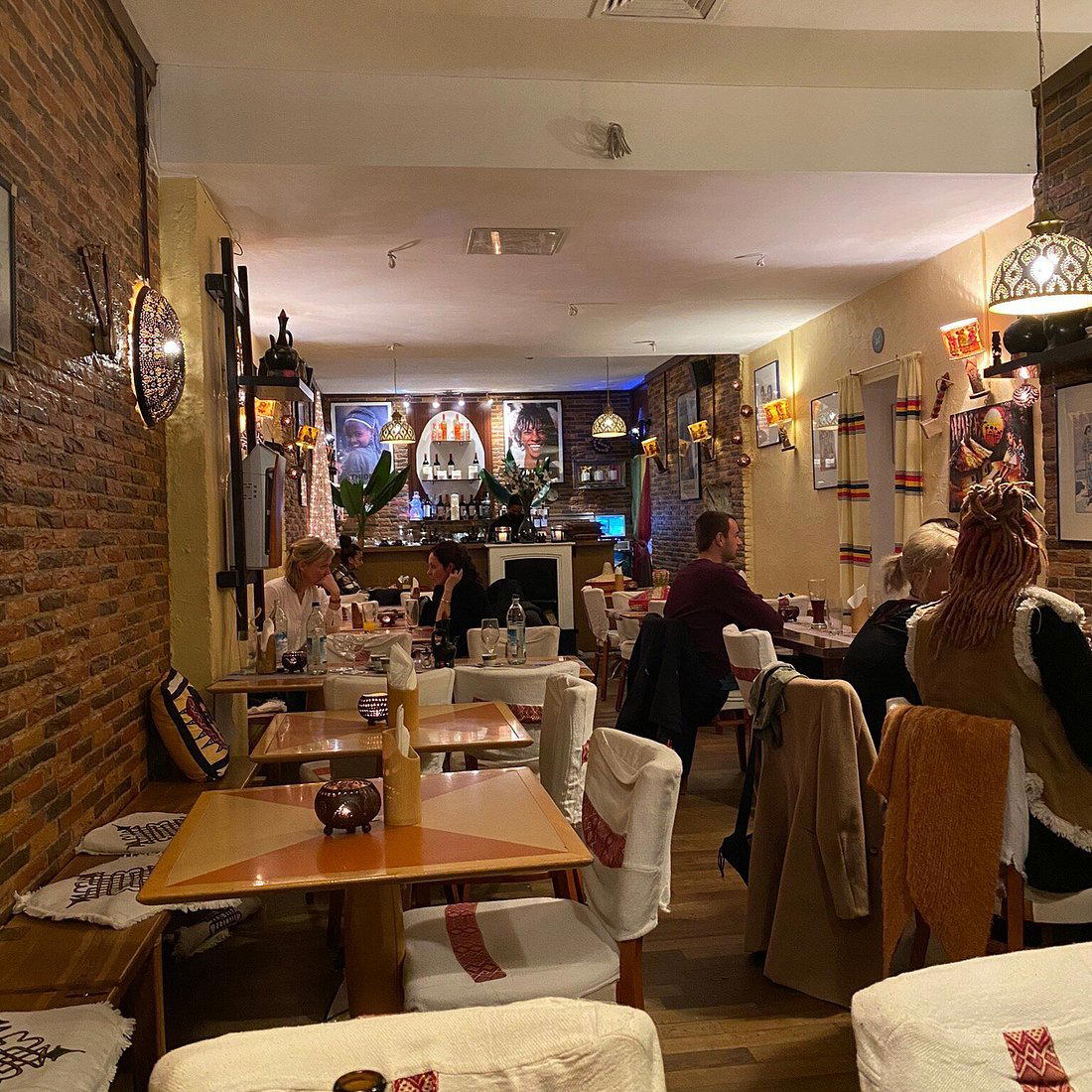
East African Cooking in a City of Tasting Menus
Munich's fine-dining conversation tends to run along predictable axes. Blue Nile One is an Authentic Ethiopian restaurant in Munich, Germany, with a casual dress code and reservations recommended. Located at Siegesstraße 22a in Schwabing, the restaurant draws on East African culinary tradition in a neighbourhood better known for its proximity to the English Garden and the art institutions clustered around Leopoldstraße than for culinary density. That positioning, culturally specific, geographically peripheral to Munich's dining core, defines what kind of experience this is and who it rewards.
Schwabing has a long-established identity as Munich's bohemian quarter, with a history of student cafés, independent bookshops, and a dining scene that skews more neighbourhood trattoria than destination restaurant. A restaurant rooted in the cooking of the Horn of Africa operates in that context as something genuinely distinct from the city's tasting-menu circuit. Where venues like JAN trade on creative European frameworks, Blue Nile One belongs to a different tradition, one built around communal eating, spice complexity, and fermented-grain staples rather than the plate-by-plate progression that defines most of Munich's recognised dining.
The Logic of East African Cooking in a European City
Across European cities, Ethiopian and Eritrean restaurants have established themselves as a reliable alternative to the dominant fine-dining grammar. The cooking relies on a fermented flatbread base, injera, typically made from teff, served as both plate and utensil, with stews, legume preparations, and spiced clarified butter building the core flavour architecture. The format is inherently communal: dishes arrive at the centre of the table rather than as individual compositions, and eating with the hands is the expected approach rather than a theatrical flourish. That structural difference from Western service formats is part of the cuisine's appeal for diners fatigued by the choreography of multi-course European menus.
Germany has a significant Ethiopian and Eritrean diaspora, and cities including Berlin, Frankfurt, and Cologne have developed East African restaurant clusters with enough depth to draw comparisons across the community. Munich's equivalent scene is smaller, which means individual restaurants carry more weight as reference points for the city's broader access to this tradition. In that context, an address on Siegesstraße functions less like a niche ethnic restaurant and more like a community anchor for a cuisine that deserves the same attentiveness that Munich's food media typically reserves for its Michelin-starred circuit. For diners who track Germany's wider dining range, venues like Schwarzwaldstube in Baiersbronn, Aqua in Wolfsburg, or Vendôme in Bergisch Gladbach, this represents a genuinely different point on the map.
Seasonal Timing and the Schwabing Approach
Schwabing's restaurant culture shifts noticeably with the seasons. Spring and early summer bring outdoor seating to much of the neighbourhood's restaurant strip, and the streets around Siegesstraße become more animated from May onward as locals reclaim pavement tables after the Bavarian winter.
The neighbourhood's density of independent restaurants means visitors can combine Blue Nile One with a broader evening in the area rather than treating it as an isolated destination.
Team Dynamic and Front-of-House in a Specialist Format
The service model at East African restaurants tends to require more front-of-house explanation than a standard European menu, not because the food is obscure but because the eating format is unfamiliar to many first-time visitors. At its leading, this produces a particularly engaged form of hospitality: staff who explain injera preparation, walk through the stew and vegetable options, and guide the table through the communal format are performing a more active educational role than the typical server reading a tasting-menu card. That team dynamic, where front-of-house carries genuine knowledge of a specific culinary tradition and translates it for a mixed audience, is part of what separates the stronger East African restaurants in European cities from those that assume diners already understand the format.
Pairing is a different calculation here than at the European fine-dining addresses with which Munich is more familiar. Traditional Ethiopian tej (honey wine) and various East African beers represent particularly culturally coherent accompaniments, though many European diners move through the meal with a short wine list or non-alcoholic options. The sommelier or beverage role at a restaurant like this is less about pulling from a deep cellar than about understanding which drinks work with the fermented, spiced, slow-cooked flavours of the cuisine, a distinct skill set from the Burgundy-heavy pairings that characterise venues such as Waldhotel Sonnora in Dreis or Restaurant Haerlin in Hamburg.
Where Blue Nile One Sits in Munich's Dining Range
Munich's dining map has significant depth at the leading end, the city holds multiple Michelin stars across formats that range from the creative European of JAN to the dessert-focused experimentation seen at places like CODA Dessert Dining in Berlin elsewhere in Germany. But the city's mid-market and specialist ethnic dining is a less-mapped territory in English-language food media. The restaurant occupies that less-mapped space: a neighbourhood address on a quiet Schwabing street, operating in a culinary tradition that gets less sustained critical attention than it warrants, in a city whose food conversation often defaults to its starred restaurants. For readers familiar with the reach of Germany's dining scene through venues like ES:SENZ in Grassau, Schanz in Piesport, or Victor's Fine Dining by Christian Bau in Perl, this represents the other end of the spectrum, informal, community-rooted, and built on a culinary logic that has nothing to do with European fine-dining convention.
Planning Your Visit
The restaurant is located at Siegesstraße 22a in Munich's Schwabing district, reachable via the U-Bahn stops at Münchener Freiheit (U6) or Giselastraße (U3/U6), both a short walk away.
Peers Worth Knowing
Comparable venues nearby, for context on price, style, and recognition.
| Venue | Cuisine | Price | Notes |
|---|---|---|---|
| Blue Nile OneThis venue — the venue you are viewing | Authentic Ethiopian | $$ | Not listed |
| Makula | West African | $$ | Ludwigsvorstadt |
| Wirtshaus Papa Benz | Modern Bavarian Gastropub | $$ | Schwabing |
| Le Voyage | Authentic Huaiyang Chinese | $$ | Schwabing |
| Wildmosers Restaurant-Cafe am Marienplatz - München | Traditional Bavarian | $$ | Altstadt |
| Taverna Diyar | Kurdish-Turkish | $$ | Haidhausen |

At a Glance
- Group Dining
- Casual Hangout
Current opening hours
- Monday
- Closed
- Tuesday
- 5:30 PM–12 AM
- Wednesday
- 5:30 PM–12 AM
- Thursday
- 5:30 PM–12 AM
- Friday
- 5:30 PM–12 AM
- Saturday
- 5:30 PM–12 AM
- Sunday
- 5:30 PM–12 AM
Hours can change for holidays and private events. Last verified .
Casual and welcoming atmosphere ideal for sharing communal platters of flavorful stews.