
Ginza’s bread culture has a different rhythm from its sushi counters and kaiseki rooms: quicker, less ceremonial, but still judged with Tokyo’s severe attention to craft. Bigo no Mise Toukyou honten belongs to that category, a take-out bakery and sweets counter recognized in Tabelog’s Bread TOKYO 100 in 2022, with shared eat-in seating rather than a full restaurant format.
Pearl is the En Primeur Club membership app — saves, bookings, and concierge access live there. Same editors, same standards.
- Address
- 東京都中央区銀座3-2-1 マロニエゲート銀座2 B2F
- Website
- bigot.co.jp
 Saves & bookings on Pearl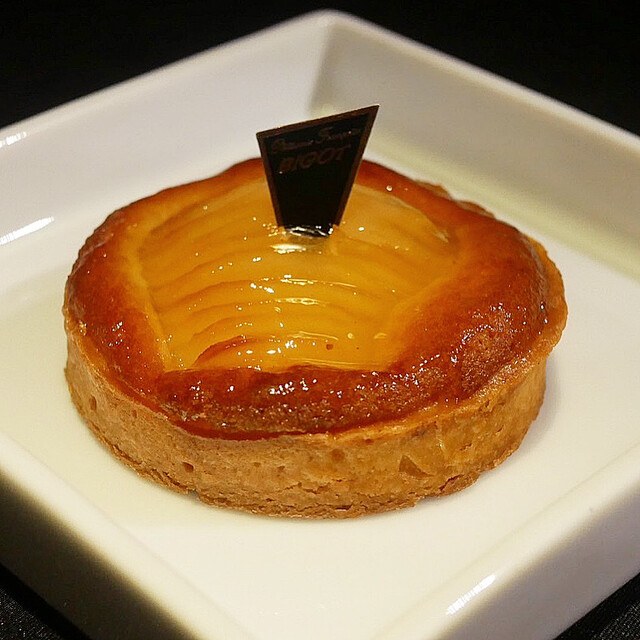
Below ground in a Ginza shopping complex, the bakery counter operates in the part of Tokyo dining that rarely gets the ceremony granted to sushi, tempura, or kaiseki. The cues are faster and more practical: trays, takeaway bags, commuters moving between rail lines, and shoppers treating bread as both an errand and a small luxury. That tension is what makes Tokyo’s serious bakeries worth reading closely. They are judged not by tableside theatre, but by consistency across loaves, sandwiches, and Western-style sweets handled at retail pace.
Bigo no Mise Toukyou honten sits inside that Ginza bread tradition rather than the capital’s destination tasting-menu circuit. Its recognition in Tabelog’s Bread TOKYO 100 for 2022 places it in a category where selection matters: bakeries compete across daily utility, pastry-case appeal, and the ability to hold attention in a city with unusually high standards for French-style and Japanese-adapted baking. The format is take-out, with shared eat-in seating on the same floor, so the experience is closer to a precise bakery stop than a lingering lunch.
Ginza bread culture rewards discipline over ceremony
Tokyo’s bakery scene has long absorbed French technique without turning every purchase into a formal meal. In Ginza, that dynamic becomes sharper. The district supports polished retail, department-store food halls, café counters, and quick-service specialists, all competing for customers who may be buying a weekday lunch, an office gift, or something to carry onto the train. A bread shop here has to function cleanly under pressure. Range matters, but so does how clearly the counter communicates what it is doing.
The useful comparison is not with a long-form restaurant such as 銀座ふじやま or a beef-focused room such as sukiyaki & shabu shabu Ginza Rangetsu. It is with Tokyo’s broader casual excellence: curry shops, cafés, bakeries, and standing counters that compress craft into a short visit. In that sense, this address belongs to the same city logic that makes a focused stop like 3 Chome no Curry Ya San relevant alongside more formal dining. Tokyo does not treat quick food as an excuse for slack execution.
The Tabelog Bread TOKYO 100 selection is the central trust signal here. It does not turn the shop into a luxury restaurant, and that is exactly the point. The award recognizes a bakery category with its own hierarchy, where the daily act of buying bread can be assessed with the same seriousness that diners apply to sushi counters or yakitori rooms. For travelers, that makes the stop useful as a calibration point: it shows how Ginza eats between reservations.
A take-out counter, not a dining room performance
Service model shapes the visit. This is not a room built around chef introductions, sommelier pacing, or front-of-house choreography. The team dynamic is retail discipline: production, counter service, payment, and handoff have to work as one system. In a bakery, front-of-house clarity is not decorative; it is the mechanism that keeps the queue legible and the case moving. The kitchen’s work is judged through what survives that format.
That makes the absence of a full seated restaurant format important. Shared eat-in seating nearby gives the shop a practical safety valve, but the core experience remains portable. This is a better fit for a daytime Ginza route than for an evening built around wine service or course progression. Travelers planning a food day might put it before a more structured dinner, or between retail stops, rather than treating it as the anchor meal.
The categories are broad enough to matter: bread, sandwiches, and Western-style sweets. That spread says something about Tokyo’s bakery expectations. A narrow boulangerie can earn attention through a few benchmarks, but a Ginza counter with this range has to satisfy multiple use cases at once. Office lunch, family purchase, and casual dessert all pass through the same counter. Children are explicitly welcomed, which reinforces the everyday character of the place rather than diminishing its seriousness.
How to place it within a Tokyo itinerary
Ginza is often framed through polished dining rooms, but its food culture is just as dependent on basement floors, station-adjacent retail, and short-format specialists. Bigo no Mise Toukyou honten is useful because it belongs to that second layer. It gives a traveler a way to read the district without committing to a long reservation, while still staying inside a recognized quality tier.
For a broader Tokyo dining map, pair this kind of bakery stop with different formats: charcoal and tuna at . 鮪と炭火焼き うお炭 秋葉原店, yakitori at 124. KAGURAZAKA (Yakitori), or Shinjuku counter dining at 12/10 Shinjuku ten. For a lighter café comparison, 2D Cafe shows another version of Tokyo’s quick-format food culture, where the setting drives the visit as much as the menu category.
Visitors building a fuller city plan should use the category guides rather than treating any single bakery as a complete answer to Tokyo dining. Start with Our full Tokyo restaurants guide, then widen the trip through Our full Tokyo hotels guide, Our full Tokyo bars guide, Our full Tokyo wineries guide, and Our full Tokyo experiences guide. The contrast is the value: Ginza bread in the afternoon, a more formal room at night, and the city begins to look less like a checklist and more like a set of daily eating systems.
Outside Tokyo, similar short-format or specialist stops can sharpen the comparison: -Grilled beef Sukiyaki- KAMAKURA TANUKIAN 鎌倉 たぬき庵 in Kamakura.cafe in Osaka.know in Kumamoto, (Shoku) Vietnam in Kawasaki, [Curry Senmon Ten] Maruyama Kyoju. in Sapporo, and [ki:] in Kyoto. Even farther afield, Jōdo Saké Bar in Los Angeles and Onigiri Time in Pasadena show how Japanese food formats change once they leave their domestic context.
The editorial read is simple: this is a recognized Ginza bakery counter with a practical format and a modest spend profile, valuable for what it reveals about Tokyo’s everyday standards. Do not approach it as a destination restaurant. Approach it as a precise stop in a district where even bread is part of the city’s competitive food culture.
The Quick Read
Comparable venues by price and recognition.
| Venue | Cuisine | Price | Notes |
|---|---|---|---|
| Bigo no Mise Toukyou hontenThis venue — the venue you are viewing | Not listed | $ | Not listed |
| BOULANGERIE SEIJI ASAKURA | Minato, French-Japanese bakery | $ | Not listed |
| Noriette | Not listed | $ | Setagaya, Classic French patisserie and cafe |
| Patisserie du Chef FUJIU | Not listed | $ | Hino / Takahatafudo, Traditional French patisserie and café |
| French Gashi Patissier Chocolatier Inamura Shozo | Taitō, French patisserie & chocolatier | $$ | Not listed |
| ici | Shibuya, Classic French Bistro | $$ | Not listed |
Recognition history
Dated appearances from independent guides and award organizations, with the underlying list record or original source where available.
Tabelog 100 #18 · No. 18
Tabelog · Tabelog 100 - Bread - TOKYO - 2022









At a Glance
- Classic
- Cozy
- Casual Hangout
- Family
- Solo
- After Work
- Standalone
A simple basement bakery counter in a commercial mall with shared eat‑in space, bright and functional rather than decorative, focused on takeaway bread and pastries with a relaxed, family‑friendly feel.