Tabelog 100 #57
Our verdict
A 24-seat Sri Lankan, curry and cafe address in Daikyocho, Shinjuku, BANDARA LANKA belongs to Tokyo’s sharper Asian and ethnic dining tier rather than the city’s generic curry circuit. Tabelog selected it for its Asian cuisine and Ethnic cuisine TOKYO “Tabelog 100” list in 2022, 2023 and 2024, a useful signal in a category where reputation often travels by regulars rather than ceremony.

Pearl is the En Primeur Club membership app, where members save venues, book tables and use the concierge.
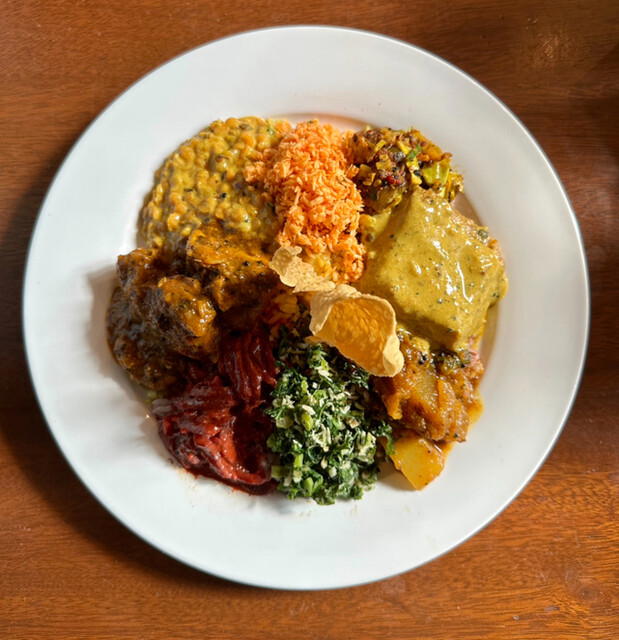
The menu
What to order
- Sri Lankan curry plates
- Dhal curry
- Deviled shrimp
- Lentil curry with yellow rice
Daikyocho sits between better-known Shinjuku routes, close enough to Yotsuya Sanchome for convenience but away from station-front restaurant churn. That setting matters: Tokyo’s Sri Lankan dining has grown through small rooms, curry counters and cafe formats, not grand dining rooms, and its stronger addresses read as neighbourhood commitments before destination restaurants. BANDARA LANKA fits the pattern: compact, non-smoking, and built around Sri Lankan, curry and cafe categories rather than a broad pan-Asian brief.
Tokyo’s South Asian and island cooking has evolved beyond spice tolerance. Diners are more literate about rice-and-curry structures, sambol logic, coconut depth, and the difference between heat and seasoning. Sri Lankan restaurants now compete less with generic curry houses than with specialist ethnic dining rooms that reward repeat ordering. Tabelog’s Asian cuisine and Ethnic cuisine TOKYO “Tabelog 100” selections in 2022, 2023 and 2024 place this address inside that tighter conversation.
Sri Lankan curry in Tokyo has moved from novelty to specialist category
Tokyo diners long treated curry as one flexible category: Japanese curry rice, European-style curry rooms, South Asian canteens and spice-led independents shared the same search term. The newer distinction is precision. Sri Lankan cooking brings a different plate architecture from North Indian or Japanese curry: multiple components, sharper contrasts, coconut-led textures and a habit of mixing rather than isolating. Even when the public category says Sri Lankan, Curry, Cafe, the serious reader should understand the shift. This is not the same competitive set as a lunch-only curry counter.
The listed budgets tell a useful story. Lunch sits at JPY 1,000 to JPY 1,999, while dinner is JPY 4,000 to JPY 4,999. That gap is common in Tokyo’s small ethnic restaurants when evenings allow more breadth, more drinking and a slower table rhythm. It places the room above quick curry turnover without pushing it into formal tasting-menu territory. For travellers comparing Shinjuku dinners, that middle band can be more revealing than another polished hotel restaurant.
The 24-seat scale keeps the experience close to a specialist room rather than a mass-market curry operation. Private rooms and private use are unavailable, reinforcing the point: this is a shared dining room, not a configurable event space. Reservations are available, and the format suits diners who value a focused category over theatrical service. Payment acceptance is broad by small-restaurant standards, with major credit cards and selected electronic money accepted, while QR code payments are not.
Daikyocho gives the room a different rhythm from central Shinjuku
Location changes use. Shinjuku’s main dining corridors reward speed, late traffic and visual noise. Daikyocho is quieter, with an arts-adjacent, residential feel around the Art Complex Center address. That makes a Sri Lankan cafe-restaurant feel less like a stopgap and more like a planned meal, especially for diners willing to walk from Yotsuya Sanchome, Shinanomachi or Kokuritsukyougijou rather than defaulting to the station cluster.
The no-parking note is practical, not minor: this is a train-and-walk restaurant, not a taxi-to-valet proposition. The nearest-station logic broadens its usefulness; it can sit between an afternoon in Shinjuku Gyoen, a museum or gallery plan, and dinner that does not require crossing town. For the wider frame, Our full Tokyo restaurants guide maps the city’s dining range, while nearby planning can be cross-checked against Our full Tokyo hotels guide, Our full Tokyo bars guide, Our full Tokyo wineries guide and Our full Tokyo experiences guide.
Within Tokyo’s comparison field, Sri Lankan curry does not replace kaiseki, ramen or Chinese dining; it answers another appetite. Meiyau occupies a lower listed budget band, Haramasa points toward kaiseki formality, Shinrakuki sits in Chinese territory, RAMEN MATSUI serves the ramen lane, and Arakicho Kintsugi works in a higher-priced Japanese register. BANDARA LANKA clarifies another lane: specialist Sri Lankan cooking with enough recognition to matter, without the ritual load of fine dining.
Recognition matters more in this category than spectacle
For Tokyo’s ethnic dining rooms, awards can be less visible than Michelin stars but more useful for decisions. Tabelog’s “Tabelog 100” Asian and ethnic selections are category-specific, relevant in a field where general rankings can blur cuisines together. A 2024 selection, following 2023 and 2022 selections, signals continuity rather than a single-year spike. The listed Tabelog score of 3.71 adds another indicator, though repeated category recognition over time matters more.
The opening date, 7 October 2018, also frames the restaurant. This is not a new opening trading on novelty. It has moved from discovery address to repeat-reference address, where Tokyo’s serious ethnic restaurants often gain authority. The city’s dining public is impatient with weak category work; sustained attention across several years usually means the restaurant has found a stable role rather than chasing fashion.
There are boundaries. Children under junior high school age are asked to refrain from entering, and remarks specify that children under 12 are not allowed. Take-out is listed, wine is listed under drinks, and the room is non-smoking. These operational signals sketch a restaurant built for adults, compact tables and category-focused meals rather than family dining or large-group social traffic.
For Tokyo itineraries built around contrasts, this belongs beside sharper small-format choices rather than luxury dining rooms. Compare it with city entries such as. 鮪と炭火焼き うお炭 秋葉原店, 12/10 Shinjuku ten, 124. KAGURAZAKA (Yakitori), 2D Cafe and 3 Chome no Curry Ya San. For a Japan-wide and transpacific read on casual-specialist formats, useful counterpoints include -Grilled beef Sukiyaki- KAMAKURA TANUKIAN 鎌倉 たぬき庵 in Kamakura.cafe in Osaka.know in Kumamoto, (Shoku) Vietnam in Kawasaki, [Curry Senmon Ten] Maruyama Kyoju. in Sapporo, [ki:] in Kyoto, Jōdo Saké Bar in Los Angeles and Onigiri Time in Pasadena.
The editorial read is clear: choose this when Tokyo’s luxury polish feels predictable and the evening calls for a compact, adult, category-specific meal. The value is not novelty; it is the maturity of a Sri Lankan address that has survived the city’s attention cycle and earned repeated recognition in the exact category where it counts.
Frequently asked questions
What's BANDARA LANKA's location?
BANDARA LANKA is located in Tokyo.
What should I budget for a meal at BANDARA LANKA?
Pricing at BANDARA LANKA is listed as JPY 4,000 - JPY 4,999 JPY 1,000 - JPY 1,999.
What time does BANDARA LANKA open and close?
Hours at BANDARA LANKA: Mon: Closed; Tue: 11 AM–2 PM, 5–9:30 PM; Wed: 11 AM–2 PM, 5–9:30 PM; Thu: 11 AM–2 PM, 5–9:30 PM; Fri: 11 AM–2 PM, 5–9:30 PM; Sat: 11 AM–2 PM, 5–9:30 PM; Sun: 11 AM–2 PM, 5–9:30 PM.
What is BANDARA LANKA known for?
BANDARA LANKA is primarily known for its core concept and execution in Tokyo.
A Credentials Check
Comparable venues to anchor price and recognition.
| Venue | Cuisine | Price | Awards | Notes |
|---|---|---|---|---|
| BANDARA LANKAThis venue (the venue you are viewing) | Authentic Sri Lankan Cuisine & Ceylon Tea | $30–50 | Tabelog 100 #57 | Not listed |
| FUGLEN TOKYO | Specialty coffee bar with Scandinavian influence | $10–20 | Tabelog 100 #66 | Shibuya |
| Ginza Swiss Honten | Classic yoshoku (Japanese Western-style) & katsu curry | $20–30 | Tabelog 100 #61 | Chūō |
| UNISON TAILOR Coffee and Beer NINGYOCHO | Specialty Coffee & Beer Cafe | $10–20 | Tabelog 100 #52 | Chūō |
| 2D Cafe | 2D Themed Dessert Cafe | $10–20 | Not listed | Shinjuku |
| Wine Shop Okukagurazaka Shoten | Standing wine bar & bistro | $30–50 | Tabelog 100 #43 | Shinjuku |
Recognition history
Dated appearances from independent guides and award organizations, with the underlying list record or original source where available.
Tabelog 100 #57 · No. 57
Tabelog · Tabelog 100 - Asian cuisine / Ethnic cuisine - TOKYO - 2024