Our verdict
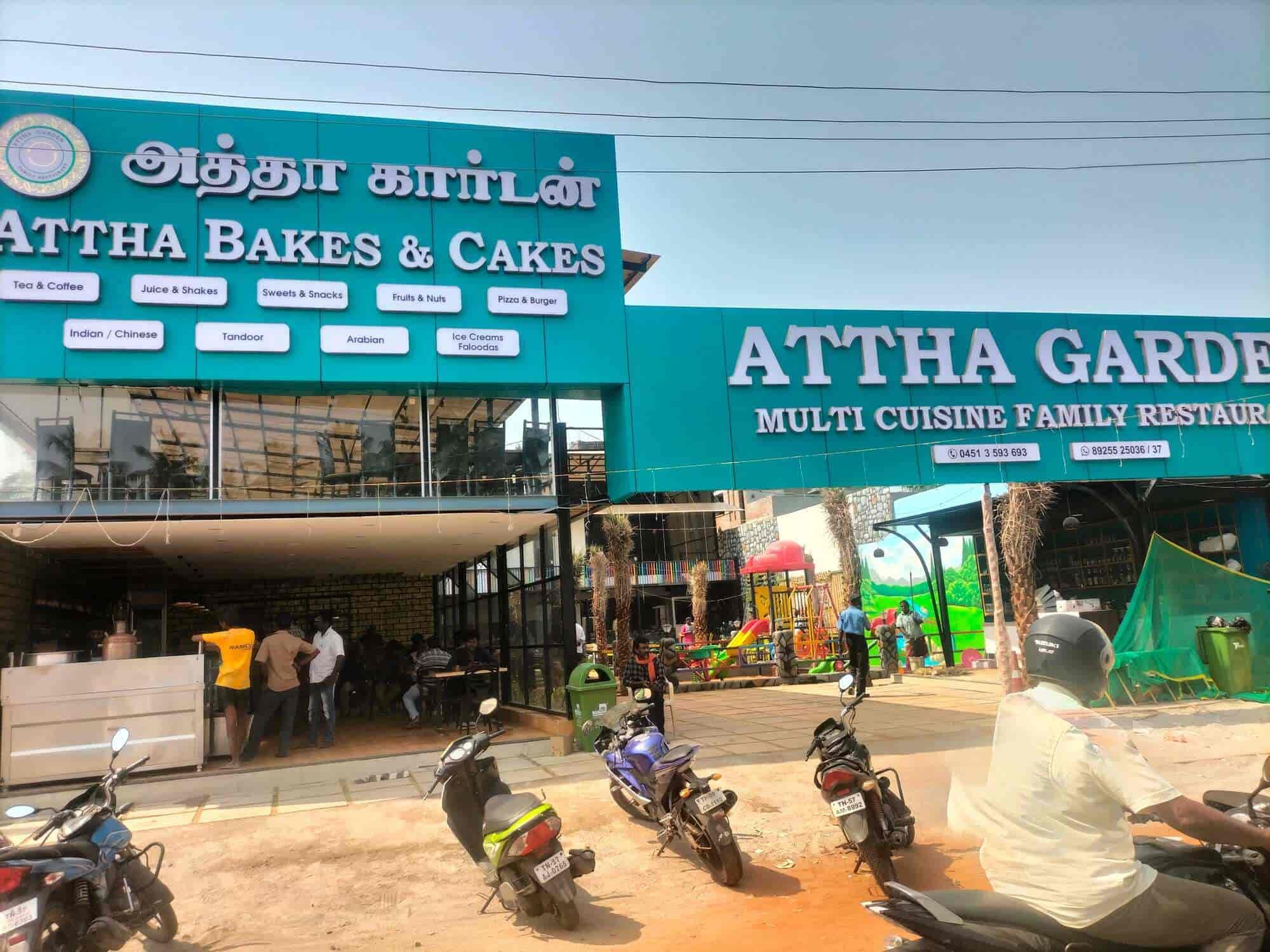
A family-oriented restaurant in Begambur on Batlagundu Road, Attha Garden sits within the broader Dindigul dining tradition where regional Tamil Nadu ingredients and home-style cooking define the table. The setting draws local families and passing travellers alike, reflecting the city's character as a junction between interior Tamil Nadu's agricultural belt and its well-travelled highway routes.

Pearl is the En Primeur Club membership app — saves, bookings, and concierge access live there. Same editors, same standards.
- Address
- No.3A, Batlagundu Road, opp. Periya Pallivasal, Begambur, Tamil Nadu 624002, India
- Phone
- +918925525036
- Hours
- Daily 11 AM–11 PM
- Website
- atthagarden.com
- Directions
- Get directions
Where Dindigul's Ingredient Belt Meets the Table
Dindigul sits at a geographic crossroads that few Indian cities match for sheer pantry variety. The Palani Hills to the north funnel produce downward through the district: small-farm vegetables, freshwater fish from the Kodaikanal-area streams, and the dry-climate aromatics that define interior Tamil Nadu cooking. The city is also the acknowledged home of the lock-spiced mutton biryani, a preparation so regionally specific that it has spawned debates about replication across Tamil Nadu and beyond. For a family restaurant positioned on Batlagundu Road in Begambur, that agricultural proximity is the baseline context, not a selling point to be marketed — it is simply the condition of sourcing in this part of the state.
Attha Garden Family Restaurant occupies a stretch of Batlagundu Road that functions as one of Dindigul's outward routes, connecting the city centre toward the interior towns and the Kodaikanal highway corridor. The address places it near Periya Pallivasal, a neighbourhood reference point that locals use instinctively for orientation. Approaching from the main road, the setting reads as the kind of mid-town family restaurant that Tamil Nadu's secondary cities have refined over decades: not a hotel-dining-room formality, not a street-stall informality, but the distinct middle register where extended families settle in for a proper meal. That format — the garden restaurant with covered seating, designed to handle groups across generations, is a durable institution in cities like Dindigul, Erode, and Salem, and it exists precisely because the food tradition here is communal by nature.
The Sourcing Logic of Interior Tamil Nadu
Understanding what reaches the plate in a Dindigul family restaurant requires understanding the district's supply geography. The region is not a coastal cooking zone. Unlike the fish-forward kitchens of Chennai or the coconut-heavy preparations of the Chettinad belt further east, Dindigul's culinary identity is built around inland proteins and dry-land agriculture. Mutton from the local black sheep breed, smaller, leaner, with a flavour that differs measurably from coastal or northern equivalents, is the prestige protein. The spice handling is specific too: Dindigul cooks tend toward a drier, more concentrated spice application rather than the wet-paste approach of coastal or Kerala-adjacent cuisines.
This regional sourcing logic connects Dindigul's family restaurants to a wider pattern visible across India's interior food cities. Kappa Chakka Kandhari in Chennai built its reputation on recovering hyper-regional Kerala ingredients at a time when urban menus were standardising. The Malabar House in Fort Cochin demonstrated that ingredient provenance could be a primary editorial frame even in a hospitality context. In Dindigul, that argument doesn't need making explicitly, the sourcing is structural, not a program. The proximity of the Palani foothills means the vegetable supply is genuinely shorter-chain than in larger Tamil Nadu cities, and the local mutton supply chain has operated continuously for generations.
For readers who follow ingredient-focused dining across the subcontinent, this places Dindigul's better family restaurants in an interesting comparative position. Farmlore in Bangalore has formalised hyper-local sourcing into a tasting-menu format. Naar in Kasauli applies similar logic in a Himalayan foothills context. Dindigul's version of the same principle operates without the tasting-menu architecture or the editorial apparatus, it is embedded in the format of the everyday family restaurant, which is arguably a more honest expression of the same sourcing logic.
The Family Restaurant as a Format
The Tamil Nadu family restaurant is a specific institution with its own conventions. Garden seating, or at minimum the suggestion of open-air ventilation, is standard. The menu architecture typically runs across multiple rice formats, multiple protein applications, and a tiffin section for lighter eating. Service is structured around the table group rather than the individual diner, shared vessels, multiple small dishes arriving in sequence or together, the assumption that the table will order broadly rather than narrowly.
Attha Garden's name signals this format directly. The garden element is not decoration; it is the format marker that distinguishes this category from a hotel dining room or a street-facing tiffin counter. For families travelling the Batlagundu Road corridor, a route used by visitors heading toward Kodaikanal as well as by local commuters, this format serves a practical function. The setting accommodates groups without the formality pressure of a hotel restaurant, and without the standing-room constraints of a highway dhaba.
Across India's interior food cities, the family restaurant tier has been the most consistent carrier of regional cuisine. It is not the format that attracts international food-media attention, that tends to go to urban fine-dining operations like Inja in New Delhi or hotel-anchored heritage rooms like Adaa at Falaknuma Palace in Hyderabad, but it is the format where the actual cooking traditions of a district survive intact across generations. View in Madurai and Royal Vega in Chennai represent the more formal southern Tamil Nadu dining tier. Attha Garden operates in the register below that formality level, which in food terms often means closer to the source.
Planning a Visit
Dindigul is accessible by road from Madurai (approximately 65 kilometres southwest) and from Tiruchirappalli (roughly 100 kilometres to the east), making it a plausible stop on a multi-city Tamil Nadu itinerary. The Batlagundu Road address places Attha Garden on a navigable outbound route from central Dindigul, and the Periya Pallivasal landmark serves as a reliable local reference point when asking for directions. For those travelling the Kodaikanal highway corridor, a common tourist route from the plains toward the hill station, the restaurant's position makes it a logical pre- or post-hill stop rather than a detour. Our full Dindigul restaurants guide covers additional options across the city's dining tiers.
Frequently asked questions
Does Attha Garden Family Restaurant work for a family meal?
The name and format position it squarely as a family dining venue. Located on Batlagundu Road in Begambur, Dindigul, the restaurant follows the Tamil Nadu family restaurant convention — broad seating, shared dishes, and formats that accommodate groups rather than intimate couples-only settings. It is a practical choice for multi-generational tables.
What should I expect atmosphere-wise at Attha Garden Family Restaurant?
The 'Garden' designation signals open-air or semi-open seating, a standard feature of Tamil Nadu family restaurants where ventilation and space take priority over interior design. The Begambur address, away from Dindigul's commercial core, means the surroundings are quieter than the town centre. Expect a functional, unhurried pace suited to long family meals rather than quick-service dining.
Where exactly is Attha Garden Family Restaurant located in Dindigul, and how do I find it?
The restaurant is at No. 3A, Batlagundu Road, opposite the Periya Pallivasal mosque, in the Begambur area of Dindigul, Tamil Nadu 624002. The mosque serves as a clear landmark for first-time visitors approaching from either the town centre or the Batlagundu highway corridor. Dindigul itself sits roughly 65 kilometres from Madurai, making the restaurant reachable by road from both cities.
Where is Attha Garden Family Restaurant located?
Attha Garden Family Restaurant is located at No.3A, Batlagundu Road, opp. Periya Pallivasal, Begambur, Tamil Nadu 624002, India, Dindigul.
Is Attha Garden Family Restaurant reservation-only?
No reservation contact details are currently documented for Attha Garden Family Restaurant. Tamil Nadu family restaurants in smaller cities like Dindigul generally operate on a walk-in basis, with tables turning through the day across lunch and dinner services. Arriving outside peak meal hours reduces wait time at venues of this type.
What is Attha Garden Family Restaurant known for?
The restaurant's identity is built around the garden-format family dining model that is a defining institution in Tamil Nadu — open or semi-open seating, multi-dish shared meals, and a broad menu suited to groups. Situated on Batlagundu Road in Begambur, Dindigul, it draws from a district whose agricultural geography supports consistent access to fresh regional produce throughout the year.
At-a-Glance Comparison
Comparable venues nearby, for context on price, style, and recognition.
| Venue | Cuisine | Price | Notes |
|---|---|---|---|
| Attha Garden Family RestaurantThis venue — the venue you are viewing | South Indian & Chinese Family Restaurant | $1–10 | Not listed |
| Aanch | North-West Frontier North Indian | $10–20 | Niranjanpur |
| Hotel Aganta Green | Indian Multicuisine | $1–10 | Fardapur |
| Swirl | Indian Pure Vegetarian | Not listed | Vrindavan |
| Mynt | Pure Vegetarian Indian | Not listed | Vrindavan |
| Omya | Modern Indian Fine Dining | $100–150 | Lodhi Road |
Continue exploring
More in Dindigul
Details
- Casual
- Family
- Casual Hangout
- Garden
- Garden
- A La Carte
- Vegetarian Friendly
Current opening hours
- Monday
- 11 AM–11 PM
- Tuesday
- 11 AM–11 PM
- Wednesday
- 11 AM–11 PM
- Thursday
- 11 AM–11 PM
- Friday
- 11 AM–11 PM
- Saturday
- 11 AM–11 PM
- Sunday
- 11 AM–11 PM
Hours can change for holidays and private events. Last verified .
Casual family-friendly atmosphere suitable for everyday dining.