Our verdict
The Chinthamani outpost of the Dindigul Thalappakatti chain brings one of Tamil Nadu's most recognised biryani traditions to Madurai's southern corridor, positioned alongside Velammal Hospital on the Madurai-Thoothukudi Highway. The brand's identity is built around the Seeraga Samba rice variety and Dindigul-style preparation, placing it in a distinct regional category within India's broader biryani conversation.

Pearl is the En Primeur Club membership app — saves, bookings, and concierge access live there. Same editors, same standards.
- Address
- Madurai - Thoothukudi Hwy, next to Velammal Hospital and Medical College, Chinthamani, Madurai, Tamil Nadu 625009, India
- Phone
- +917823900019
- Hours
- Daily 10 AM–11 PM
- Website
- thalappakatti.com
- Directions
- Get directions
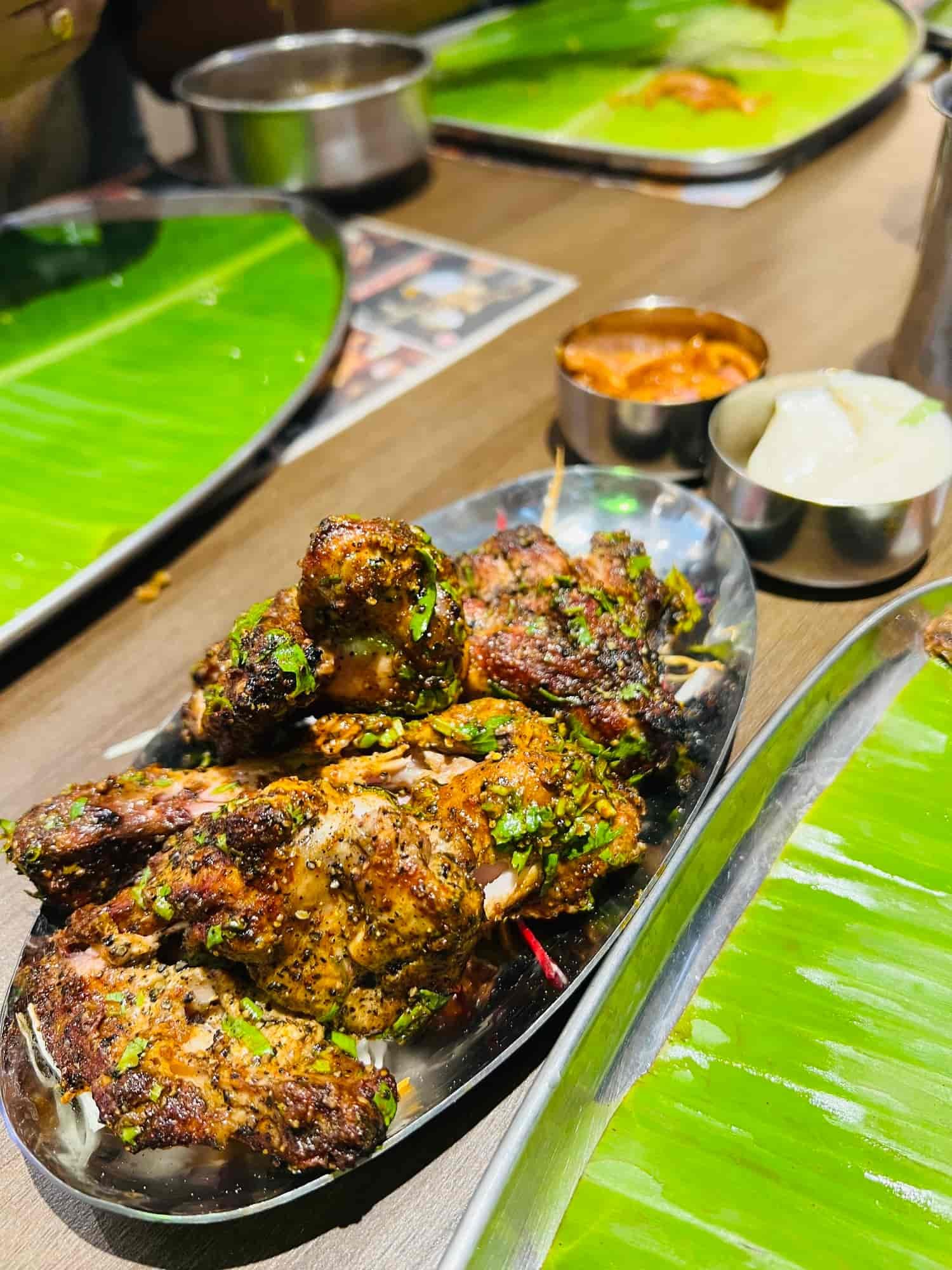
Where the Highway Meets the Handi
Arriving at the Chinthamani branch of Dindigul Thalappakatti along the Madurai-Thoothukudi Highway, the context matters as much as the food. This stretch of road, flanked by medical institutions and outbound traffic, represents a particular type of Tamil Nadu dining culture: the reliable regional landmark that pulls both local families and travellers making the southward run toward Thoothukudi. The setting is functional rather than atmospheric in any decorative sense, but that utilitarian confidence is itself a signal. Restaurants that carry genuine culinary authority in Tamil Nadu rarely need to perform it through their interiors.
Thalappakatti as a brand occupies a specific and well-documented position in South Indian food culture. The name traces back to Nagasamy Naidu, who began selling biryani in Dindigul in 1957, and the chain has since expanded across Tamil Nadu and beyond while keeping the recipe architecture anchored to the same regional logic: Seeraga Samba rice, Dindigul-reared mutton, and a spice profile that reads as sharper and more mineral than the heavier, ghee-forward Hyderabadi or Lucknawi styles. For anyone mapping India's biryani traditions geographically, Dindigul-style biryani sits in a distinct southern category, closer in character to Tamil and Chettinad spicing than to Mughal-derived northern preparations. Restaurants doing justice to that tradition, like Kappa Chakka Kandhari in Chennai, demonstrate how South Indian culinary specificity can hold its own against more internationally profiled cuisines.
The Ingredient Logic Behind Dindigul Biryani
The editorial angle that matters most here is sourcing, because Dindigul-style biryani derives its identity almost entirely from two hyperlocal ingredients. Seeraga Samba, a short-grain aromatic rice cultivated primarily in Tamil Nadu, absorbs spice differently from Basmati: the grains are smaller, denser, and carry a nuttier baseline flavour that holds up under the pressure of slow cooking without dissolving into mush. The biryani that results is structurally distinct from long-grain preparations, with more cohesion between rice and meat and a spice penetration that reads through to the centre of each grain.
The second sourcing variable is the mutton itself. Dindigul's regional reputation for goat meat, particularly from smaller-framed local breeds grazed on the rocky terrain around the Palani Hills, contributes a leanness and a slightly gamey depth that distinguishes the preparation from goat biryani made with imported or feedlot-reared animals. This is the kind of ingredient provenance that rarely makes it onto menus but that trained palates can identify immediately. It places Dindigul biryani in a comparable conversation to terroir-driven cooking traditions found at places like Farmlore in Bangalore or Naar in Kasauli, where sourcing geography is the foundational editorial argument.
Spice blend, called the Thalappakatti masala, has been standardised across outlets to maintain consistency, which is both a practical achievement at chain scale and a constraint worth acknowledging. What the Chinthamani branch delivers is a reliable articulation of that formula rather than an idiosyncratic local interpretation. For travellers accustomed to the studied provenance storytelling of restaurants like Inja in New Delhi or the highly individual sourcing narratives of Bomras in Anjuna, the Thalappakatti model is a different proposition: institutional rather than artisanal, but no less grounded in a specific regional food logic.
Madurai's Dining Register and Where This Fits
Madurai operates on a different frequency from India's metropolitan restaurant scenes. The city's food culture is oriented toward volume, value, and inherited recipes rather than fine-dining theatre. Comparing the Chinthamani branch to the more atmosphere-conscious establishments across town, like View or Melting Pot Restaurant Madurai, clarifies the competitive set. Thalappakatti here is not competing on ambiance or innovation; it is competing on the authority of a 60-plus-year recipe tradition delivered at accessible price points to a high-volume audience.
That positioning is worth taking seriously rather than dismissing. The kind of rigour applied to ingredient sourcing and recipe standardisation at a chain like Thalappakatti across dozens of outlets is a different discipline from the creativity-led model of restaurants such as Adaa at Falaknuma Palace in Hyderabad or Americano in Mumbai, but it is not a lesser one. Maintaining the integrity of a regional recipe at scale, with consistent sourcing and preparation, is its own form of culinary commitment. The same logic applies to establishments like Dining Tent in Jaisalmer or Leela Kerala Terrace in Trivandrum, which anchor themselves to regional tradition rather than trend.
For travellers building a broader map of South Indian food, the Chinthamani branch serves as a useful data point alongside explorations of Kerala cuisine at The Malabar House in Fort Cochin or the kind of ingredient-forward northern Indian cooking found at Neel in Patiala and Ran Baas The Palace in Qila Mubarak. Our full Madurai restaurants guide maps these choices across price tiers and cuisines.
Planning Your Visit
The Chinthamani branch sits on the Madurai-Thoothukudi Highway adjacent to Velammal Hospital and Medical College, making it straightforwardly locatable for anyone moving along that corridor. The highway address means it is more practical for visitors with private transport than for those relying entirely on auto-rickshaws from the city centre, though the route is a standard one. Given the branch's position as a high-traffic chain outlet serving both locals and passing travellers, waits during peak lunch service, particularly on weekends, are a practical consideration. Arriving before or after the main lunch rush reduces that variable considerably. For price-range reference, Thalappakatti outlets across Tamil Nadu have historically operated in the accessible mid-range rather than the premium tier, consistent with the brand's positioning as a regional staple rather than a special-occasion destination. Comparable regional chains in the South Indian market confirm this general price architecture. See also Palaash in Yavatmal for another example of how regional Indian food traditions translate into destination dining outside metropolitan centres.
Frequently asked questions
Is Dindigul Thalappakatti Restaurant - Chinthamani okay with children?
Yes. The Chinthamani branch operates on the high-volume, family-oriented model that defines Thalappakatti's positioning across Madurai. The format is casual and communal, with no dress code or formal dining pressure, which makes it straightforwardly workable for families with children.
What is the atmosphere like at Dindigul Thalappakatti Restaurant - Chinthamani?
Expect a busy, functional dining room calibrated for throughput rather than atmosphere. The Chinthamani location sits on the Madurai-Thoothukudi Highway adjacent to Velammal Hospital, which means the clientele runs from highway travellers to hospital visitors to local regulars. It is loud, efficient, and unpretentious — consistent with how Madurai's food culture operates at its core.
What makes Dindigul Thalappakatti's biryani different from other Tamil Nadu biryani styles?
Dindigul biryani is distinguished by two hyperlocal ingredients: seeraga samba rice, which is shorter and more flavour-absorbent than long-grain varieties, and the use of curd-marinated meat with small onions that introduce a characteristic tang absent from most other regional styles. Thalappakatti, which originated in Dindigul city, is credited widely across Tamil Nadu with codifying and popularising this preparation — the Chinthamani branch in Madurai brings that tradition approximately 70 kilometres south along the highway corridor.
What's the must-try dish at Dindigul Thalappakatti Restaurant - Chinthamani?
Dindigul-style biryani is the reason this chain carries the weight it does across Tamil Nadu. The dish is built around seeraga samba rice — a short-grain, aromatic variety that holds spice differently from basmati — combined with Dindigul's locally distinctive sourness from curd and small onions. Ordering anything else here before trying the biryani would be missing the point of the address entirely.
Where do I go for Dindigul Thalappakatti Restaurant - Chinthamani?
Dindigul Thalappakatti Restaurant - Chinthamani is located at Madurai - Thoothukudi Hwy, next to Velammal Hospital and Medical College, Chinthamani, Madurai, Tamil Nadu 625009, India, Madurai.
Is Dindigul Thalappakatti Restaurant - Chinthamani reservation-only?
No reservations are required or, in practice, expected at the Chinthamani branch. The highway-side location is built for walk-in volume, and seating turns over quickly given the operational pace. Peak hours — particularly lunch service — will see queues, so arriving slightly off-peak is advisable.
Side-by-Side Snapshot
Comparable venues nearby, for context on price, style, and recognition.
| Venue | Cuisine | Price | Notes |
|---|---|---|---|
| Dindigul Thalappakatti Restaurant - ChinthamaniThis venue — the venue you are viewing | South Indian Biryani | $1–10 | Not listed |
| View | Indian with Scenic Views | $20–30 | Pasumalai |
| Melting Pot Restaurant Madurai | Multi-Cuisine Indian Fusion | $1–10 | KK Nagar |
| Nand Di Hatti | Classic Punjabi Chole Bhature | $1–10 | Sadar Bazar |
| Green Park | Indian & International Garden Dining | $1–10 | Fatehabad Road |
| The Big Barbeque - Buffet | Indian BBQ Buffet | $1–10 | Thanjavur |
Continue exploring
More in Madurai
Details
- Classic
- Well Known
- Casual Hangout
- Group Dining
- Family
- Standalone
- A La Carte
- Family Style
- Vegetarian Friendly
Current opening hours
- Monday
- 10 AM–11 PM
- Tuesday
- 10 AM–11 PM
- Wednesday
- 10 AM–11 PM
- Thursday
- 10 AM–11 PM
- Friday
- 10 AM–11 PM
- Saturday
- 10 AM–11 PM
- Sunday
- 10 AM–11 PM
Hours can change for holidays and private events. Last verified .
Casual dining atmosphere with traditional South Indian hospitality and attentive service.