
Tabelog 100 #96
Our verdict
Asian N Soup Curry Besu belongs to Sapporo’s soup curry conversation rather than the city’s luxury dining circuit: a house-restaurant format in Shiroishi, 38 seats, counter and table service, and repeated Tabelog 100 Curry EAST selections. Its reputation rests on category credibility, casual accessibility, and the kind of local curry culture that rewards repeat eating over ceremony.

Pearl is the En Primeur Club membership app, where members save venues, book tables and use the concierge.
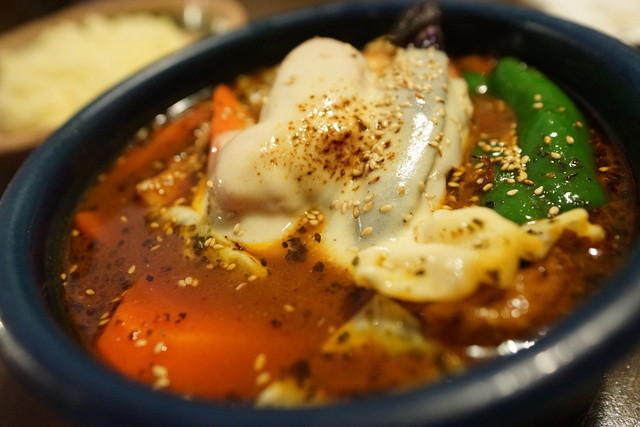
In Shiroishi, the approach is quieter than central Sapporo’s station-side dining corridors: residential streets, a house-restaurant setting, and a room built for counter meals and family tables. That matters for soup curry. The genre is not a formal tasting-menu tradition, but a local habit shaped by broth, spice, rice, and customization; its stronger addresses often feel more like neighbourhood infrastructure than destination theatre.
Asian N Soup Curry Besu fits that Sapporo grammar. The signal is not a chef biography or luxury fit-out, but repeated recognition in a fiercely specific category: Tabelog 100 Curry EAST selections in 2019, 2020, 2023, and 2024. In a city where soup curry has its own hierarchy, that recurring placement says more than a broad restaurant accolade. It marks a place judged against curry specialists, not sushi counters, ramen shops, or hotel dining rooms.
Sapporo soup curry, judged by specialists rather than ceremony
Soup curry is one of Sapporo’s defining casual forms, and asks a different question from Japanese curry rice. The plate is not thick roux over rice; the bowl tends toward a looser, spiced broth with rice kept separate, letting diners control pacing and intensity. In Hokkaido, the format suits the climate: warming, filling, and flexible without becoming formal dining.
That flexibility makes the category hard to read from outside. Price alone does not separate serious shops from ordinary ones, because much of the city’s curry conversation lives in the same everyday band. Ka~ru Ma~ru, Spice&mill, and Magic Spice Sapporo honten operate in a similar casual spend range, while Kuriya sits in a different economic tier. The useful comparison is not luxury versus non-luxury, but whether a curry address has earned category-specific attention over time.
Besu’s Tabelog score of 3.65 and Tabelog 100 Curry EAST 2024 selection place it in that specialist frame. The list is not a Michelin-style fine-dining marker, and treating it as one misreads Sapporo curry. Its value is narrower: it filters curry shops through a dedicated category lens, exactly how a traveller should approach this part of the city’s food culture.
The room reinforces the point. Thirty-eight seats, including counter and table seating, make the experience feel like a dependable local restaurant rather than a high-ceremony address. Non-smoking service, children welcome, and take-out availability broaden the use case without changing the identity. This is a curry stop for diners who care about the category, not a room borrowing prestige from another format.
Why the Shiroishi setting changes the read
Central Sapporo can compress dining decisions: ramen alleys, izakaya clusters, department-store basements, and station-adjacent convenience all compete for the same evening. Shiroishi shifts the rhythm. A curry meal here belongs to a less performative side of the city, where repeat local custom and practical access matter. Parking beside the store and a station-plus-bus route from central Sapporo underline that this is not a stroll-by address for every visitor.
That extra effort is editorially relevant. In a destination city, travellers default to density: Susukino for nightlife, Sapporo Station for logistics, Odori for broad access. A Shiroishi curry address needs a reason beyond convenience. Repeated category recognition supplies it, especially for visitors mapping Sapporo through soup curry rather than treating it as one obligatory meal.
The better use of Besu is within a curry-focused itinerary, not as a lone trophy stop. Pair it mentally with Ajanta Indo Curry Ten, Ajanta Sohonke, and [Curry Senmon Ten] Maruyama Kyoju. to clarify the range: Indian-influenced curry lineages, soup curry specialists, and neighbourhood curry rooms all sit under a broad word that hides real differences. Sapporo rewards that segmentation.
There is also a useful contrast with other local comfort-food forms. Ramen specialists such as 175°DENO Tantanmen Sapporo kitaguchi ten or Menya Nanabee Honten answer a different craving: noodles, speed, and broth concentration. Soup curry gives more space to rice, spice level, and vegetable-forward structure. For travellers building several meals around Hokkaido’s casual strengths, the distinction prevents the itinerary from becoming one long bowl-based blur.
How to place it in a Sapporo eating plan
The practical case is concise: this is a casual, category-recognised soup curry restaurant in Shiroishi with a house-restaurant setting, counter seats, table seats, and no reservations. Cash planning matters because credit cards and electronic money are not accepted, while QR code payment through PayPay is listed. The published schedule includes midday and evening service on operating days, with Monday and Thursday closures, so it fits better as a planned curry meal than a spontaneous late-night fallback.
For a broader Sapporo read, use it alongside Our full Sapporo restaurants guide, then build the trip around category rather than convenience. Our full Sapporo hotels guide helps solve the base question; Our full Sapporo bars guide, Our full Sapporo wineries guide, and Our full Sapporo experiences guide fill in the city beyond the curry bowl.
Readers tracing adjacent Japanese dining should also compare how casual specialisation works elsewhere: Aigues Vives, -Grilled beef Sukiyaki- KAMAKURA TANUKIAN 鎌倉 たぬき庵 in Kamakura, . 鮪と炭火焼き うお炭 秋葉原店 in Tokyo, .cafe in Osaka.know in Kumamoto, (Shoku) Vietnam in Kawasaki, and [ki:] in Kyoto each show a different relationship between format, neighbourhood, and expectation. Outside Japan, Jōdo Saké Bar in Los Angeles and Onigiri Time in Pasadena offer another lens on how Japanese casual forms travel.
The critical read is clear. Besu is not a cellar-led restaurant, chef-counter performance, or luxury dining room. Its interest lies in how Sapporo’s soup curry culture creates serious addresses at everyday scale, where repeated category selection, local format, and practical informality carry the authority. For travellers who understand that curry in Japan is not a monolith, that is the point.
Frequently asked questions
What time does Asian N Soup Curry Besu open and close?
Hours at Asian N Soup Curry Besu: Mon: Closed; Tue: 11 AM–3 PM, 5:30–8:30 PM; Wed: 11 AM–3 PM, 5:30–8:30 PM; Thu: Closed; Fri: 11 AM–3 PM, 5:30–8:30 PM; Sat: 11 AM–3 PM, 5:30–8:30 PM; Sun: 11 AM–3 PM, 5:30–8:30 PM.
What's the pricing like at Asian N Soup Curry Besu?
Pricing at Asian N Soup Curry Besu is listed as JPY 1,000 - JPY 1,999 JPY 1,000 - JPY 1,999.
Where is Asian N Soup Curry Besu in Sapporo?
Asian N Soup Curry Besu is located in Sapporo.
What has Asian N Soup Curry Besu built its reputation on?
Its reputation rests on Tabelog 100 Curry EAST selection in 2024, with earlier selections in 2023, 2020, and 2019. The Sapporo address in Shiroishi Ward, 38-seat layout, and JPY 1,000–1,999 price range make it a practical benchmark for soup curry in the city.
Where It Fits
Comparable venues by cuisine and price in the same metro.
| Venue | Cuisine | Price | Awards | Notes |
|---|---|---|---|---|
| Asian N Soup Curry BesuThis venue (the venue you are viewing) | Soup curry restaurant | Not listed | Tabelog 100 #96 | Not listed |
| Aigues Vives | Coastal artisan bakery | $10–20 | Tabelog 100 #5 | Otaru |
| BAR PROOF | Bar / Cocktails | $30–50 | Tabelog 100 #12 | Chūō |
| soup curry yellow | Sapporo soup curry specialist | $10–20 | Tabelog 100 #75 | Chūō |
| Yakiniku Restaurant Totori | Yakiniku & Korean Barbecue | $30–50 | Tabelog 100 #4 | Chūō |
| Noka no Chaya Shizen Mankitsu Club | Farm café & parfaits / soft serve | $1–10 | Tabelog 100 #30 | Kiyota |
Recognition history
Dated appearances from independent guides and award organizations, with the underlying list record or original source where available.
Tabelog 100 #96 · No. 96
Tabelog · Tabelog 100 - Curry - EAST - 2024
Continue exploring
More in Sapporo
Restaurants in Sapporo
All restaurants in Sapporo →
Bars in Sapporo
All bars in Sapporo →


Details
Current opening hours
- Monday
- Closed
- Tuesday
- 11 AM–3 PM, 5:30–8:30 PM
- Wednesday
- 11 AM–3 PM, 5:30–8:30 PM
- Thursday
- Closed
- Friday
- 11 AM–3 PM, 5:30–8:30 PM
- Saturday
- 11 AM–3 PM, 5:30–8:30 PM
- Sunday
- 11 AM–3 PM, 5:30–8:30 PM
Hours can change for holidays and private events. Hours as of .