
Tabelog 100 #37
Our verdict
A compact Sapporo ramen counter with deep local history, Aji no Sanpei belongs to the city’s old-school bowl culture rather than its newer destination-dining circuit. Its Tabelog Ramen HOKKAIDO 100 selection in 2024 and 2025, counter-only format, and central Odori-area setting make it a useful reference point for travelers measuring Sapporo ramen by substance rather than spectacle.

Pearl is the En Primeur Club membership app, where members save venues, book tables and use the concierge.
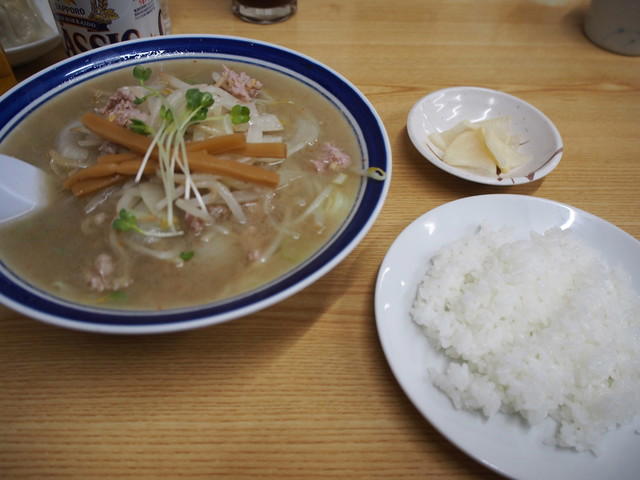
The menu
What to order
- Miso ramen
- Spicy miso ramen
- Shoyu (soy sauce) ramen
- Shio (salt) ramen
- Shumai dumplings
The approach is urban and practical: a central Sapporo building, an upper-floor ramen room, and the compressed rhythm of counter dining rather than street-front theatre. This is not the polished ramen-bar template exported across Japan’s major stations. Its appeal is narrower and more Sapporo: a bowl that can be lunch, local memory, and price-conscious eating in one quick sitting.
Sapporo’s ramen identity is often flattened into a single postcard image. Miso ramen carries the broad recognition, but the stronger visitor point is how ramen competes with soup curry, seafood, izakaya cooking, and bakery culture for everyday attention. Aji no Sanpei fits that daily-use category: small, direct, counter-based, and tied to a lineage predating the current ramen tourism circuit.
Old Sapporo ramen without the tasting-menu inflation
Ramen in Japan now runs in several directions: chef-led bowls with limited runs, regional specialists built around a single broth style, and heritage shops where the format has changed less than the audience around it. The Sapporo end matters because the city is not short on cold-weather eating traditions. A ramen counter here has to make sense against curry houses, grilled meat shops, seafood counters, and casual set-meal cooking, not only other noodle rooms.
Aji no Sanpei’s strongest editorial claim is value in the old sense: compact format, central location, and recognition from Tabelog’s Ramen HOKKAIDO 100 list in both 2024 and 2025. That award signal places it inside a curated Hokkaido ramen conversation, while the room keeps the exchange simple. Counter seating sets the pace. Turnover, proximity, and the bowl in front of the diner matter more than ceremony.
The historical detail is useful not as nostalgia, but as context for why this counter reads differently from newer ramen openings. The shop was founded in 1950 in Susukino and moved to its current Daimaru Fujii Central Building location in 1968. In a city where winter tourism and regional branding can turn food into performance, that continuity gives the place a harder edge. It belongs to Sapporo’s working restaurant memory as much as to its visitor-facing ramen map.
That distinction matters for travelers sorting limited meals in Hokkaido. A bowl here is not competing with a long dinner at a French-influenced dining room such as メリメロ, the curry-rice orbit represented by SOUP CURRY KING Sentoraru, or the meat-and-rice comfort of Tezukuri Hamburger Steak Kobo Toshi. It occupies a tighter lane: ramen as a short, concentrated stop, priced for repeat use rather than occasion dining.
Counter dining as the point, not a limitation
Small ramen counters reward diners who understand the format before arriving. There is little value in treating them like restaurants built for lingering. The counter concentrates attention on pace, ordering discipline, and kitchen rhythm. For solo travelers, that can be an advantage; for groups expecting a long, conversational meal, it may feel clipped. The format is part of the value proposition because the experience is not padded by a room designed for spectacle.
There is also a useful family signal: school-age children are welcomed, and a children’s ramen option is listed. That separates the shop from counters that are technically casual but socially awkward for families. In Sapporo, where visitors move between museums, shopping arcades, transit hubs, and evening drinking districts, a ramen stop that can handle solo diners, friends, and families occupies a practical middle ground.
The trade-off is clear. Reservations are not the mode, cards and electronic payments are not part of the operating pattern, and private-room expectations do not belong here. For some visitors, that is inconvenient. For others, it is exactly why the experience remains legible: show up, eat at the counter, pay simply, move on. The value is in the bowl and in the absence of luxury-restaurant friction.
That usefully corrects how premium travel can misread Japan. Not every important meal is expensive, reservation-only, or chef-biographical. In Sapporo, a revealing itinerary often pairs one serious table with several precise casual stops. Ramen can carry as much local meaning as formal dinner when the counter has history, local use, and a clear place in the city’s food economy.
How it fits into a sharper Sapporo eating plan
For a broader Sapporo plan, ramen should not be isolated from the city’s casual food structure. The same day might include a specialist noodle counter, a curry stop, and a bar later, with hotels chosen around transit rather than resort-style seclusion. EP Club’s city pages help map that spread: start with Our full Sapporo restaurants guide, then use Our full Sapporo hotels guide, Our full Sapporo bars guide, Our full Sapporo wineries guide, and Our full Sapporo experiences guide to keep the trip balanced.
Within the restaurant list, the city’s casual depth becomes clearer when ramen is viewed beside other focused addresses. 175°DENO Tantanmen Sapporo kitaguchi ten points toward spice and noodle specialization, while [Curry Senmon Ten] Maruyama Kyoju., Ajanta Indo Curry Ten, and Ajanta Sohonke show curry as a parallel comfort-food system. Aigues Vives widens the frame further, reminding travelers that Hokkaido’s appeal is not confined to bowls and seafood.
Japan-wide planning benefits from the same category discipline. A quick ramen counter in Sapporo should not be judged by the same criteria as -Grilled beef Sukiyaki- KAMAKURA TANUKIAN 鎌倉 たぬき庵 in Kamakura. 鮪と炭火焼き うお炭 秋葉原店 in Tokyo.cafe in Osaka.know in Kumamoto, (Shoku) Vietnam in Kawasaki, or [ki:] in Kyoto. Outside Japan, the same logic applies to focused casual formats such as Jōdo Saké Bar in Los Angeles and Onigiri Time in Pasadena: the question is not luxury, but whether the format delivers clarity for the spend.
Aji no Sanpei is for travelers who want Sapporo ramen with historical weight and a tight counter experience, not a staged dining event. Its value sits in concentration: local continuity, recognized ramen credentials, and a format that keeps the meal brief. In a city where serious eating can sprawl across seafood markets, soup curry rooms, beer halls, and late-night noodles, that clarity is useful.
Frequently asked questions
What should I budget for a meal at Aji no Sanpei?
Pricing at Aji no Sanpei is listed as JPY 1,000 - JPY 1,999 JPY 1,000 - JPY 1,999.
Where do I go for Aji no Sanpei?
Aji no Sanpei is located in Sapporopporo.
Is Aji no Sanpei open every day?
Hours at Aji no Sanpei: Mon: Closed; Tue: 11 AM–3:30 PM, 5–6:20 PM; Wed: 11 AM–3:30 PM, 5–6:20 PM; Thu: 11 AM–3:30 PM, 5–6:20 PM; Fri: 11 AM–3:30 PM, 5–6:20 PM; Sat: 11 AM–3:30 PM, 5–6:20 PM; Sun: 11 AM–3:30 PM, 5–6:20 PM.
What is Aji no Sanpei known for?
Aji no Sanpei is primarily known for its core concept and execution in Sapporo.
Recognition Snapshot
Comparable venues to anchor price and recognition.
| Venue | Cuisine | Price | Awards | Notes |
|---|---|---|---|---|
| Aji no SanpeiThis venue (the venue you are viewing) | Historic Sapporo miso ramen shop | $10–20 | Tabelog 100 #37 | Not listed |
| Sapporo Ramen Kifu Susukino ten | Japanese Ramen | $1–10 | Tabelog 100 #90 | Chūō |
| Bem Bera network company | Sapporo soup curry | $10–20 | Tabelog 100 #67 | Chūō |
| China Soba Chiu | Traditional Sapporo ramen counter | $10–20 | Tabelog 100 #33 | Chūō |
| Ramen Yamasawa | Ramen & Tsukemen Shop | $1–10 | Tabelog 100 #18 | Shiroishi |
| Menya Takahashi | Tsukemen & ramen shop | $10–20 | Tabelog 100 #35 | Toyohira |
Recognition history
Dated appearances from independent guides and award organizations, with the underlying list record or original source where available.
Tabelog 100 #37 · No. 37
Tabelog · Tabelog 100 - Ramen - HOKKAIDO - 2025
Continue exploring
More in Sapporo
Restaurants in Sapporo
All restaurants in Sapporo →
Bars in Sapporo
All bars in Sapporo →
Details
- Well Known
- Lively
- Classic
- Cozy
- Solo
- Casual Hangout
- Family
- Late Night
- Chefs Counter
- Historic Building
- Standalone
- Beer Program
- A La Carte
- Counter Dining
- Beer
- Pescatarian Friendly
Current opening hours
- Monday
- Closed
- Tuesday
- 11 AM–3:30 PM, 5–6:20 PM
- Wednesday
- 11 AM–3:30 PM, 5–6:20 PM
- Thursday
- 11 AM–3:30 PM, 5–6:20 PM
- Friday
- 11 AM–3:30 PM, 5–6:20 PM
- Saturday
- 11 AM–3:30 PM, 5–6:20 PM
- Sunday
- 11 AM–3:30 PM, 5–6:20 PM
Hours can change for holidays and private events. Hours as of .
A compact, no-frills counter-only ramen shop inside a department store, with bright functional lighting, tightly packed seats, and a bustling atmosphere that reflects its popularity and fast turnover more than design or decor.