
A Tabelog Award 2026 Bronze winner in Kamakura's Onarimachi district, anchoa runs a 15-seat Spanish course restaurant three minutes from Kamakura Station West Exit. The kitchen builds its menus around local seafood, with a fish-first sourcing approach that sits at an unusual intersection of Iberian technique and Sagami Bay produce. Dinner runs JPY 15,000–19,999; lunch from JPY 6,000–7,999.
 Discover on Pearl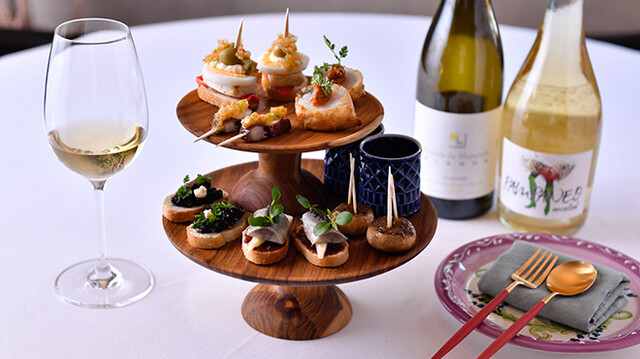
Where Sagami Bay Meets the Spanish Coast
Kamakura's dining scene has always been pulled in two directions: the centuries-old temple-town identity that draws day-trippers to soba and kaiseki, and a quieter current of technically ambitious kitchens that serve a more local, repeat-visit clientele. anchoa belongs firmly to the second category. The restaurant sits inside Onarimage Village, a low-rise complex a three-minute walk from Kamakura Station's West Exit on the Enoden side, and its compact dining room, 15 seats in total across three counter seats and a handful of tables, signals from the outset that this is a place built around precision rather than volume.
The physical approach matters here. Kamakura's Onarimachi district is notably quieter than the tourist corridors around the main station exit, and that separation is deliberate. Spanish course restaurants in Japan tend to concentrate in Tokyo's denser neighbourhoods, where competition and foot traffic create their own logic. Kamakura offers something different: a coastal town with direct access to Sagami Bay's fishing grounds, and an audience that travels specifically for the meal rather than stumbling in. anchoa's Tabelog score of 4.03 and its 2026 Bronze Award reflect a kitchen that has earned that audience's attention since opening in August 2021.
The shortlist, unlocked.
Hard-to-book tables, cellar releases, and concierge-planned trips.
Get Exclusive Access →The Sourcing Argument
The central editorial claim that anchoa makes, and that its Tabelog listing makes explicit, is fish. The kitchen is categorised as "particular about fish," and the course format is built around that specificity. This is not unusual language in Japanese restaurant listings, but the combination with Spanish technique creates a distinct proposition. Spanish coastal cooking, from the pintxos counters of San Sebastián to the rice-focused kitchens of Valencia, has always treated the harbour as its primary larder. In Kamakura, that logic translates directly: Sagami Bay produces a range of fish, shellfish, and molluscs that Spanish preparation methods are well-suited to handle.
Port-to-plate timelines in the Kamakura area benefit from proximity. The Sagami Bay fishing grounds feed into nearby ports, and the absence of a long supply chain between catch and kitchen is exactly the condition that Spanish seafood cooking rewards most. Techniques like escabeche, a la plancha preparation, and salt-cure methods emphasise the quality of the raw ingredient rather than transforming it through layered sauce work. When the fish is two days out of the water rather than five, those preparations read differently on the plate. This sourcing framework is not a marketing claim anchoa makes in isolation: it positions the kitchen within a broader pattern of Japanese-European restaurants that have relocated out of Tokyo specifically to close the gap between raw material and dining room.
For comparison, HAJIME in Osaka and Goh in Fukuoka each operate high-recognition European-inflected kitchens in cities with their own strong local sourcing identities. anchoa in Kamakura applies similar logic at a smaller scale: 15 seats, a course format with no à la carte option, and a menu built to reflect what the bay and surrounding region provides. The fish-focus also places anchoa in a different conversation than Kamakura's other recognised kitchens. Mikasa works in tempura, a format that also rewards exceptional raw seafood, and Unagi Tomoei anchors Kamakura's freshwater eel tradition. anchoa operates in a separate lane, and the Tabelog Spanish Cuisine Top 100 selection for 2024 confirms that its peer set extends nationally rather than just locally.
The Room and the Format
Small-room course restaurants in Japan operate under a specific set of hospitality conventions. The 15-seat capacity at anchoa, with its three counter seats and tables seating up to four, creates conditions where service is necessarily attentive and the kitchen's output is visible. The dress code is smart casual, and the space is described as stylish and relaxing with spacious seating, an unusual combination in a venue of this size that suggests a deliberate effort to avoid the compressed, high-pressure atmosphere that some omakase-style formats produce.
The drinks program deserves separate attention. The listing notes a sommelier is available, and the venue is described as "particular about wine" alongside offering sake, cocktails, and a BYO option. For a 15-seat Spanish restaurant outside Tokyo, this is a notably layered drinks offer. Spanish food's natural wine pairings, from Galician Albariño with shellfish to Ribera del Duero reds with heavier preparations, require a wine list with some depth. The BYO allowance adds flexibility for guests who want to bring a specific bottle. English-language menus and English-speaking staff are both available, which removes a practical barrier for non-Japanese speakers navigating a course format with specific dietary restrictions stated upfront.
The dietary limitations are worth noting explicitly. The kitchen cannot accommodate guests with multiple food allergies, or those who do not eat seafood, garlic, onions, or bell peppers. These are not incidental ingredients in Spanish cooking: they form structural elements of the cuisine's flavour base. This restriction is a signal of the kitchen's commitment to a defined culinary logic rather than a broad accommodation of all preferences, which is consistent with how course-only restaurants in this tier typically operate. It places anchoa alongside Japanese omakase counters like Harutaka in Tokyo in its approach: the menu is the offer, and guests self-select accordingly.
Pricing and the Kanagawa Context
Listed dinner range of JPY 15,000–19,999 sits below the upper tier of Tokyo Spanish restaurants, where evening courses at similarly credentialled tables often exceed JPY 25,000. Review-based spending on Tabelog suggests some guests spend into the JPY 20,000–29,999 range at dinner once drinks are included, which brings the all-in cost closer to Tokyo equivalents. Lunch at JPY 6,000–7,999 is the value entry point into the kitchen's cooking, and with lunch served only at 12:15 PM on Wednesdays through Sundays and public holidays, it requires the same advance planning as dinner.
10% service charge applies to dinner only. Credit cards are accepted across the major networks, with QR code and electronic money payments not available. Parking is not provided on-site, though the venue offers a 300-yen parking contribution to guests using nearby Times car parks, a practical detail that reflects the reality of visiting by car in this part of Kamakura.
Reservations are required for all visits. Groups of two to four can book through the online system; parties of five or more, and guests with children, need to call directly. Same-day cancellations incur a 100% course fee charge. For context on European-influenced restaurants operating at this price point in Japan, akordu in Nara and Salone 2007 in Yokohama represent the broader pattern of ambitious non-Japanese kitchens finding audiences outside the capital. Internationally, the fish-forward European course format has clear antecedents at places like Le Bernardin in New York City and, in the Korean-European fusion register, Atomix in New York City, though anchoa operates at a fraction of that scale.
Planning Your Visit
anchoa is at Onarimage Village Building A, 1F, 2-14-3 Onarimachi, Kamakura, a three-minute walk from Kamakura Station's West Exit on the Enoden side. Tuesday dinner only runs from 18:00; Wednesday through Friday add a lunch service from 12:00. Weekend and public holiday lunch starts at 12:00, with dinner from 17:30. The kitchen is closed on Mondays and on days following public holidays for lunch. Reservations through the online system cover groups of two to four; phone bookings handle larger parties, same-day requests, and families with young children. Lunch seating for children is restricted to one window-side table.
For visitors building a wider Kanagawa itinerary around this meal, Ramenya Iida Shouten offers a different register of the region's food culture, while 1000 in Yokohama and 6 in Okinawa illustrate how Japan's broader archipelago of precise, small-room restaurants operates across very different coastal contexts. The full Kanagawa restaurants guide covers the wider field, alongside guides to Kanagawa hotels, bars, wineries, and experiences. For context on Kyoto's equivalent small-room precision dining, Gion Sasaki occupies a comparable position in that city's competitive hierarchy.
What to Order at anchoa
anchoa operates as a course-only restaurant with no à la carte menu, so the question of what to order is partly answered by the kitchen's daily decisions. Given the fish-first sourcing philosophy and the explicit Tabelog note that the kitchen is "particular about fish," the seafood-led courses at both lunch and dinner are where the restaurant's case is made most directly. The course at lunch, priced from JPY 6,000, offers the lower-commitment entry point into that argument. The dinner course, where the Tabelog Award 2026 Bronze recognition is most relevant and the sommelier-led wine pairing most applicable, is where the full scope of the kitchen's Spanish technique applied to Sagami Bay produce becomes apparent. Guests who cannot eat seafood, garlic, onions, or bell peppers should not book: the menu is built on these foundations and there is no alternative course structure available.
Comparison Snapshot
A compact peer snapshot based on similar venues we track.
| Venue | Cuisine | Price | Awards | Notes |
|---|---|---|---|---|
| anchoa | Spanish, Seafood, European | JPY 15,000 - JPY 19,999 JPY 6,000 - JPY 7,999 | {"Year":"2026","Award Source":"Tabelog",… | This venue |
| Mikasa | Tempura | Tempura | ||
| Salone 2007 | Italian | Italian | ||
| Unagi Tomoei | Unagi | Unagi | ||
| Ramenya Iida Shouten | Ramen | Ramen |
Need a table?
Our members enjoy priority alerts and concierge-led booking support for the world's most difficult tables.
Get Exclusive AccessThe shortlist, unlocked.
Hard-to-book tables, cellar releases, and concierge-planned trips.
Get Exclusive Access →