Al's #1 Italian Beef
Our verdict
On West Taylor Street in Chicago's Little Italy, Al's #1 Italian Beef has anchored the city's beef sandwich tradition since 1938. The menu is built around a single proposition: thinly sliced, seasoned beef, dipped in its own cooking juices, served on Italian bread. It is one of the most direct expressions of Chicago's working-class food culture available anywhere in the city.

Pearl is the En Primeur Club membership app — saves, bookings, and concierge access live there. Same editors, same standards.
- Address
- 1079 W Taylor St, Chicago, IL 60607
- Phone
- (312) 226-4017
- Hours
- Mon–Fri 9 AM–11 PMSat 10 AM–11 PMSun Closed
- Website
- alsbeef.com
- Directions
- Get directions
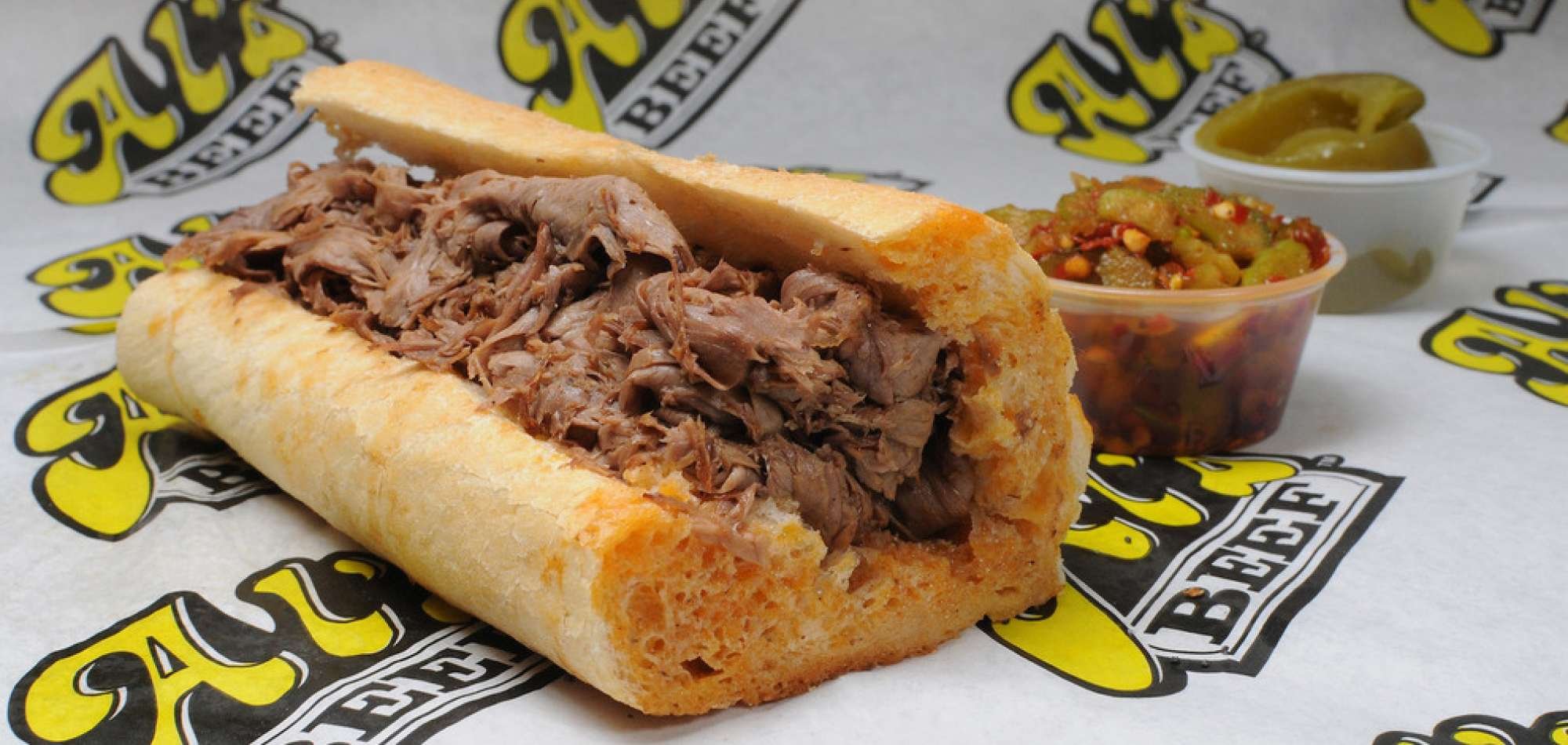
The menu
What to order
- Italian Beef Sandwich
- Italian Beef-Sausage Combo
West Taylor Street and the Logic of the Beef Sandwich
There is a particular kind of Chicago eating that operates entirely outside the register of tasting menus and reservation queues. It runs on counter service, wax paper, and a menu short enough to read in under ten seconds. At 1079 W Taylor St, in the stretch of Little Italy that has fed the city's Italian-American community for over a century, Al's #1 Italian Beef sits inside that tradition with the confidence of an institution that has never needed to reinvent itself. The sandwich it serves — thinly sliced seasoned beef, packed into Italian bread and dunked in cooking juices — is not a variation on a theme. It is the theme, repeated with minimal deviation since 1938.
Chicago's dining scene has expanded dramatically in recent decades. The city now holds multiple Michelin-starred restaurants across price brackets: tasting-menu destinations like Alinea, Smyth, and Oriole have placed Chicago in the same conversation as New York or San Francisco for ambitious progressive cooking. Kasama and Next Restaurant extend that range further. None of that has any bearing on Al's. It occupies a completely separate tier, not a lesser one, a different one, where the metric is not technique or innovation but fidelity to a specific local product.
What the Menu Architecture Says
The menu at Al's is structured in a way that reveals the priorities of the operation immediately. The Italian beef sandwich is the anchor, and virtually every ordering decision the customer makes is a variation on how they want that sandwich delivered. The key variable is wetness: the sandwich can be ordered dry, wet, or dipped, the last option meaning the entire assembled roll is submerged briefly in the beef au jus before serving. Giardiniera, the Chicago-style pickled vegetable relish spiked with sport peppers and celery, is the condiment of record. Sweet peppers offer a milder alternative.
This is not a menu that hedges. There are no build-your-own permutations designed to appeal to the widest possible audience, no seasonal additions meant to signal culinary ambition. The structure says: we make one thing, these are the only decisions that matter, make yours. That kind of menu discipline is, in its own way, harder to maintain than a rotating tasting format, it offers no cover for inconsistency and nowhere to hide behind novelty. The places that sustain it longest tend to become reference points for a dish rather than just practitioners of it.
The Italian beef as a category has specific Chicago roots. Unlike the beef sandwiches found in other American cities, the Chicago version is defined by the dipping technique and by the giardiniera, which provides the acid and heat contrast the rich braising liquid requires. The bread, a sturdy Italian roll engineered to absorb juice without immediate collapse, is as technically important as the beef itself. A dipped sandwich that falls apart is a failure of either bread or timing. These are the constraints the format has always operated within, and they are what give the sandwich its character.
Little Italy and the Neighbourhood Frame
West Taylor Street's culinary identity has shifted considerably since Al's opened in 1938. The block still carries Italian-American lineage, in its bakeries, its older family restaurants, its Catholic institutions, but it now sits adjacent to the University of Illinois at Chicago campus, which brings a younger, more varied daily population through the corridor. The neighbourhood is a useful reminder that Chicago's food geography is not evenly distributed: the concentrations of Michelin-level ambition in the West Loop and River North exist about two miles northeast, operating in an entirely different economic and social register.
Al's relationship to that geography is instructive. It is not positioned as a contrast to fine dining, it predates the current fine-dining moment by decades. It was already a neighbourhood fixture before Le Bernardin in New York, The French Laundry in Napa, or Lazy Bear in San Francisco had any presence in the American dining conversation. Its longevity is a function of product consistency and local loyalty, not of trend cycles or critical attention.
How to Approach a First Visit
Al's operates as a counter-service establishment. There is no reservation, no dress consideration, and no pacing structure beyond the queue. The ordering logic rewards knowing what you want before you reach the counter: size, wet or dry, with or without giardiniera. First-time visitors who are calibrating their tolerance for heat should note that the hot giardiniera at Al's is genuinely assertive, the sport peppers carry real capsaicin load, not decorative warmth. Sweet peppers offer the structural function without the heat.
West Taylor Street is accessible by the CTA Pink Line (Polk station is within walking distance) and has street parking availability that varies by time of day. The lunch window tends to be the highest-traffic period. Al's draws a cross-section that spans construction workers, university faculty, tourists navigating Chicago's food history, and residents who have been eating there for thirty or forty years, a demographic mix that itself reflects the sandwich's position as a civic rather than purely neighbourhood institution.
For visitors using Al's as a reference point within a broader Chicago food itinerary, the Taylor Street location provides useful contrast to the city's more ambitious dining rooms. The same city that houses Alinea's multi-course progressive format and restaurants drawing comparisons to Blue Hill at Stone Barns, Addison, Providence, Atomix, Frasca Food & Wine, SingleThread, The Inn at Little Washington, Emeril's, and Atelier Moessmer Norbert Niederkofler in terms of cooking ambition also produced, and has sustained for eighty-six years, a beef sandwich served from a street-facing counter on a working-class residential block. That range is part of what Chicago's food identity actually looks like. Our full Chicago restaurants guide maps both ends of that spectrum.
Frequently asked questions
Where is Al's #1 Italian Beef located?
Al's #1 Italian Beef is located at 1079 W Taylor St, Chicago, IL 60607, Chicago.
How does Al's #1 Italian Beef fit into Chicago's broader Italian-American food history?
Al's opened in 1938 on West Taylor Street, placing it at the centre of what was then one of Chicago's most concentrated Italian-American neighbourhoods. The Italian beef sandwich itself is a Chicago-specific format, and Al's is among the longest-operating counters still serving it in the city. That continuity on the same block gives the venue a direct line to the sandwich's mid-20th-century origins in a way that newer operators in other neighbourhoods cannot claim.
What should I eat at Al's #1 Italian Beef?
The Italian beef sandwich is the point of the operation — thinly sliced seasoned beef on Italian bread, ordered wet (dipped in the cooking juices), dry, or somewhere between. A first visit calls for going wet with hot giardiniera, which is the combination that has defined the Taylor Street counter since 1938. Everything else on the menu exists around that anchor.
What's the best way to book Al's #1 Italian Beef?
There are no reservations at Al's. The operation runs as a walk-up counter at 1079 W Taylor St in Chicago's Little Italy, and the queue moves on foot traffic alone. Expect a line during lunch hours on weekdays and weekend afternoons; the counter format means turnover is fast.
What do critics highlight about Al's #1 Italian Beef?
Editorial attention consistently returns to two things: the longevity of the operation — open since 1938 on West Taylor Street — and the sandwich's role as a reference point for the Chicago Italian beef style citywide. Al's is frequently positioned as the standard against which other beef counters in the city are measured, a function of its unbroken presence in a neighbourhood that has changed considerably around it.
Where the Accolades Land
Comparable venues nearby, for context on price, style, and recognition.
| Venue | Cuisine | Price | Awards | Notes |
|---|---|---|---|---|
| Al's #1 Italian BeefThis venue — the venue you are viewing | Chicago Italian Beef | $10–20 | Not listed | Not listed |
| White Palace Grill | Classic American Diner | $10–20 | Diners, Drive-Ins and Dives Featured Restaurant | West Side |
| All Too Well | Gourmet Sandwiches & Deli | $20–30 | Not listed | Lincoln Park |
| DJ's Great Room | Elevated American Comfort Food | $30–50 | Not listed | River North |
| GEMINI | Classic American Bistro | $30–50 | Not listed | Lincoln Park |
| Valois Restaurant | Classic American Diner | $10–20 | Not listed | Hyde Park |

Details
- Well Known
- Lively
- Classic
- Casual Hangout
- Late Night
- Historic Building
- Standalone
- Beer Program
- A La Carte
Current opening hours
- Monday
- 9 AM–11 PM
- Tuesday
- 9 AM–11 PM
- Wednesday
- 9 AM–11 PM
- Thursday
- 9 AM–11 PM
- Friday
- 9 AM–11 PM
- Saturday
- 10 AM–11 PM
- Sunday
- Closed
Hours can change for holidays and private events. Last verified .
Casual fast-food atmosphere with a lively, no-frills vibe focused on quick service and hearty sandwiches.