Afghania
Our verdict
On a Georgetown block that has cycled through several dining identities, Afghania at 2811 M St NW holds a position that Afghan cuisine rarely occupies in the American capital: a sit-down address in a high-rent corridor, competing for attention alongside the city's broader Middle Eastern and contemporary dining tier. The kitchen draws on a culinary tradition that spans Central Asian, Persian, and South Asian influences, one of the more compositionally complex in the region.

Pearl is the En Primeur Club membership app, where members save venues, book tables and use the concierge.
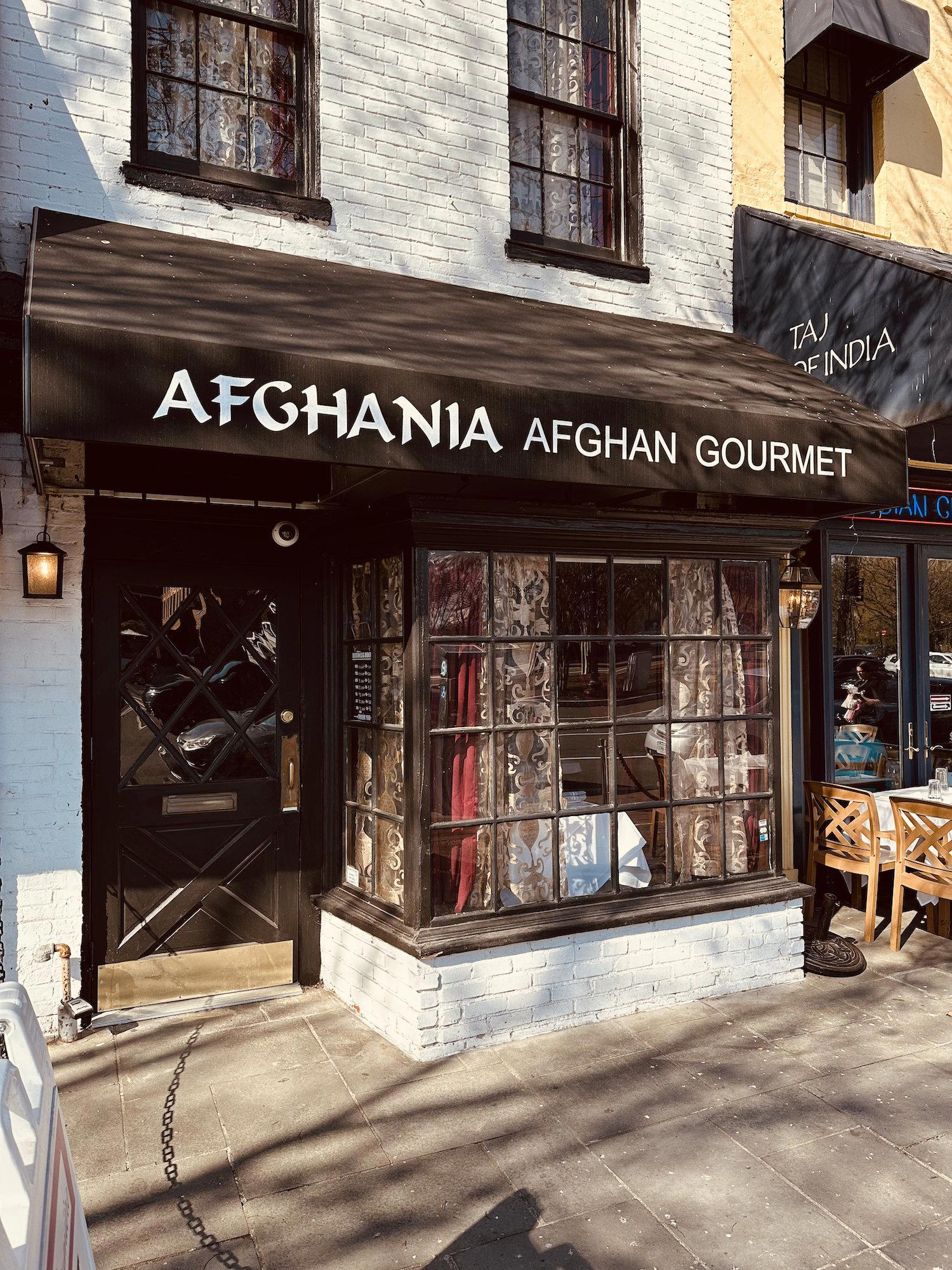
Georgetown's Afghan Table in a Shifting Dining District
M Street in Georgetown has never been a quiet address. The stretch between 28th and 29th runs through one of Washington's most commercially pressured corridors, where restaurant concepts turn over at a pace that keeps landlords busy and diners perpetually recalibrating. Against that backdrop, an Afghan restaurant at 2811 M St NW occupies a position that is, by the standards of the American dining market, genuinely unusual. Afghan cuisine remains one of the least represented traditions in the country's restaurant infrastructure, even as its source cuisine draws on centuries of exchange between Persian, Central Asian, Turkic, and South Asian cooking. In a city where the Middle Eastern dining tier has grown considerably Albi operates at the upper end of that bracket with a $$$$ price point, Afghania sits in that same general orbit while representing a culinary tradition that rarely gets its own dedicated address in American cities.
What Afghan Cuisine Actually Represents
The culinary geography that Afghan cooking draws from is worth understanding on its own terms before considering any individual restaurant. Afghanistan's position along the historic Silk Road routes meant that its kitchen absorbed spice logic from the subcontinent, rice technique from Persia, and meat preparation traditions from Central Asia. The result is a cuisine built around pilaf-style rice dishes like qabuli palaw, slow-braised lamb, charcoal-grilled meats, and yogurt-based preparations that carry both tangy and aromatic registers simultaneously. Flatbreads, dried fruits, and nuts appear as structural elements rather than garnishes. It is a tradition that rewards patience, both in the kitchen, where braises and spice blooms take time, and at the table, where the flavors read as layered rather than immediate.
In Washington, the broader Middle Eastern and South Asian dining scene has matured considerably over the past decade. The city's Dupont Circle and Adams Morgan neighborhoods carry significant Afghan and Persian community dining infrastructure, largely in casual formats. What makes a Georgetown address notable is the context shift: M Street rent structures push operators toward either high-volume casual or full-service formats with substantive check averages. Afghania's presence in that corridor signals an attempt to position Afghan cooking within the city's more considered dining tier, rather than in the quick-service or strip-mall formats where the cuisine more commonly appears in American markets.
The Reinvention Question in D.C.'s Mid-Tier
Washington's mid-market restaurant sector has been reconfiguring since roughly 2018, when a wave of ambitious contemporary openings began pulling diner attention toward tasting menus and single-cuisine specialists. Venues like Oyster Oyster and Causa represent the specialist-format end of that shift, tight concepts with clearly defined culinary identities operating at $$$-$$$$ price points. At the upper end, destination formats like Jônt and minibar anchor D.C.'s case for inclusion in serious American fine dining conversations. Afghan restaurants have not historically participated in either of those movements. The evolution question for a venue like Afghania is whether the Georgetown address and the cuisine itself can hold ground as diner expectations in the corridor shift toward more format-conscious experiences.
That evolution context matters because Georgetown has historically rewarded restaurants that anchor themselves in a specific culinary identity rather than chasing broader trend cycles. The neighborhood's demographics skew toward well-traveled, internationally aware diners who engage with non-European culinary traditions on their own terms, a different audience than the expense-account market that dominates downtown or the avant-garde community that migrates toward Shaw and NoMa.
Afghan Cooking in the American Context
The broader American moment for Central Asian and Middle Eastern cuisines has been building steadily. Persian, Levantine, and Yemeni restaurants have each found moments of wider critical attention over the past five years, with food media increasingly framing these traditions as underexplored rather than niche. Afghan cooking has been slower to enter that conversation at the restaurant level, partly because diaspora communities in the U.S. have concentrated it in community-facing formats rather than destination dining. When venues do attempt to bring it into higher-exposure corridors, the comparison set is thin by definition. That scarcity cuts two ways: there is no dense local competition in the sub-category, but there is also no established critical framework in the city for how Afghan food at this address tier should be assessed.
For broader reference on how other American cities have handled the elevation of underrepresented culinary traditions into serious dining formats, the national picture includes venues like Providence in Los Angeles, Smyth in Chicago, and Lazy Bear in San Francisco, all of which built sustained reputations by committing to a specific culinary point of view rather than hedging toward the mainstream. The model is applicable regardless of cuisine: clarity of identity tends to outperform range in the current American dining market.
Planning Your Visit to Afghania
Afghania is located at 2811 M St NW in Georgetown, placing it within walking distance of the neighborhood's main commercial and residential density. Georgetown's dining scene concentrates along M Street and Wisconsin Avenue, with parking limited enough that arriving by rideshare or Metro connection via the Foggy Bottom station is practical for most visitors. Georgetown restaurants at this address tier typically operate with full table service; walk-in availability varies by day and time of week. For a broader view of where Afghania sits within Washington's dining options, EP Club's full Washington, D.C. restaurants guide maps the city's key addresses across price tiers and cuisine types. Comparable Mid-Atlantic fine dining context is available through The Inn at Little Washington, which represents the region's most decorated format. Nationally, Le Bernardin in New York City, The French Laundry in Napa, Blue Hill at Stone Barns in Tarrytown, Single Thread Farm in Healdsburg, Addison in San Diego, Emeril's in New Orleans, Atomix in New York City, and Atelier Moessmer Norbert Niederkofler in Brunico collectively illustrate the range of formats that have built durable reputations by staying tightly defined in their culinary identity, the same discipline that will determine Afghania's long-term place in Georgetown's competitive dining tier.
Frequently asked questions
Where is Afghania located?
Afghania is located at 2811 M St NW, Washington, DC 20007, Washington, D.C.
Is Afghania one of the few Afghan restaurants in Washington D.C.?
Afghan dining in Washington D.C. occupies a narrow slice of the city's broader Central Asian and Middle Eastern restaurant scene, which has been expanding steadily since the late 2010s. Afghania's position on M Street in Georgetown places it in a commercially dense neighborhood where Central Asian kitchens remain scarce relative to Levantine and Persian options. That relative scarcity means it draws diners specifically seeking Afghan cooking rather than competing within a crowded sub-category.
What dish is Afghania famous for?
Afghan cooking in general centers on slow-braised meats, rice preparations like qabuli pulao, and flatbreads, categories that form the backbone of most serious Afghan menus in the United States. Visiting with that framework in mind gives the best read on what the kitchen prioritizes.
Do I need a reservation for Afghania?
Georgetown's M Street corridor draws consistent foot traffic, particularly on weekends, so arriving early or calling ahead directly tends to be the safer approach for any mid-block dining room on that stretch.
A Lean Comparison
Comparable venues nearby, for context on price, style, and recognition.
| Venue | Cuisine | Price | Notes |
|---|---|---|---|
| AfghaniaThis venue (the venue you are viewing) | Authentic Afghan Frontier | $30–50 | Not listed |
| Darvish Kitchen | Authentic Persian | Not listed | Dupont Circle, Authentic Persian |
| Otto Mediterranean | Modern Mediterranean with Turkish Influences | $20–30 | Georgetown, Modern Mediterranean with Turkish Influences |
| Chaia | Vegetarian Tacos | $10–20 | West Village Georgetown, Vegetarian Tacos |
| Floriana | Northern Italian Handmade Pasta | $50–100 | Dupont Circle, Northern Italian Handmade Pasta |
| NaanWise Indian Cuisine | Authentic Indian Cuisine | $20–30 | Woodley Park, Authentic Indian Cuisine |