Our verdict
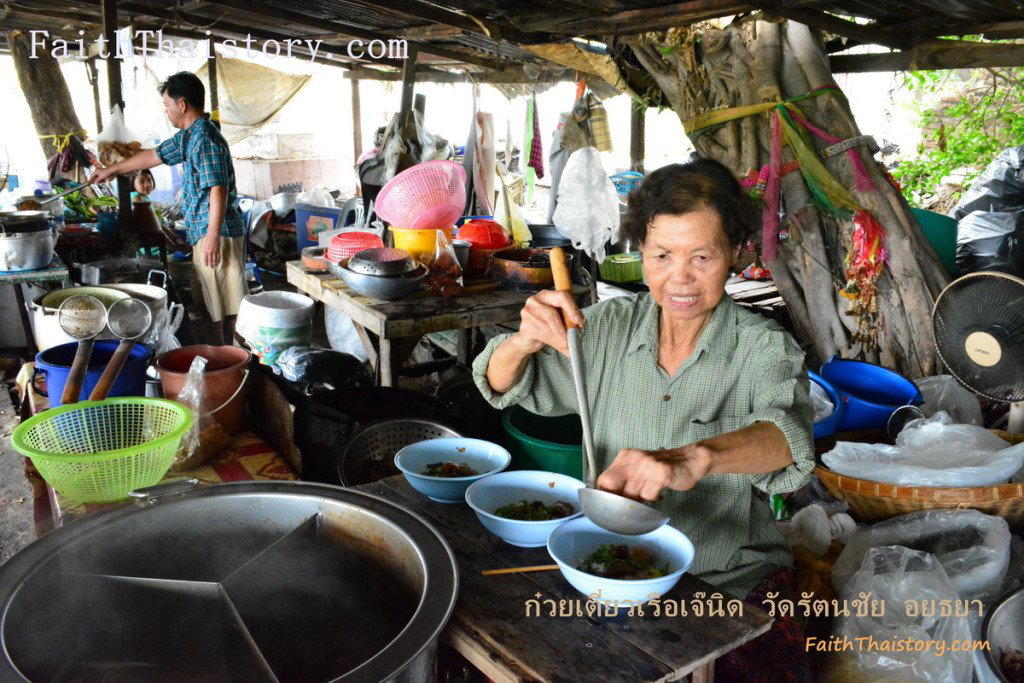
In Ayutthaya, boat noodles are less a menu item than a civic institution, and Jeh Nid's version draws locals and temple-circuit visitors alike to a format that has changed little in decades. The bowls are small, the broth is dark and layered, and the expectation is that you order multiple rounds. A practical, honest stop for anyone serious about central Thai street cooking.

Pearl is the En Primeur Club membership app, where members save venues, book tables and use the concierge.
The menu
What to order
- ก๋วยเตี๋ยวเรือหมูต้มยำ
- ก๋วยเตี๋ยวเรือเนื้อ
Boat Noodles in Ayutthaya: A Format Built on the River
The boat noodle, or kuay tiew reua, arrived in Thailand's central plains during the mid-twentieth century, sold from vessels that moved along the canals threading through the old capital. The format was practical: small bowls, concentrated broth, quick turnover. Vendors ladled portions from pots kept warm over charcoal, and customers flagged them down from the bank. Ayutthaya, sitting at the confluence of three rivers and carrying centuries of trade infrastructure, was a natural home for this tradition. The canal-side stalls that replaced those boats kept the logic intact, dense, iron-rich broth in palm-sized portions, designed to be ordered in multiples rather than as a single large serving.
Jeh Nid operates inside that tradition. The name, a common Thai nickname denoting an older sister or familiar market figure, signals the register immediately: this is neighbourhood food, priced for regulars, with a format that assumes the diner understands the game. You order two bowls, then four, then reassess. The broth does the work. For visitors arriving from Bangkok's higher-end Thai dining circuit, the ฿฿฿฿ tier that includes places like Sorn in Bangkok, the contrast is instructive. Both ends of the spectrum take Thai ingredients seriously; they simply operate at different scales of formality and price.
The Sourcing Logic Behind Central Thai Broth
What gives kuay tiew reua its character is the broth construction, which in the central Thai tradition draws on pork blood, fermented bean curd, and a spice base that typically includes cinnamon, star anise, and dried chillies. The result is a liquid that reads as simultaneously sweet, saline, and faintly medicinal, a profile that comes from slow reduction and layered seasoning rather than from any single premium ingredient. This is not the ingredient-as-hero approach you find at farm-to-table operations like PRU in Phuket, where provenance documentation drives the menu narrative. Here, provenance operates at the level of recipe continuity: the same spice ratios, the same base technique, passed through market-cooking culture over generations.
The noodle itself is typically thin rice or glass, kept separate from the broth until the moment of service. Toppings in the central Thai boat noodle format generally include braised pork, meatballs, and fried garlic, each element functioning as a textural counterpoint to the liquid's intensity. The bean sprout garnish, added raw, provides crunch and cuts the richness. Central Thai cooking at this level is a compression exercise: maximum flavour in minimum volume, which is why the small-bowl format exists in the first place.
For a useful regional comparison within Thailand's street-food breadth, Cherng Doi Roast Chicken in Chiang Mai and Loet Rot in Mueang Chiang Mai both demonstrate how northern Thai cooking applies similar discipline to entirely different ingredient sets. The throughline is the same: regional technique, applied consistently, producing results that Bangkok's fine-dining tier frequently tries to reference or reconstruct.
Ayutthaya as a Dining Context
Ayutthaya sits roughly 80 kilometres north of Bangkok, accessible by train or road in under two hours, and most visitors arrive to see the UNESCO-listed ruins of the former Siamese capital. The food infrastructure around the old city reflects a population that eats at markets and canal-side stalls rather than destination restaurants. There is no Michelin presence in Ayutthaya; the city operates outside the award tier entirely. That absence does not indicate a lack of quality, it reflects a category mismatch. The Michelin model, as applied in Thailand, concentrates on Bangkok and Phuket, and the evaluative criteria it applies do not map cleanly onto a canal-side noodle stall that closes when the pot runs out.
For visitors building an Ayutthaya day around food, the practical reality is that the leading eating tends to happen at midday, when market stalls are fully operational and produce is at its freshest from the morning's supply. The boat noodle format is particularly suited to this window: the broth has had time to develop, and the lunch rush at a well-established stall signals freshness through volume alone, high turnover means nothing sits. Those planning a broader central Thailand eating itinerary should also consider AKKEE in Pak Kret, which operates in a comparable register of serious regional cooking north of Bangkok.
Our full Ayutthaya restaurants guide covers the broader eating picture across the city, from riverside spots to market-adjacent stalls. For those comparing Thailand's street-food traditions to other provincial cooking cultures in Southeast Asia, Krua Laew Tae R-Rom in Pattaya and Hoy Tord Chao Lay in Bangkok offer further reference points in the category of cooking that prioritises technique and repetition over plating and presentation.
Planning a Visit
Midday visits align with peak freshness and the highest certainty of availability. The boat noodle format is inherently low-cost, historically a few baht per bowl, which places it well outside the price tier of Bangkok's contemporary Thai fine-dining scene and into a category where the barrier to entry is proximity, not budget. Families eat here; solo travellers eat here; the format is democratic by design. Street food at this price level in central Thailand is also well-suited to travellers with children, since the flavour profile of a mild boat noodle bowl is adjustable by the diner through the table condiments, dried chilli, fish sauce, sugar, and vinegar, that accompany every order as standard.
Those arriving in Ayutthaya with a broader appetite for Thai cooking traditions would benefit from cross-referencing other regional cooking styles in the EP Club network: Khok Kloi Bami Tom Yam Khai in Takua Thung represents the southern Thai take on noodle-soup traditions, while Little Edo Suratthani in Mueang Surat Thani illustrates how Japanese-Thai crossover operates in a provincial context far from Bangkok's international dining nodes. For those who want to understand the full spectrum of what Thai cooking looks like when sourcing and technique are applied at the luxury end, Benz Restaurant at Soneva Kiri in Koh Kood and the ingredient-driven philosophy at PRU in Phuket provide the counterpoint.
Frequently asked questions
Does ก๋วยเตี๋ยวเรือ เจ๊นิด work for a family meal?
The market-stall format at Jeh Nid in Ayutthaya suits families comfortable with informal, communal dining. Boat noodles are served in small bowls, which makes it easy to order multiple rounds and sample across the table. There are no reservations or set menus to contend with, so the pace is entirely self-directed.
What kind of setting is ก๋วยเตี๋ยวเรือ เจ๊นิด?
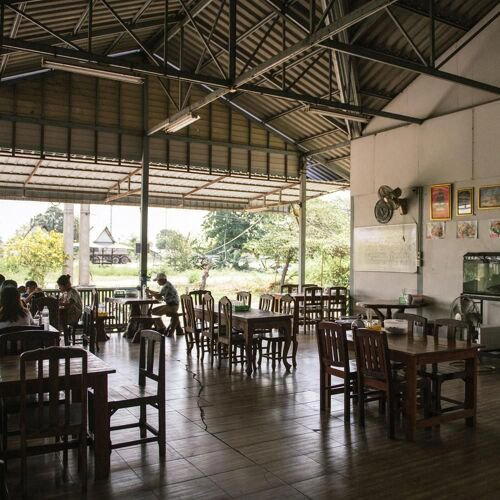
Jeh Nid operates as a market-format stall, the same category as the original canal-side boat noodle vendors that worked the central Thai waterways from the mid-twentieth century onward. Expect open-air or semi-covered seating, minimal décor, and a focus on throughput rather than atmosphere. Ayutthaya's street-food scene runs on this model broadly, and Jeh Nid fits squarely within it.
How does Jeh Nid fit into an Ayutthaya day trip from Bangkok?
Ayutthaya sits roughly 80 kilometres north of Bangkok, reachable by train or road in under two hours, making Jeh Nid a practical stop alongside the city's UNESCO-listed temple ruins. Most visitors move through the historic sites in a half-day, leaving time for a midday or early-afternoon meal at a market stall like this one.
What's the signature dish at ก๋วยเตี๋ยวเรือ เจ๊นิด?
Kuay tiew reua, the boat noodle, is the defining dish here. In the central Thai tradition, the broth is built on pork blood and fermented bean curd, giving it a depth and iron-edged richness that separates it from simpler noodle soups. Bowls are intentionally small, following the format of the original riverboat stalls where space dictated portion size.
Where do I go for ก๋วยเตี๋ยวเรือ เจ๊นิด?
ก๋วยเตี๋ยวเรือ เจ๊นิด is located at อยุธยา, Ayutthaya.
Quick Comparison
| Venue | Cuisine | Price | Awards | Notes |
|---|---|---|---|---|
| ก๋วยเตี๋ยวเรือ เจ๊นิดThis venue (the venue you are viewing) | ก๋วยเตี๋ยวเรือแบบดั้งเดิม | $1–10 | Not listed | Not listed |
| Sorn | Fine Southern Thai | $200–300 | 3 Michelin Stars · World's 50 Best #12 | Southern Thai, ฿฿฿฿ |
| Baan Tepa | Creative Thai Fine Dining | $150–200 | 2 Michelin Stars · World's 50 Best #53 | Thai contemporary, ฿฿฿฿ |
| Côte by Mauro Colagreco | Riviera Mediterranean Fine Dining | $200–300 | 2 Michelin Stars · World's 50 Best #91 | Mediterranean, Modern Cuisine, ฿฿฿฿ |
| Gaa | Modern Indian Fine Dining with Thai Influences | $150–200 | 2 Michelin Stars · World's 50 Best #95 | Modern Indian, Indian, ฿฿฿฿ |
| Sühring | Modern German Fine Dining | $200–300 | 3 Michelin Stars · World's 50 Best #18 | German, ฿฿฿฿ |
Continue exploring
More in Ayutthaya
Details
- Rustic
- Classic
- Casual Hangout
- Waterfront
- Historic Building
- Waterfront
- A La Carte
บรรยากาศผ่อนคลายแบบชาวบ้านริมแม่น้ำป่าสัก คลาสสิกติดแพริมน้ำ