삼보식당
삼보식당 sits on 중정로 in the heart of 서귀포시, representing the kind of neighbourhood restaurant that anchors daily life in Jeju's southern port city. The address places it within walking distance of the old market district, where local diners outnumber tourists and the rhythm of the meal follows Jeju convention rather than visitor expectation. Details on menu and hours are best confirmed on arrival or through local inquiry.
 Discover on Pearl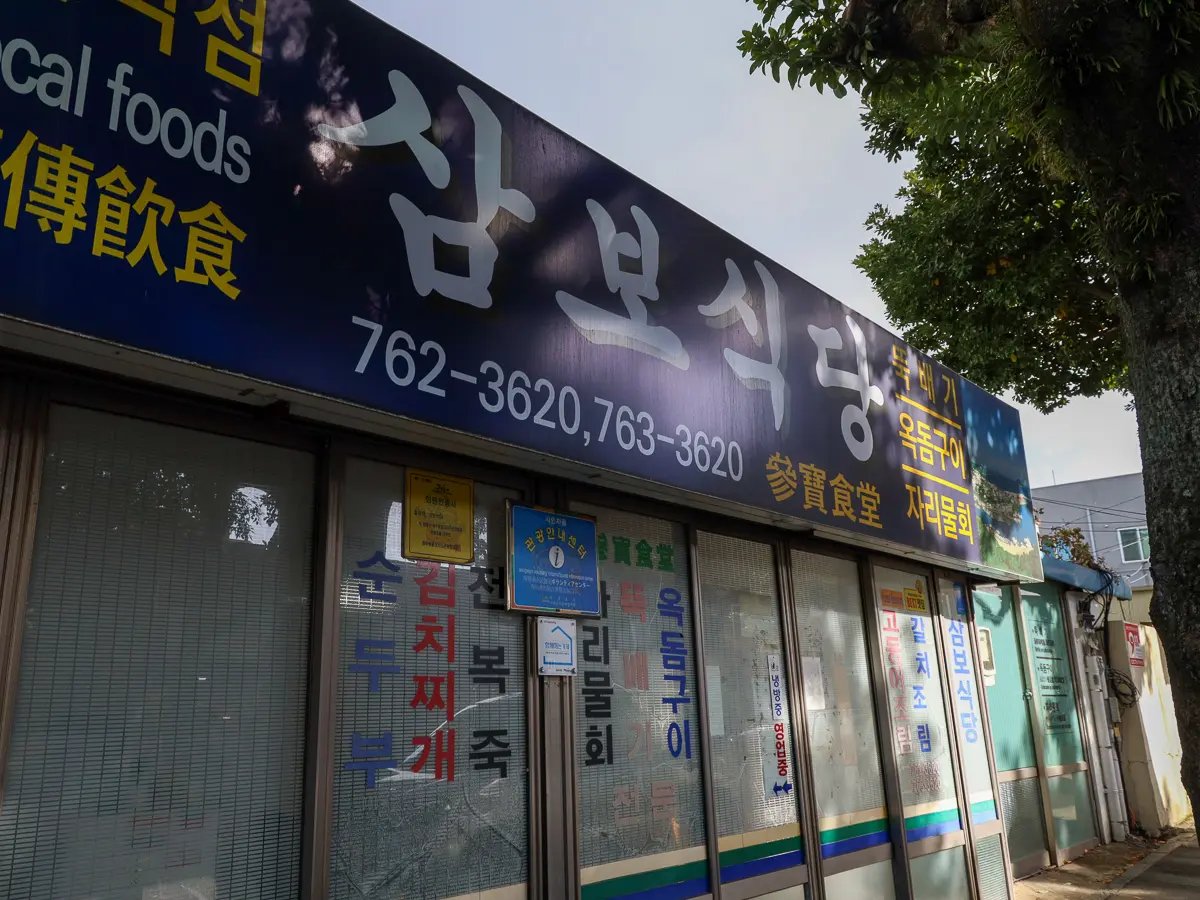
The Rhythm of Eating in 서귀포시
In 서귀포시, the southern port city that most Jeju visitors pass through rather than linger in, the restaurants that matter most to residents rarely advertise. They operate on the logic of the neighbourhood: a fixed address, a regular clientele, and a menu shaped by what the island produces rather than what menus elsewhere are doing. 삼보식당, at 중정로 25, sits inside that tradition. The street itself runs through one of the older commercial stretches of 서귀포시, a few blocks from the waterfront markets where haenyeo divers have sold catch since before tourism became the island's primary industry.
This context matters because it frames the kind of meal 삼보식당 likely offers. Jeju's local restaurant culture divides broadly into two registers: the places that have packaged island identity for visitors (black pork, abalone, citrus-inflected banchan arranged for the camera) and the places that have simply kept serving the food that sustained the neighbourhood. The address on 중정로 places 삼보식당 closer to the latter category, in a part of the city where foot traffic is local and lunch service tends to be the primary event of the day.
The shortlist, unlocked.
Hard-to-book tables, cellar releases, and concierge-planned trips.
Get Exclusive Access →How a Meal Works Here
Korean dining ritual, particularly at the neighbourhood restaurant scale, carries a logic that visitors from outside the peninsula sometimes misread as informality. It is not informal — it is a different kind of formality, one organised around communal pacing rather than individual sequencing. At a place like 삼보식당, the meal likely arrives largely at once: a main dish surrounded by banchan, the small plates of fermented, pickled, and seasoned accompaniments that are not sides in the Western sense but structural elements of the meal. You do not order the banchan. They arrive as a matter of course, and at a neighbourhood restaurant they tend to reflect what is seasonal and what the kitchen has prepared that morning.
The pacing that follows is unhurried by design. In 서귀포시's older dining culture, a meal is not a transaction with a defined endpoint — it is a session. Rice and soup anchor the table; banchan are replenished if you are a regular or ask; and the expectation is that you eat through the meal in a way that is attentive to the food rather than to the clock. For visitors more accustomed to the timed omakase format of somewhere like Atomix in New York City, or the formal progression of a restaurant like Le Bernardin, this lack of imposed sequence can feel disorienting at first. It is, in fact, its own discipline.
Jeju's island geography inflects what appears on neighbourhood tables. Seafood is present in ways it would not be in inland Korean cities , not as a premium category requiring separate ordering, but as a baseline ingredient in broths, in banchan, in the anchovy stocks that underpin many sauces. The island's agricultural output, particularly its citrus and root vegetables, tends to show up in seasonal preparations. At the neighbourhood restaurant level, this is not a curated expression of terroir; it is simply what is available and what cooks have always used.
서귀포시 in the Wider Jeju Dining Picture
Jeju's dining reputation has shifted considerably over the past decade. The island now hosts a range of formats that would have seemed improbable fifteen years ago, from the cocktail-forward design of Badang Lounge in Jeju to serious Korean barbecue operations like 88돼지 in 제주시 and Black Pork BBQ in Seogwipo. The island has also attracted visitors who approach it as a food destination in the way they might approach a city, drawing comparisons to the kind of regional Korean cooking that fine-dining venues in Seoul, such as Mingles, have brought to international attention.
서귀포시 itself sits slightly outside the main tourist circuit, which concentrates further north and east. That position makes it more representative of the island's everyday food culture. The old market area near 중정로 has the kind of infrastructure , dried goods sellers, produce vendors, small teahouses , that supports a different kind of dining economy than the resort zones. Restaurants here compete for local regulars, not passing visitors, which tends to produce more consistent cooking and less menu engineering. The same principle holds in other regional Korean cities: in Busan, neighbourhood restaurants around older residential districts operate on comparable logic, as seen at places like Mori in Busan and the more casual formats represented by Dining Room (다이닝룸) in 부산광역시.
Elsewhere in 서귀포시, comparable neighbourhood formats include Hinode (히노데), 국수바다, and 오는정김밥, each of which operates within the same local-first dining culture. For a broader map of where these restaurants sit in the city's food geography, the full 서귀포시 restaurants guide provides useful orientation.
The pattern repeats across Korean regional cities. In Gyeongju, neighbourhood staples like Gyeongju Wonjo Kongguk (경주원조콩국) in 경주시 and Hwangnam Bread and Busan Steamed Bun in Gyeongju demonstrate how local eating culture persists alongside tourism infrastructure without necessarily serving it. In Suwon, restaurants like Gobojeong Galbi #1 (가보정 1관) in 수원시 and Doosoogobang in Suwon follow the same model. In Inje County, Injegol and in Incheon, Market Café each anchor their own versions of regional eating.
Planning a Visit
삼보식당's address at 중정로 25, 서귀포시, 제주특별자치도 63592 places it in the central commercial area of the city, reachable on foot from 서귀포 bus terminal or by taxi from the main tourist areas near 천지연 waterfall. Because the restaurant has no listed website or phone number in available records, the most reliable approach is to visit directly, ideally at lunchtime, when neighbourhood restaurants of this type typically run their main service. Arriving outside peak local lunch hours , roughly 12:00 to 13:30 , improves the chance of a table without a wait. Prices at restaurants of this category in 서귀포시 typically fall in the range that makes solo dining practical, with a full set meal often available for under 15,000 KRW, though this should be confirmed on arrival.
The shortlist, unlocked.
Hard-to-book tables, cellar releases, and concierge-planned trips.
Get Exclusive Access →Frequently Asked Questions
What It’s Closest To
A quick look at comparable venues, using the data we have on file.
| Venue | Cuisine | Awards | Notes |
|---|---|---|---|
| 삼보식당 | This venue | ||
| Hinode (히노데) | |||
| 국수바다 | |||
| 오는정김밥 |
Need a table?
Our members enjoy priority alerts and concierge-led booking support for the world's most difficult tables.
Get Exclusive AccessThe shortlist, unlocked.
Hard-to-book tables, cellar releases, and concierge-planned trips.
Get Exclusive Access →