Google: 4.5 · 7,812 reviews
11th Street Diner
A genuine 1948 Kullman diner car anchored to Washington Avenue, 11th Street Diner occupies a distinct position in Miami Beach's dining scene: American diner format inside authentic mid-century architecture, open around the clock in a neighbourhood where most kitchens close by midnight. For visitors oriented around South Beach's late-night rhythms, the address functions as both a meal and a period-correct piece of the city's built history.
 Discover on Pearl
Pearl is the En Primeur Club membership app — saves, bookings, and concierge access live there. Same editors, same standards.
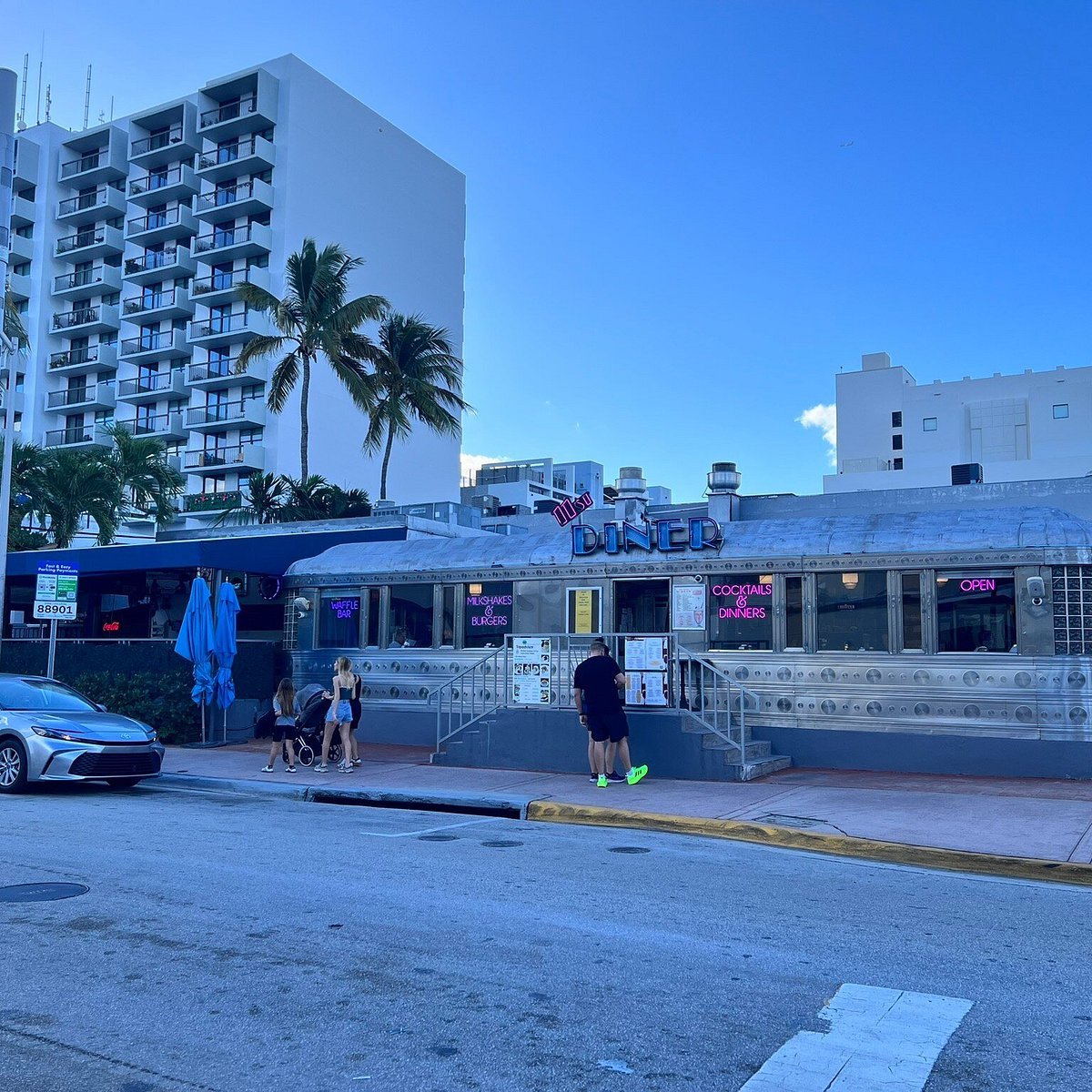
A Diner Car on Washington Avenue
Most American cities have lost their original diner cars to demolition or relocation, leaving only reproductions built to evoke a period that the structures themselves no longer represent. Miami Beach is an exception. The 1948 Kullman diner car at 1065 Washington Ave was transported from Wilkes-Barre, Pennsylvania, and reinstalled on South Beach in 1992, making it one of the few working examples of that manufacturing era still operating in its intended commercial capacity. The steel-clad exterior, rounded corners, and row of porthole windows belong to a specific postwar American industrial vocabulary that no contemporary fit-out can replicate. Approaching from Washington Avenue, the car reads as a period object before it reads as a restaurant.
Inside, the spatial logic follows the original Kullman configuration: a continuous counter with stools running the length of the car, a narrow service aisle, and booth seating compressed into the remaining width. The proportions are tight by design. Kullman cars were engineered for efficiency, not comfort, and the current interior preserves that arithmetic. Chrome fixtures, a tiled floor, and the refined service counter all belong to the original structure rather than to a later renovation. For the editorial category of designed environments, this matters: the space has authentic provenance, not period styling applied after the fact. Compare it to the broader South Beach dining room tendency toward large, high-ceilinged rooms designed for visual spectacle, and the diner car operates in an entirely different register, one defined by compression, utility, and genuine age.
Washington Avenue in Context
Washington Avenue runs parallel to and one block west of Ocean Drive, and the two streets attract different commercial activity. Ocean Drive concentrates tourist-oriented restaurants with outdoor terraces, refined price points, and menus calibrated to visitors seeing the Art Deco strip for the first time. Washington Avenue has historically carried a less curated mix: convenience retail, late-night venues, and a handful of places that serve the neighbourhood rather than the postcard version of it. The 11th Street Diner sits at that intersection between local utility and genuine architectural significance, a combination that positions it differently from the seafood-forward, design-heavy rooms that dominate the South Beach dining conversation.
Miami Beach's dining scene at the higher end is represented by restaurants that draw comparison to destinations like Le Bernardin in New York City, Alinea in Chicago, or The French Laundry in Napa. The diner operates in a completely different tier and makes no claim to that peer set. Its relevance is architectural and cultural rather than gastronomic, and understanding that distinction is the starting point for assessing what it actually offers. For a fuller picture of where the diner sits within the broader South Beach offer, our full Miami Beach restaurants guide maps the range from this end of the market to its most ambitious rooms.
The American Diner Format in a Beach City
The diner as a format has a specific American geography: it concentrates in the Northeast and Mid-Atlantic, where Kullman, Mountain View, and Silk City manufactured cars from the 1930s through the 1970s. Florida is not diner territory in any traditional sense. The state's postwar growth came later and in forms shaped more by automobile culture and strip-mall development than by the rail-adjacent industrial patterns that produced diner culture in New Jersey or Pennsylvania. A working 1948 Kullman car on Miami Beach is therefore genuinely anomalous, not as a curiosity but as a piece of material culture that ended up far outside its region of origin.
The American diner's core format logic, counter service, all-day breakfast, short-order cooking, and extended or continuous hours, maps reasonably well onto a neighbourhood like South Beach, where the rhythms of the nightlife economy create demand for food at hours when most kitchens have closed. Places like Lazy Bear in San Francisco or Blue Hill at Stone Barns in Tarrytown represent the farm-to-table, tasting-menu pole of American dining. The 11th Street Diner represents the opposite pole: democratic access, minimal ceremony, and a format designed to feed people efficiently across the full clock. Neither pole is more legitimate than the other; they serve different needs.
Placing It Against South Beach Peers
Within Miami Beach specifically, the diner occupies a category that few other addresses share. Restaurants like A Fish Called Avalon, a'Riva, Alma Cubana, Amalia, and American Bistro each operate within specific cuisine categories and price tiers that position them as deliberate dining choices. The diner functions differently: it is a place people arrive at because of hour, proximity, or a specific appetite for the format, rather than because of a cuisine category they set out to find. That distinction, between destination dining and situational dining, shapes everything from menu expectations to the appropriate price frame.
The restaurant addresses that represent American fine dining at the level of Providence in Los Angeles, Addison in San Diego, Atomix in New York City, or The Inn at Little Washington share almost no formal characteristics with this address. What they share is the category of deliberately chosen dining experience, whereas the diner functions on a different logic entirely. Internationally, tightly formatted rooms like 8 1/2 Otto e Mezzo Bombana in Hong Kong or destination American addresses like Single Thread Farm in Healdsburg, Emeril's in New Orleans, or Blue Hill at Stone Barns represent how seriously American dining takes itself at the highest tier. The 11th Street Diner does not participate in that conversation, which is itself a form of positioning.
Planning Your Visit
The diner sits at 1065 Washington Avenue in South Beach, within walking distance of the main Art Deco hotel strip and the Ocean Drive tourist corridor. Washington Avenue is accessible on foot from most South Beach accommodation, and the address requires no reservation under the diner format. The physical constraints of the Kullman car mean seating capacity is limited by the original 1948 structure, so peak weekend hours after midnight can produce a queue. The extended hours, running well past the closing time of most surrounding restaurants, make it a practical option for late arrivals or post-event meals when the alternative is delivery or nothing at all. No booking system is listed in the venue record; walk-in is the standard access method.
At a Glance
A compact peer snapshot based on similar venues we track.
| Venue | Notes | Price |
|---|---|---|
| 11th Street Diner | This venue | |
| Las’ Lap | Afro-Caribbean lounge / cuisine | |
| Silverlake Bistro | ||
| Yue Chinese | Northern Chinese | |
| Bolivar Restaurant Bar Lounge | ||
| Avalon By Day |
Continue exploring
More in Miami Beach
Restaurants in Miami Beach
Browse all →
Bars in Miami Beach
Browse all →
At a Glance
- Classic
- Iconic
- Cozy
- Brunch
- Late Night
- Casual Hangout
- Historic Building
- Craft Cocktails
Retro Art Deco train car interior with chrome, booths, and 1960s nostalgic atmosphere.