Urcove Nanjing Zhongshan Mountain National Park occupies one of the most historically weighted addresses in eastern China, where the forested slopes of Purple Mountain have drawn emperors, scholars, and pilgrims for centuries. The property positions itself within a small tier of nature-immersed retreats that trade urban convenience for landscape access and architectural restraint. For travellers whose priority is proximity to the national park over city-centre density, it represents a considered alternative to Nanjing's downtown hotel stock.
 Discover on Pearl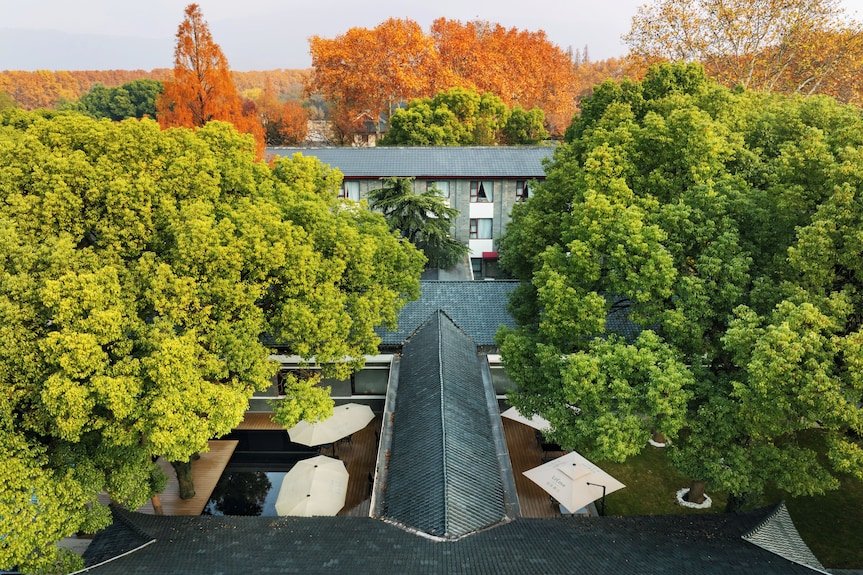
Architecture Inside a Protected Landscape
There is a particular discipline required to build within a national park that most hotel developers underestimate. Zhongshan Mountain National Scenic Area, known in Mandarin as Zhongshan Fengjingqu, sits on the eastern edge of Nanjing and encompasses the mausoleum of Sun Yat-sen, the Ming Xiaoling Mausoleum, and several thousand hectares of mixed deciduous forest. Any structure placed inside this boundary operates under strict preservation controls that limit scale, material palette, and visual intrusion. Urcove Nanjing Zhongshan Mountain National Park was built within those constraints, and the result is a property whose architectural character is defined at least as much by what it omits as by what it includes.
The broader category of park-integrated resorts in China has matured considerably over the past decade. Properties like Amanfayun in Hangzhou, set among tea plantations beside Lingyin Temple, established a template for low-density construction that defers to its natural and cultural surroundings rather than competing with them. Banyan Tree Ringha in applied a similar logic at higher altitude, using Tibetan architectural vernacular to anchor the property within its landscape. Urcove Nanjing belongs to this same broader movement, where the site itself is the primary asset and the built environment serves as a frame rather than a focal point.
Purple Mountain as Context, Not Backdrop
Zhongshan Mountain is not incidental scenery. The Ming Xiaoling Mausoleum, begun in 1381, is a UNESCO World Heritage Site and one of the most significant imperial funerary complexes in China. Sun Yat-sen Mausoleum, completed in 1929, draws millions of visitors annually and sits within walking distance of the park's forested interior trails. For a hotel positioned inside this geography, the monuments are not background colour: they are the primary reason any serious traveller would choose this location over a downtown address. Properties that understand this tend to structure their guest experience around park access timing, trail orientation, and seasonal foliage cycles rather than conventional hotel programming.
Autumn is the period most consistently rewarded at Zhongshan. The canopy of ginkgo and maple across the mountain slopes shifts in late October through November, and the crowds at the major mausoleums thin relative to the spring and summer peaks. Spring, particularly the weeks surrounding the Qingming Festival in early April, brings heavy domestic visitor traffic to the monument zones, which is worth factoring into any booking decision. Guests whose priority is access to the quieter forest trails rather than the main heritage sites will find the shoulder periods on either side of national holidays considerably more useful.
Where Urcove Sits in Nanjing's Accommodation Spectrum
Nanjing's premium hotel market clusters in two distinct zones. The first is the Xinjiekou and Gulou corridor, where international-brand city hotels serve corporate and transit travellers. The second, smaller tier consists of properties positioned for cultural and leisure visitors, particularly those with interests in the city's Ming-dynasty heritage, the Yangtze River waterfront, and the national park itself. Urcove Nanjing operates in that second category, which means its competitive set is not the business-class downtown tower but the smaller cohort of design-attentive properties that treat location specificity as a core product attribute.
For comparison within the broader Chinese landscape-resort category, properties like Conrad Jiuzhaigou and Jangala Dunhuang each built their identities around proximity to a protected natural or cultural site. In each case, the hotel's design posture — whether that means earth-toned materiality, low-rise massing, or landscape-integrated corridors — signals to the reader that the surrounding environment takes precedence over conventional luxury signifiers. Urcove Nanjing operates within a similar logic, and travellers who have stayed at properties in that peer set will arrive with calibrated expectations.
Nanjing as a city rewards travellers willing to look past its designation as a secondary stop between Shanghai and Beijing. The old city walls, among the longest surviving Ming-era fortifications anywhere in Asia, frame a city with genuine historical density. The Confucius Temple district along the Qinhuai River, the Nanjing Massacre Memorial, and the Presidential Palace each occupy different registers of the city's layered past. For visitors structuring more than two nights, the national park base makes sense as a counterpoint to the urban heritage circuit. Our full Nanjing guide maps the city's dining and accommodation options across both zones.
Planning Your Stay
Access to Zhongshan Mountain National Scenic Area from central Nanjing is manageable by Metro Line 2, which connects Xinjiekou to the Zhongshan Ling station near the main mausoleum entrance. The park's eastern and northern trail networks are less served by public transport, and guests prioritising trail access over monument visits will find private transfers or a vehicle more practical. Peak domestic holiday periods, particularly Golden Week in early October and the Qingming Festival week, compress availability across all Nanjing accommodation, and the national park zone is not exempt from that pressure. Booking well ahead of those windows is the standard practice.
For travellers comparing options across China's nature-adjacent hotel category before committing to Nanjing, the Honor Resort Yun Shu Dali and INTO Hotel Chibi represent regional alternatives within the same design-led, landscape-immersive tier. Within Nanjing itself, New Jingli Hotel offers a downtown alternative for travellers who prefer city-centre density with day-trip access to the park. Further afield in China's premium hotel category, Mandarin Oriental Qianmen in Beijing and Altira Macau illustrate how the urban end of the spectrum is structured, while Amandayan in Lijiang and Atlantis Sanya anchor the leisure resort end. For those considering American park-adjacent properties as a reference point, Amangiri in Canyon Point is the clearest structural analogue: a property whose architectural identity is built around and answerable to its protected landscape setting.
Frequently Asked Questions
- What is Urcove Nanjing Zhongshan Mountain National Park known for?
- The property is known primarily for its position inside Zhongshan Mountain National Scenic Area, which places guests within direct reach of the Ming Xiaoling UNESCO World Heritage Site and the Sun Yat-sen Mausoleum. In a city where most premium accommodation clusters downtown, the national park address is the defining characteristic. Travellers choosing this property are typically prioritising landscape access and heritage proximity over urban convenience.
- Is Urcove Nanjing Zhongshan Mountain National Park more low-key or high-energy?
- By the standards of Nanjing's hotel market, this is a low-key address. The national park setting imposes a quieter rhythm than anything in the Xinjiekou commercial district, and the monument zones that surround it attract reflective cultural visitors rather than nightlife or entertainment seekers. If the priority is proximity to the city's restaurant and bar scene, a downtown property would be more practical.
- What room should I choose at Urcove Nanjing Zhongshan Mountain National Park?
- Without confirmed room-category data in our records, specific room recommendations are not possible at this stage. As a general principle for park-integrated properties in this format, rooms oriented toward the forested slopes rather than any road-facing aspect tend to deliver the most consistent landscape connection. Checking directly with the property for current room configurations and seasonal availability is the advised approach.
- Can I walk in to Urcove Nanjing Zhongshan Mountain National Park?
- Walk-in availability at properties in this category, particularly those inside protected scenic areas with managed visitor numbers, tends to be limited during peak periods. Golden Week and the Qingming Festival window are the highest-pressure booking periods across all Nanjing accommodation. Given that specific booking and contact details for this property are not confirmed in our current records, reaching out through the property's official channels before arrival is the practical course.
- Is Urcove Nanjing Zhongshan Mountain National Park a good base for visiting Nanjing's Ming-dynasty heritage sites?
- For travellers specifically focused on Ming-dynasty Nanjing, the national park location is the most direct base available. The Ming Xiaoling Mausoleum and the Avenue of Stone Sculptures that leads to it are among the most complete surviving examples of imperial funerary architecture from the period, and both are within the park boundary. The old city walls, another key Ming-era structure, require a separate trip into central Nanjing, which is accessible via Metro Line 2.
Side-by-Side Snapshot
These are the closest comparables we have in our database for quick context.
| Venue | Cuisine | Price | Awards | Notes |
|---|---|---|---|---|
| Urcove Nanjing Zhongshan Mountain National Park | This venue | |||
| Amanfayun | ||||
| Banyan Tree Hangzhou | ||||
| Banyan Tree Macau | ||||
| Banyan Tree Sanya | ||||
| Conrad Guangzhou |
Preferential Rates?
Our members enjoy concierge-led booking support and priority upgrades at the world's finest hotels.
Get Exclusive Access