



Occupying the upper floors of a Nishi-Umeda high-rise, The Ritz-Carlton, Osaka holds a 2024 Michelin Key and a La Liste Top Hotels score of 94.5 points. The hotel's 291 rooms lean firmly into Old European grandeur, with Italian marble bathrooms and city or bay views, while four restaurants span Japanese, French, Italian, and Cantonese formats. From Kansai International Airport, the journey takes around 60 minutes by limousine bus.
 Discover on Pearl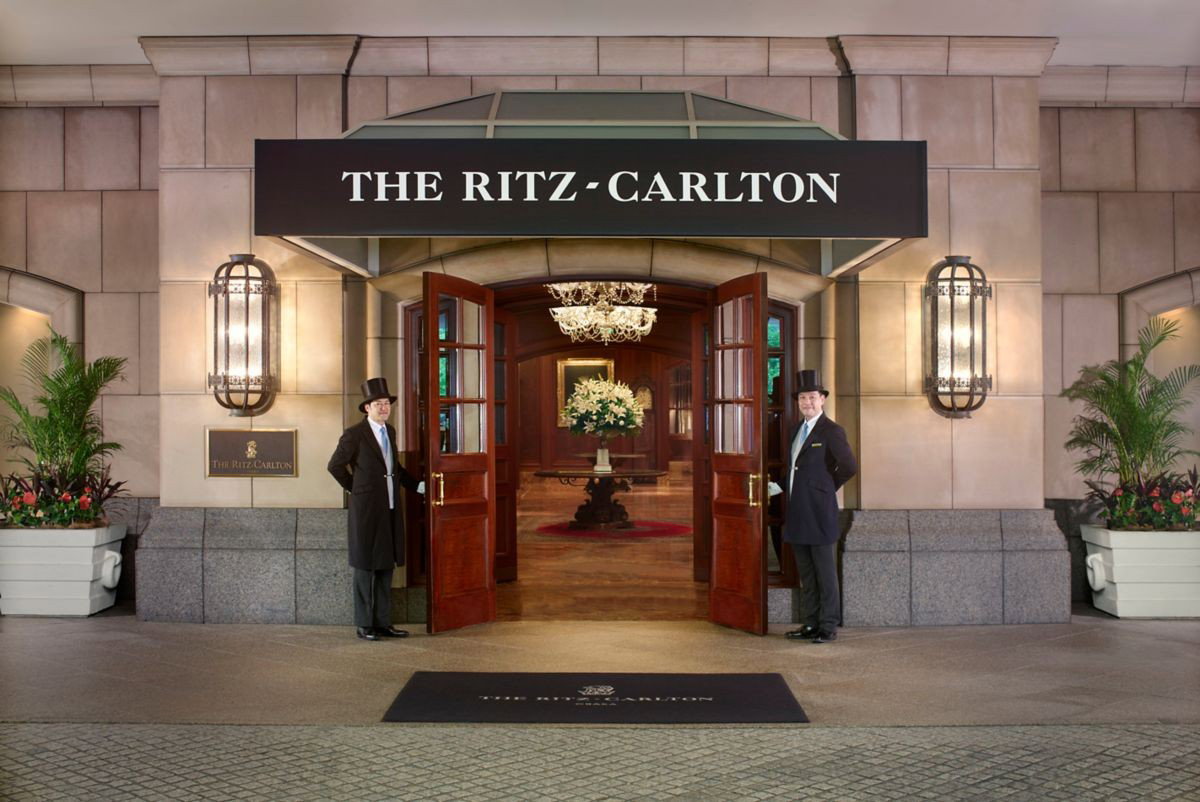
European Luxury, Osaka Address
Nishi-Umeda sits at the northern edge of Osaka's commercial spine, where department stores, office towers, and upscale dining blocks converge into one of the city's most concentrated pockets of corporate and leisure spending. The hotels here are not ryokan retreats or design-forward boutiques; they are full-service international properties with multi-restaurant programs and business-grade infrastructure. Within that peer group, which includes the Conrad Osaka, the InterContinental Osaka, and the W Osaka, The Ritz-Carlton occupies a specific position: resolutely classical, European in aesthetic register, and operating with a service philosophy shaped as much by brand heritage as by local hospitality convention.
The building itself offers no particular visual announcement. From the street, it reads as one more sleek high-rise in a district of sleek high-rises, its floors stacked above the retail and commercial base that Osaka's mixed-use towers routinely incorporate. The declaration comes once you step into the upper-floor lobby, where the aesthetic pivots hard toward Old World grandeur: formal furnishings, heavy drapery, and a spatial arrangement that communicates ceremony rather than the understated warmth that defines most Japanese luxury properties. If you arrive expecting the quiet linen-and-lacquer minimalism of somewhere like HOTEL THE MITSUI KYOTO or the sculptural integration of nature at Amanemu, this is a deliberate counterpoint.
What the Awards Confirm
Two independent assessments place The Ritz-Carlton, Osaka in its competitive tier with some precision. The 2024 Michelin Key designation groups the hotel with a cohort of Osaka properties that meet a consistent threshold of room quality, service reliability, and overall experience. Locally, the InterContinental Osaka, W Osaka, and Conrad Osaka share that Michelin Key status, suggesting the award marks a floor rather than a ceiling for this segment. La Liste's 2026 Leading Hotels score of 94.5 points adds a separate dimension: La Liste aggregates critical sources and guest sentiment rather than applying a single inspector's visit, so a score at that level across multiple inputs indicates sustained performance rather than a single strong season.
Room rates starting at $578 place the hotel at the upper tier of Osaka's international hotel market. That pricing reflects both the Ritz-Carlton brand premium and the property's positioning against similarly credentialed competitors. The The St. Regis Osaka occupies a comparable bracket, and the gap between these properties and the mid-market options in the same district, such as the Osaka Excel Hotel Tokyu, is substantial in both price and format.
The European Commitment and What It Means for Dining
The Ritz-Carlton, Osaka's dining program is a direct expression of the hotel's broader identity: multi-cuisine, internationally framed, and structured around four distinct restaurant formats covering Japanese, French, Italian, and Cantonese. This is a familiar architecture for large-footprint international hotels in Asia, where a diversified restaurant program serves business travelers, long-stay guests, and the local dining public simultaneously. The Japanese restaurant represents the concession to context, while the remaining three concepts maintain the European and pan-Asian cosmopolitan positioning that defines the Ritz-Carlton brand globally.
Framing the dining program through the lens of ingredient sourcing raises a question that luxury hotel restaurants in Japan navigate in different ways. Japan's domestic ingredient supply is among the most developed in the world for premium hospitality: Kobe beef from Hyogo Prefecture, Awaji Island produce from just offshore, Kyoto-grown vegetables with Protected Geographical Indication status, and seasonal seafood from Osaka Bay all sit within short supply distances from Nishi-Umeda. How a hotel restaurant program engages with that supply, rather than defaulting to imported European formats, tends to define whether it reads as genuinely rooted in place or as an internationally branded dining floor. The Japanese restaurant within the Ritz-Carlton's lineup is the natural conduit for that engagement; the French and Italian formats, operating within the hotel's Old Europe aesthetic commitment, would draw on different sourcing logic. The Cantonese option occupies a middle position: the Kansai region has a deep Cantonese dining presence, and ingredient sourcing for a Cantonese kitchen in Osaka can draw on many of the same high-quality local producers that Japanese cuisine uses.
Afternoon tea in the lobby is an established fixture at Ritz-Carlton properties globally and occupies a specific role at the Osaka hotel: it is the most explicitly non-Japanese ritual in the program, running counter to local tea culture in format if not in spirit. The hotel leans into it rather than apologizing for it, which is consistent with the brand's overall approach to maintaining its European identity regardless of geography.
291 Rooms, Two Orientations
With 291 rooms, The Ritz-Carlton, Osaka operates at a scale that is mid-sized by international luxury hotel standards but large enough to sustain the multi-outlet food and beverage program and the full-service meetings and events infrastructure that characterize the Ritz-Carlton brand. Rooms look out over either the city skyline or Osaka Bay, and the divergence between those two orientations is meaningful. City-facing rooms sit within the visual grammar of Kita Ward's dense commercial built environment, while bay-facing rooms open onto water and horizon, offering a spatial contrast that is genuinely different in character.
Italian marble bathrooms appear throughout the room inventory, consistent with the Old World aesthetic that runs from the lobby through to the guest floor finishes. The combination of contemporary building construction, classically furnished interiors, and high-end bathroom specification is a deliberate formula within the Ritz-Carlton brand system, prioritizing comfort and material quality over architectural distinctiveness. Guests who place significant weight on design-led accommodation should note that properties like the Patina Osaka or, further out, the art-integrated Benesse House on Naoshima occupy a different design register entirely.
Service, Setting, and the Japan Premium
One consistent observation about international hotel brands operating in Japan is that the country's hospitality culture raises the floor on service delivery. The baseline of attentiveness, accuracy, and pre-emption in Japanese service contexts is unusually high by global comparison, and luxury hotel operators in Japan absorb that standard into their existing brand protocols. For a group already differentiated on service, Japan represents the most favorable operating environment available. The Ritz-Carlton, Osaka draws on that combination directly.
For guests whose Japan itinerary extends beyond Osaka, the Ritz-Carlton's Marriott International affiliation provides continuity across the brand's Japanese properties. Points accumulation, room preferences, and service familiarity carry across stays. The broader Japan luxury hotel market offers properties that operate on entirely different principles, from the ryokan-format Gora Kadan in Hakone to the contemporary onsen design of ENOWA Yufu or the traditional structure of Asaba in Izu, each operating at a high level but through entirely different hospitality frameworks.
Getting There and Planning a Stay
The hotel sits at 2-chōme-5-25 Umeda, Kita Ward, placing it in immediate proximity to the Umeda transport hub, one of the densest rail interchange points in western Japan. From Kansai International Airport, the airport limousine bus No. 5 runs to Herbis Osaka, from which a courtesy phone at the bus stop connects directly to the bell desk; the hotel is minutes from that stop. The full journey from the airport runs approximately 60 minutes. For travelers arriving by Shinkansen, Shin-Osaka Station connects to the Umeda area via subway, keeping transfers manageable. Rooms from $578 per night. For the full picture of accommodation options across the city, see our full Osaka hotels guide. Dining and bar exploration beyond the hotel's own program is covered in our full Osaka restaurants guide and our full Osaka bars guide. Those building a wider Kansai or Japan itinerary will find context in our full Osaka experiences guide and our full Osaka wineries guide.
Frequently Asked Questions
- What's the vibe at The Ritz-Carlton, Osaka?
- The hotel holds a 2024 Michelin Key and a La Liste score of 94.5 points, placing it firmly in Osaka's upper tier of international luxury hotels. With rates from $578 per night and a European-classical interior aesthetic, the atmosphere reads as formal and ceremonial rather than contemporary or design-forward. It suits guests who want the predictability and service discipline of a major luxury brand operating at high altitude in Japan's most service-conscious city. Those after something more locally inflected in design or format might compare it against the Cuvée J2 Hôtel Osaka by Onko Chishin or the Imperial Hotel, Osaka before deciding. For international travelers who carry Marriott status, the Ritz-Carlton's loyalty integration adds a practical dimension that tips the comparison.
- Which room offers the leading experience at The Ritz-Carlton, Osaka?
- The hotel holds a Michelin Key and a La Liste score of 94.5, and with 291 rooms all finished to the same Italian marble and European-classical standard, the primary differentiator between room categories is orientation: city skyline versus Osaka Bay. Bay-facing rooms provide a visual break from the dense urban fabric of Nishi-Umeda, with water and horizon replacing the office-tower view. For guests arriving at rates from $578 and seeking spatial contrast within the building's format, a higher-floor bay-facing room represents the clearer choice. For those comparing the Ritz-Carlton against other Osaka luxury options in the same award tier, the W Osaka and Conrad Osaka offer different design registers at comparable positioning. Internationally, the contrast is sharpest against Ritz-Carlton's own network peers: the Bvlgari Hotel Tokyo, the The Fifth Avenue Hotel in New York, the Aman New York, or the Aman Venice each represent a different model of luxury hotel positioning.
Cuisine Lens
A small comparison set for context, based on the venues we track.
| Venue | Cuisine | Awards | Notes |
|---|---|---|---|
| The Ritz-Carlton, Osaka | Michelin 1 Key, La Liste Top Hotels: 94.5pts | This venue | |
| Conrad Osaka | Michelin 1 Key | Michelin 1 Key | |
| InterContinental Osaka | Michelin 1 Key | Michelin 1 Key | |
| The St. Regis Osaka | |||
| W Osaka | Michelin 1 Key | Michelin 1 Key | |
| Imperial Hotel, Osaka |
Preferential Rates?
Our members enjoy concierge-led booking support and priority upgrades at the world's finest hotels.
Get Exclusive Access