
On the western shore of Lake Taihu, The Hanyu Garden Reserve Suzhou translates the classical garden city's aesthetic vocabulary into a lakeside resort setting. Poetry, water, and layered greenery define the physical experience, while Suzhou's Gusu District keeps the property within reach of the city's canal quarters and cultural sites.
Pearl is the En Primeur Club membership app — saves, bookings, and concierge access live there. Same editors, same standards.
- Address
- Gusu District, Suzhou, China
- Directions
- Get directions
 Saves & bookings on Pearl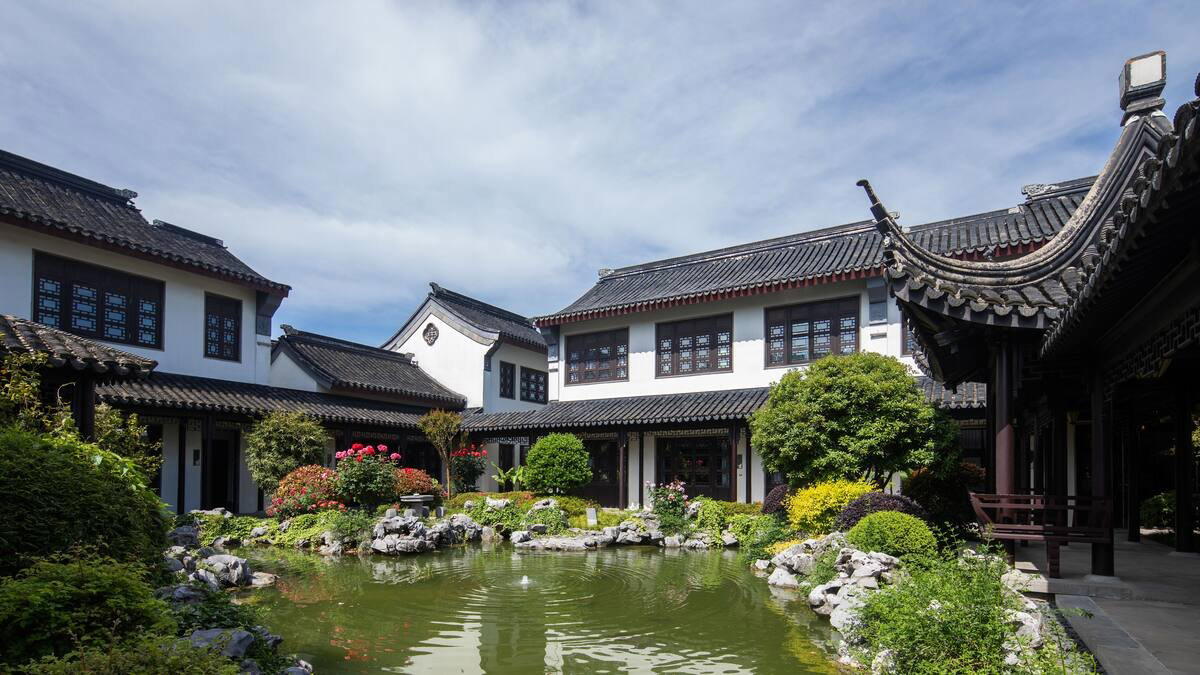
Where Classical Garden Design Meets the Lake
Suzhou has spent more than two thousand years refining a specific idea: that a garden is not decoration but architecture. The city's Scholar Gardens, inscribed as UNESCO World Heritage Sites, established a compositional grammar of borrowed views, layered rock, water mirrors, and pavilions that frame landscape like a sequence of painted scrolls. The Hanyu Garden Reserve Suzhou operates inside that tradition, drawing its design logic from the same poetic sensibility that shaped the Humble Administrator's Garden and the Master of the Nets Garden across the city. The difference is scale and setting. Where the classical gardens are walled urban compositions, the resort sits on the shores of Lake Taihu, allowing that inherited vocabulary to expand into an open landscape.
Arriving at the property, the relationship between built structure and water is immediately apparent. Lake Taihu is one of China's largest freshwater lakes, and its particular quality of light, diffuse, soft, given to mist in the early morning hours, has shaped the aesthetic of this entire region for centuries. Suzhou poets wrote about it. Suzhou painters used it as subject and mood reference. A resort positioned on its shore is working with source material that carries significant cultural weight, and the design of the Hanyu Garden Reserve acknowledges that debt visibly, in the orientation of its spaces and the way the property allows the lake to read as both foreground and horizon.
Design Philosophy: Poetry as Architecture
The resort draws its inspiration from poetry and nature, a pairing that, in the Suzhou context, is more precise than it sounds. The classical garden tradition in this region was built by literati, scholars and officials who were simultaneously painters, calligraphers, and poets. Their gardens were three-dimensional arguments about the relationship between human thought and natural form. When a contemporary resort in Suzhou cites poetry as a design reference, it is locating itself within that specific intellectual and aesthetic lineage, not merely reaching for romantic metaphor.
Across China's high-end resort market, design approaches have increasingly split between two models. The first imports international luxury signatures with minimal concession to local context. The second works from regional tradition outward, using local materials, indigenous forms, and site-specific cultural references as the organizing logic. The Hanyu Garden Reserve belongs clearly to the second category. The verdant, garden-forward character of the property and its relationship to classical Suzhou aesthetics places it in a cohort that includes properties like Amanfayun in Hangzhou, which uses a preserved tea-farming village as its physical framework, and Amandayan in Lijiang, where Naxi architectural forms anchor the guest experience. In each case, the property's authority derives from its fidelity to a specific cultural and physical context rather than from the application of a global brand template.
Within Suzhou itself, the comparable tier includes The Ritz-Carlton, Suzhou, which positions itself at the intersection of international five-star standards and the city's garden-city identity. The Hanyu Garden Reserve differentiates on setting: the Lake Taihu shore offers a quieter, more nature-immersed context than properties anchored to Suzhou's urban core.
The Lake Taihu Setting in Context
Lake Taihu's western shore has historically been less developed than the zones closer to Suzhou's city center, which makes the resort's location a deliberate choice about the kind of experience it offers. The lake is known for its Taihu stone, the distinctive perforated limestone formations that became the defining sculptural element of classical Suzhou gardens. To stay on its shores is to be at the geological and aesthetic source of among the more recognizable design traditions in Chinese cultural history.
For guests traveling from major Chinese cities, the logistics are manageable. Suzhou sits between Shanghai and Nanjing on the high-speed rail corridor, with journey times of approximately 25-30 minutes from Shanghai Hongqiao. From Suzhou station, the Gusu District address places the resort within the historically significant part of the city, though Lake Taihu's western shore sits at the city's edge rather than in the canal district that draws most first-time visitors. Planning a stay here is more coherent with at least two nights, allowing time to engage with both the property's landscape and the city's classical garden circuit. Those arriving via Shanghai might note that JW Marriott Hotel Shanghai at Tomorrow Square provides a strong urban base before or after a Suzhou leg.
Suzhou's Broader Hotel Tier
Suzhou's premium accommodation market reflects the city's dual identity as a heritage destination and a modern industrial and financial hub. Properties in the upper tier tend to align either with the canal-quarter experience in the historic center or with the lake-and-garden escape model that the Hanyu Garden Reserve represents. For travelers building a longer Yangtze Delta or eastern China itinerary, the city's key neighborhoods each offer distinct dining and accommodation character.
Beyond Suzhou, the nature-retreat model the property represents has parallels at several points across China. Xiamen Yunding Resort in Xiamen uses mountain terrain and forest setting in a comparable way. Banyan Tree Chongqing Beibei and Vanke Lake Songhua Yunlu Hotel in Jilin operate on similar premises of immersive natural settings with strong regional identity. Properties like 1 Hotel Haitang Bay in Sanya and Mandarin Oriental Qianmen in Beijing address different traveler priorities, coastal resort and historic urban, respectively, but together these properties map the range of approaches that China's upper-tier hospitality market currently offers.
Planning Your Stay
The resort's position on Lake Taihu means seasonal timing matters more than at city-center properties. Spring and autumn bring the clearest conditions on the lake and the photogenic garden scenery; summer is warm and humid, as across the Yangtze Delta, while winter mornings can produce the mist and stillness that defines the classical landscape painters' version of this setting. For guests interested in the classical garden circuit, Suzhou's major sites require pre-booked timed entry on busy weekends and public holidays. Combining a Lake Taihu stay with the city's garden district works well with dedicated transport rather than reliance on public connections from the lakeshore. The balance of seclusion and accessibility that the property offers makes it more suitable for leisure travelers with at least two or three nights than for brief business stopovers.
Quick Comparison
Comparable venues nearby, for context on price, style, and recognition.
| Venue | Cuisine | Price | Awards | Notes |
|---|---|---|---|---|
| The Hanyu Garden Reserve SuzhouThis venue — the venue you are viewing | Classical Jiangnan courtyard resort with low pavilions and landscaped gardens on Lake Taihu shores. | $$$$ | Not listed | Not listed |
| Hotel Indigo Suzhou Yangcheng Lake | Boutique resort blending modern design with local Jiangnan water town elements | $$$ | Not listed | Suzhou Industrial Park |
| Kimpton Bamboo Grove Suzhou | Modern luxury lifestyle hotel inspired by Suzhou artistic gardens | $$$$ | 5-Star | Gusu District |
| The Ritz-Carlton, Suzhou | Contemporary luxury hotel interpreting Suzhou's classical garden architecture and Jiangnan water town heritage through modern minimalist design with oriental-inspired elements. | $$$$ | 5-Star | Gusu District |
| Hotel Indigo Suzhou Grand Canal | Contemporary luxury boutique hotel blending imperial heritage with modern minimalism, inspired by Emperor Qianlong's historic Grand Canal journey and Suzhou's 2,600-year legacy. | $$$ | 5-Star | Suzhou New District |
| Songtsam Basongcuo Linka Hotel | Tibetan resort lodge | $$$$ | Not listed | Cuogao Town |
Recognition history
Dated appearances from independent guides and award organizations, with the underlying list record or original source where available.
Small Luxury Hotels of the World Member
Small Luxury Hotels of the World
At a Glance
- Scenic
- Elegant
- Quiet
- Sophisticated
- Romantic Getaway
- Wellness Retreat
- Anniversary
- Waterfront
- Garden
- Historic Building
- Wi Fi
- Indoor Pool
- Fitness Center
- Spa
- Concierge
- Room Service
- Restaurant
- EV Charging
- Free Parking
- Garden
- Wi Fi
- Indoor Pool
- Fitness Center
- Spa
- Concierge
- Room Service
- Restaurant
- EV Charging
- Free Parking
Lavish interiors with cultural relics, calligraphy, and artworks create a peaceful, heritage-inspired atmosphere with natural light and serene garden views.