
A Michelin Selected glamping and spa property set within the thermal landscape of the Vulci archaeological zone near Canino, Viterbo. Terme di Vulci occupies a rare position in northern Lazio's premium accommodation tier, combining open-air lodging with thermal bathing in one of Italy's least-trafficked heritage corridors. It offers a deliberate alternative to the region's more conventional agriturismo and historic-building conversions.
Pearl is the En Primeur Club membership app — saves, bookings, and concierge access live there. Same editors, same standards.
- Address
- Via delle Terme, Canino, Viterbo, Italy
- Phone
- +39 0761438574
 Saves & bookings on Pearl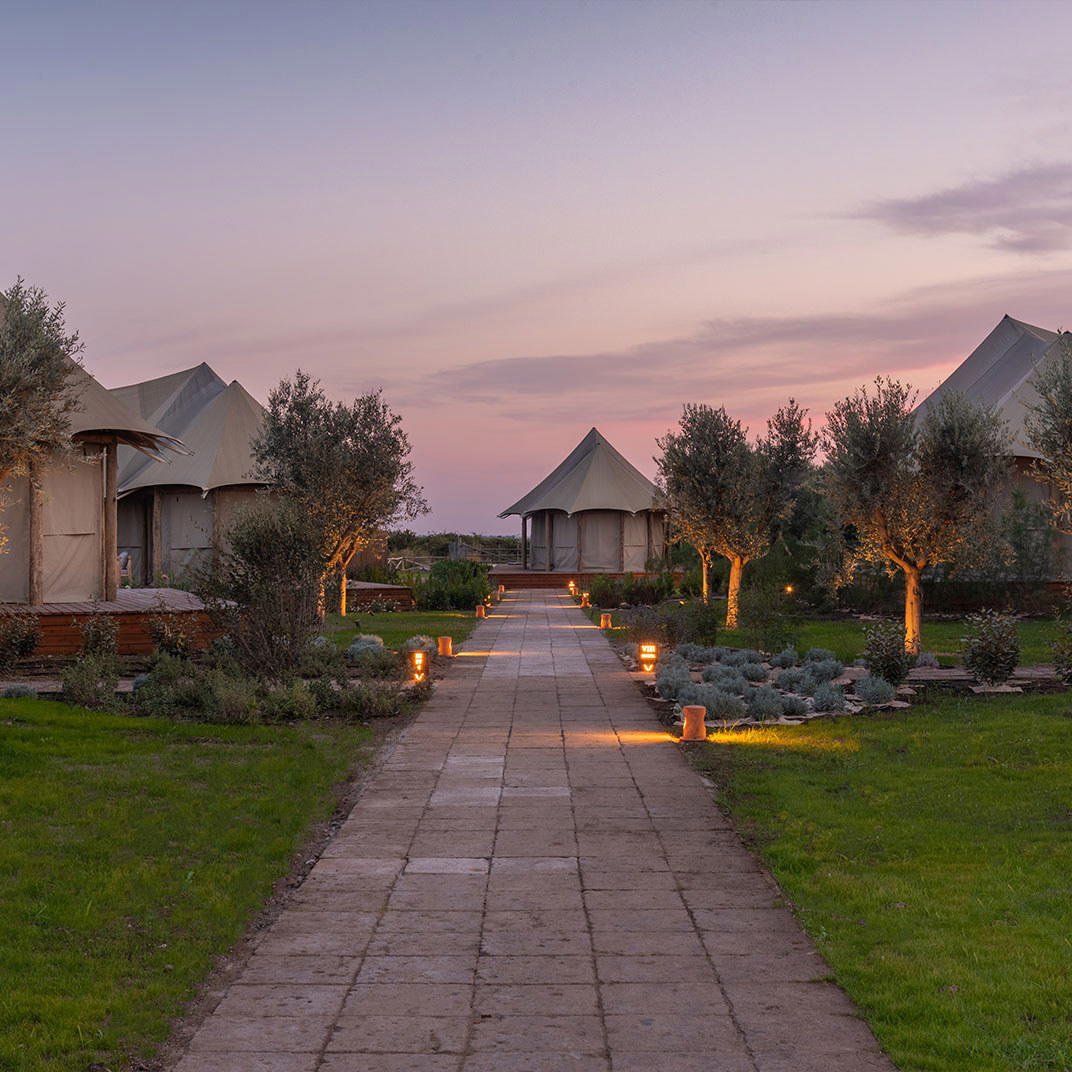
Where the Etruscan Plain Meets the Canvas Ceiling
Northern Lazio's thermal belt runs from the sulfurous springs of Saturnia north through the volcanic plateau of the Maremma, and most of it remains conspicuously under-served by accommodation that matches the landscape's ambition. The area around Canino, in the province of Viterbo, sits inside this corridor with the added weight of the Vulci archaeological park at its edge, among the more significant Etruscan necropolis sites in Italy. Against that backdrop, Terme di Vulci Glamping & Spa operates in a format that the Italian premium accommodation market has been slow to adopt at any serious level: purpose-designed glamping that treats the physical environment as both setting and structural argument.
Glamping in Italy has tended to arrive as either low-investment camping with upgraded mattresses or as agriturismo overflow dressed in canvas. The more considered end of the format, where the open-air structure is a deliberate design choice rather than a budget concession, remains genuinely rare outside a handful of properties in Tuscany and the Dolomites. Terme di Vulci's Michelin Selected designation for 2025 places it in a recognized tier of hotels worth tracking. See our full Viterbo restaurants guide for how the wider area sits within the region's travel circuit.
The Architecture of Open Air
Terme di Vulci is, before anything else, spatial. Glamping as a lodging category asks a specific architectural question: how much of the boundary between interior and exterior do you dissolve before the guest experience loses coherence? Properties that answer well, like Borgo San Felice Resort in Castelnuovo Berardenga or Rosewood Castiglion Del Bosco in Montalcino, tend to anchor the guest within landscape features rather than simply placing structures inside them. The thermal springs at Vulci provide exactly that kind of anchor. The water element does the spatial work that stone walls perform in a conventional hotel: it fixes the property to its site and gives the guest a sensory reason to be precisely here.
The glamping and spa pairing reflects a broader shift in Italian wellness hospitality. Properties like Bellevue Hotel & Spa in Cogne and Castel Fragsburg in Merano have built their reputations on landscape-integrated wellness, but both operate within solid-wall architecture. The open-structure version of that proposition requires the design to work harder, since there is no building envelope to carry the weight of luxury signaling. Material choices, ground treatment, light management, and the relationship between individual lodging units and communal bathing spaces become the entire vocabulary.
Northern Lazio's Accommodation Position
Viterbo province has historically attracted far less premium accommodation investment than Tuscany's southern corridor or the Amalfi Coast, despite holding comparable archaeological and thermal assets. The city of Viterbo itself contains a medieval papal quarter that would anchor a boutique hotel scene in almost any northern European country. Instead, the area's premium accommodation options cluster around agriturismo conversions and, increasingly, smaller-scale properties that identify a specific asset, thermal water, archaeological adjacency, vineyard land, and build a single-proposition stay around it.
Terme di Vulci sits in this second group. Nearby, Corte della Maestà in Civita di Bagnoregio represents the historic-building conversion model in the same province. Further afield in the Italian center, Borgo Santandrea on the Amalfi Coast and Il San Pietro di Positano demonstrate how landscape integration can command a distinct premium tier when executed with rigor. The gap in northern Lazio between asset quality and hospitality investment is real, and properties that close it with credible design and recognized quality signals occupy an increasingly valuable position in a market where informed travelers are actively seeking non-Tuscan alternatives.
The Michelin Selected classification, which covers hotels rather than restaurants and reflects criteria around quality, comfort, and character rather than cuisine, puts Terme di Vulci in a documented conversation with properties across the Italian peninsula, from Aman Venice to Casa Maria Luigia in Modena, even if the formats and price tiers differ substantially. For the glamping category specifically, that kind of external validation matters more than in established formats, because the guest is being asked to accept a degree of structural unconventionality on faith.
The Thermal Proposition
Italy's thermal bathing tradition is deep and regionally specific. Saturnia's free cascades attract a mass market that has little to do with premium hospitality. Terme di Saturnia the resort operates at a different register. The volcanic springs of the Viterbo area, including those at Bagnoregio and Terme dei Papi in Viterbo itself, historically served papal and aristocratic clients and retain a character distinct from the more commercialized Tuscan thermal circuit. Terme di Vulci draws on this same subterranean geology, which means the spa component here is not decorative: the water is the reason the site exists where it does.
For travelers building an itinerary around thermal wellness, the northern Lazio circuit offers an alternative to the Saturnia corridor. The archaeological dimension, with the Vulci necropolis accessible from the property's address at Via delle Terme, Canino, adds a cultural layer that pure wellness properties in the region cannot match. The combination of thermal bathing, Etruscan heritage, and open-air lodging is specific enough to constitute a distinct travel proposition rather than a generic rural retreat.
Planning Your Stay
Terme di Vulci is located on Via delle Terme in Canino, in the province of Viterbo, in the northern Lazio Maremma. The nearest major road access runs through Canino, which sits approximately midway between the Via Aurelia coast road and the A1 Autostrada. Viterbo city, the provincial capital, is roughly 40 kilometers northeast and provides the nearest concentration of rail connections for travelers arriving without a car. A car is, in practical terms, necessary for exploring the archaeological sites and surrounding countryside that give the location its full context. Spring and autumn are the more comfortable visiting windows. Advance booking is advisable, particularly for shoulder-season weekends.
For travelers comparing this kind of landscape-embedded property against the grander scale of, say, Four Seasons Hotel Firenze or Bulgari Hotel Roma, the calculation is different: those properties trade on urban cultural density and institutional prestige. Terme di Vulci trades on irreplaceable site specificity and a format that neither of those properties can replicate. The comparison set is closer to properties like Therasia Resort in Lipari or Il Pellicano in Porto Ercole. Other landmark Italian properties worth benchmarking against the wider premium tier include Passalacqua in Moltrasio, Borgo Egnazia in Savelletri di Fasano, Portrait Milano, Il Sereno in Torno, Grand Hotel Tremezzo, Castello di Reschio in Lisciano Niccone, JK Place Capri, and Savoia Excelsior Palace Trieste. International reference points for the broader conversation include The Fifth Avenue Hotel in New York City, Badrutt's Palace Hotel in St. Moritz, and Hôtel de Paris Monte-Carlo.
How It Stacks Up
Comparable venues nearby, for context on price, style, and recognition.
| Venue | Cuisine | Price | Awards | Notes |
|---|---|---|---|---|
| Terme di Vulci Glamping & SpaThis venue — the venue you are viewing | Luxury glamping resort blending safari-camp aesthetics with contemporary Italian minimalism and thermal wellness focus. | $$$ | 4-Star | Not listed |
| Executive SPA Hotel | Renovated 1980s modernist building with contemporary Italian luxury. | $$$ | 4-Star | Fiorano Modenese |
| Schwarzer Adler | Concept Living | Concept living apartment hotel fusing historic roots with modern luxury. | $$$ | 4-Star | Vipiteno main square |
| Locanda Palazzone | Medieval country residence with contemporary minimalist interiors; family-run winery and rural hotel blending 14th-century architecture with Scandinavian-chic design. | $$$ | 4-Star | Rocca Ripesena |
| 1880 Atypical Rooms | Renovated 19th-century building with atypical modern design | $$$ | 4-Star | Monti |
| Relais San Giuliano | Contemporary boutique hotel housed in a restored 18th-century noble estate with rural Sicilian heritage. | $$$ | 4-Star | Viagrande |
Recognition history
Dated appearances from independent guides and award organizations, with the underlying list record or original source where available.
Michelin Selected
Michelin
At a Glance
- Romantic
- Scenic
- Quiet
- Elegant
- Wellness Retreat
- Romantic Getaway
- Family Vacation
- Anniversary
- Destination Spa
- Garden
- Panoramic View
- Private Dining
- Spa
- Pool
- Restaurant
- Bar
- Sauna
- Free Parking
- Garden
- Vineyard
- Spa
- Pool
- Restaurant
- Bar
- Sauna
- Free Parking
Serene and rejuvenating with contemporary minimalist design inside tents, surrounded by rolling hills, olive groves, lavender and herb gardens; spa lighting and natural thermal waters create a calming, wellness-focused atmosphere.