

2 Michelin Keys · Relais Chateaux Award
A ten-room lodge on the Manali-Leh Highway in Palchan, Sitara Himalaya occupies a valley framed by high Himalayan peaks and operates at a remove from Manali's main tourist circuit. Created by Good Earth founder Anita Lal, the property draws Indian, Tibetan, and English design influences through its interiors while an Ayurvedic spa and Himalayan kitchen anchor the experiential offer. Pricing is on request only.

Pearl is the En Primeur Club membership app, where members save venues, book tables and use the concierge.
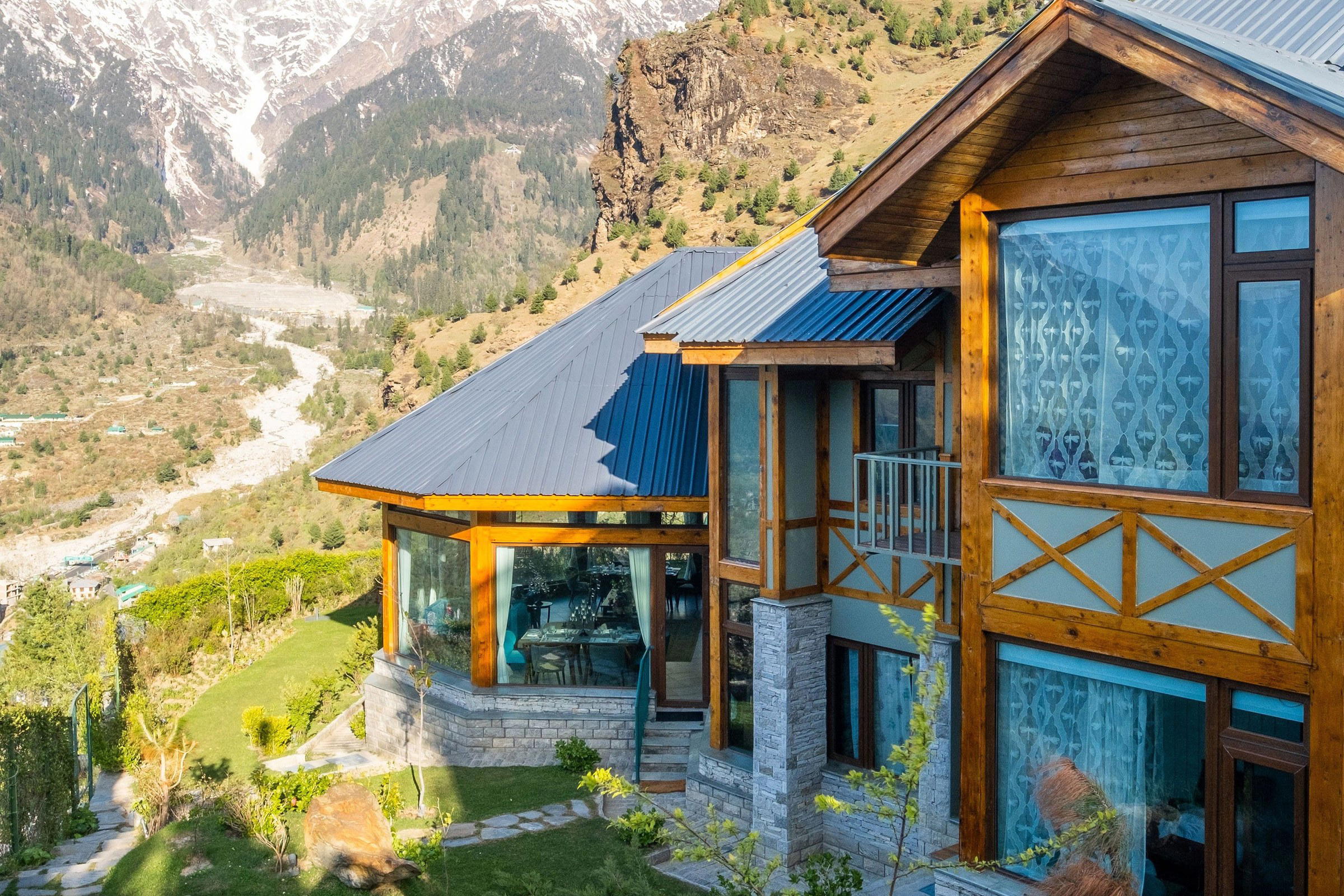
A Valley Lodge at the Edge of the Accessible Himalayas
The drive north from Manali on the Leh Highway narrows quickly. By the time you reach Palchan, roughly 11 kilometres from Manali Bus Station, the valley has closed in and the peaks are no longer backdrop but foreground. Sitara Himalaya sits at GPS coordinates 32.3116, 77.1795 along this corridor, at an altitude where the light is sharper and the soundscape is defined by wind and water rather than traffic. The nearest commercial airport is Bhuntar; for travellers arriving by rail, Chandigarh is the closest major station, making the final leg to the property a considerable overland commitment. That commitment is, in part, the point.
Northern India's mountain hospitality has long divided between two formats: large resort complexes positioned at the lower reaches of hill towns, and small, deliberately remote lodges that treat inaccessibility as a feature rather than a limitation. Sitara Himalaya belongs firmly to the second category. Ten rooms means a guest count that never tips into crowd territory, and the Palchan location places it outside the commercial density of Manali proper. Properties of this scale in this setting compete less on amenity breadth and more on atmosphere, design coherence, and the quality of stillness they can deliver. Compare that positioning to, say, The Himalayan further along the valley corridor, and the differences in scale and operating philosophy become instructive.
Design as Spatial Argument: Three Traditions in Conversation
The interior language at Sitara Himalaya draws from three distinct design traditions: Indian craft, Tibetan visual culture, and English country-house sensibility. That combination is less arbitrary than it might first appear. The Kullu-Manali region sits at a historic crossroads between the Subcontinent's plains cultures and the Tibetan plateau, and colonial-era hill stations introduced a third design vocabulary that has never entirely disappeared from the mountains. At Sitara Himalaya, the interiors reflect this layered history rather than resolving it into a single aesthetic. Indian textile craft sits alongside Tibetan motifs and furnishing proportions that recall an earlier era of mountain hospitality.
Good Earth, the design and lifestyle brand through which Anita Lal has worked for decades, has consistently approached Indian craft traditions as living material rather than heritage display. That sensibility is legible in properties and spaces associated with the brand: an emphasis on handmade textiles, material honesty, and spatial arrangements that feel inhabited rather than staged. At a ten-room scale, those choices read with more intensity than they would in a larger property. The design decisions are closer to those of a private house than a hotel, which aligns directly with the Vedic hospitality concept the property cites as its guiding principle: oneness with surroundings rather than separation from them.
For travellers who have stayed at design-led Indian properties further south, such as Amanbagh in Ajabgarh or Alila Fort Bishangarh in Manoharpur, the comparison is instructive: those properties deploy heritage architecture as their primary design statement, while Sitara Himalaya relies on the mountain setting and craft-led interiors to do equivalent work at a fraction of the room count. Properties such as Suján Jawai in Pali offer a similar low-count, landscape-led positioning in Rajasthan's wilderness, though the aesthetic register differs sharply from Sitara's mountain-and-craft vocabulary.
The Setting as Primary Architecture
No interior decision at Sitara Himalaya will matter more than the valley itself. The property's awards data flags views of the Himalayas as a primary draw, and at this location that designation carries real weight. The peaks visible from Palchan include the high ridgelines that form the southern wall of the Rohtang corridor, and the light on those faces changes substantially across a single day. Morning brings a cold, clear quality that photographers chase; late afternoon turns the limestone and snow through orange into shadow within minutes.
This is the category of setting that large mountain resorts describe but rarely deliver, because their scale requires positioning at lower elevations with road access and services infrastructure. A lodge of ten rooms can occupy a position that a 150-key resort cannot. The trade-off is that Sitara Himalaya operates at a remove from the services, restaurants, and activity operators concentrated in Manali town. Guests who want to move through the region's dining and bar scene will need to plan that around travel time. For those using the property primarily as a base for the mountains or as a place of deliberate withdrawal, the distance is not a deficit.
Restoration as Programme: Spa and Kitchen
The property's experiential offer centres on two elements: an Ayurvedic spa and what it describes as a Himalayan kitchen. Ayurvedic practice in a mountain context is distinct from its coastal or plains counterparts, with the altitude, dry air, and seasonal temperature swings shaping both the treatments on offer and the pace at which they are most effective. The spa positioning aligns Sitara Himalaya with a broader category of Indian retreat properties that treat wellness as the primary activity rather than a supplementary amenity. Ananda in the Himalayas in Narendra Nagar represents the most extensively developed version of this model in the Indian mountains; Sitara Himalaya operates at a smaller, more private scale within the same broader tradition.
Mountain cuisine in Himachal Pradesh draws from a combination of Pahadi (hill people) staples, Tibetan-influenced preparations, and the seasonal produce that the short growing windows at altitude make available. Specific menu and pricing details are on request only, consistent with the property's general approach to operating outside standard booking and pricing infrastructure.
Where Sitara Sits in the Indian Luxury Spectrum
India's premium accommodation market spans an enormous range of formats, from urban palace hotels such as The Taj Mahal Palace, Mumbai and The Leela Palace New Delhi in New Delhi through heritage conversions like Haveli Dharampura in Delhi to wilderness camps and mountain lodges. Sitara Himalaya occupies the mountain lodge tier, with a design and cultural pedigree that places it closer to the craft-and-retreat end of that spectrum than to the amenity-and-service maximalism of urban luxury. It has more in common, conceptually, with Chapslee in Shimla than with The Oberoi Amarvilas in Agra, though the three properties represent quite different expressions of Indian hospitality across different geographies.
At ten rooms, the total review pool will grow slowly, and the ratings that do appear carry more individual weight than those at higher-volume properties. The awards highlights, which flag the property as off the beaten track and as a spiritual retreat sanctuary alongside its Himalayan views, describe a property whose value is calibrated to a specific kind of traveller: one for whom remoteness is a feature, craft detail matters, and the absence of a large-scale amenity programme is not a loss.
Planning a Stay
Sitara Himalaya is located in Palchan on the Manali-Leh Highway, approximately 11 kilometres from Manali Bus Station. The nearest airport is Bhuntar; Chandigarh serves as the major rail gateway for travellers arriving by train. The Manali-Leh Highway is subject to seasonal closures, and the optimal window for access generally runs from late spring through early autumn, though shoulder-season visits offer quieter conditions and a different quality of light. Pricing is available on request only, with no standard rates published, which is consistent with the private-lodge operating model. For broader regional context across Manali's accommodation and dining options, see our full Manali restaurants guide.
Fast Comparison
Comparable venues nearby, for context on price, style, and recognition.
| Venue | Cuisine | Price | Awards | Notes |
|---|---|---|---|---|
| Sitara HimalayaThis venue (the venue you are viewing) | luxury mountain lodge blending private home and resort | Not listed | 2 Michelin Keys · Relais Chateaux Award | Not listed |
| The Himalayan | Victorian Gothic Revival castle resort | $100–200 | World Travel Awards | Old Manali |
| Ran Baas The Palace | Restored 18th-century royal guesthouse blending heritage grandeur with modern luxury | Not listed | 1 Michelin Key · Relais Chateaux Award | Qila Mubarak |
| Six Senses Vana | Wellness-oriented luxury resort harmoniously integrated with Himalayan nature | Not listed | 1 Michelin Key · Mr & Mrs Smith Seal of Approval | Malsi |
| Taj Usha Kiran Palace, Gwalior | Heritage palace hotel blending 1880 Maratha royal architecture with contemporary tropical luxury and modern amenities. | $200–300 | 1 Michelin Key | Gwalior |
| Brij Rama Palace Varanasi | Heritage palace hotel blending Maratha architecture with royal luxury on the Ganges. | $100–200 | Michelin Selected | Darbhanga Ghat |
Recognition history
Dated appearances from independent guides and award organizations, with the underlying list record or original source where available.
Michelin 2 Keys
Michelin
Relais Chateaux Award
Relais Chateaux
Full recognition history (4 entries)
Michelin 2 Keys
Michelin
Relais Chateaux Award
Relais Chateaux
Continue exploring
More in Manali
Hotels in Manali
All hotels in Manali →
Restaurants in Manali
All restaurants in Manali →
Details
- Romantic
- Quiet
- Scenic
- Cozy
- Elegant
- Intimate
- Sophisticated
- Honeymoon
- Romantic Getaway
- Wellness Retreat
- Anniversary
- Weekend Escape
- Panoramic View
- Garden
- Spa
- Wi Fi
- Room Service
- Mountain
Warm interiors blending Indian, Tibetan, and English influences with vast windows showcasing snow-capped peaks, creating a restorative and familial atmosphere.