Puente del Inca sits in the high Andes of Mendoza Province, where the natural thermal bridge over the Río Mendoza has drawn travellers for over a century. The site functions as both a geological landmark and a staging point for Aconcagua expeditions, placing it firmly in Argentina's adventure-travel circuit. Logistics here are shaped by altitude and seasonality rather than hotel star ratings or restaurant reservations.
Pearl is the En Primeur Club membership app — saves, bookings, and concierge access live there. Same editors, same standards.
- Address
- Mendoza Province, Argentina
- Directions
- Get directions
 Saves & bookings on Pearl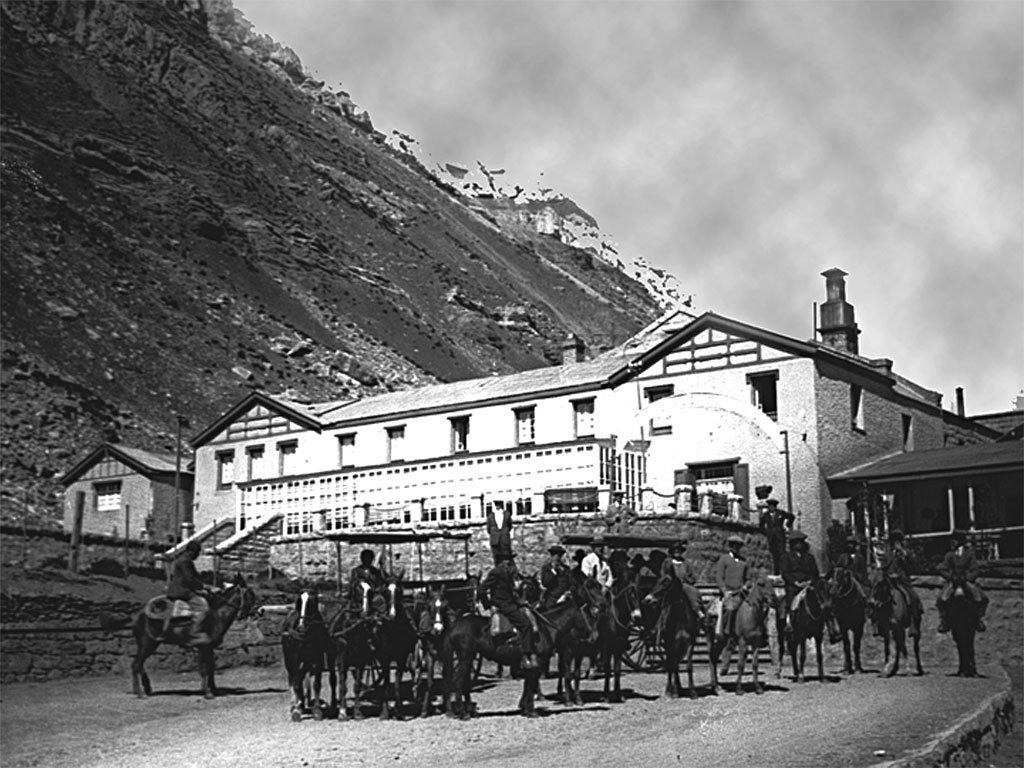
Where the Andes Set the Agenda
At roughly 2,700 metres above sea level on the road toward the Chilean border, Puente del Inca operates by rules that have little to do with the hospitality conventions governing Mendoza's wine-country lodges or Buenos Aires's grand hotel corridors. The natural stone arch spanning the Río Mendoza, stained ochre and sulphur-yellow by thermal mineral deposits, has been a documented landmark since the early nineteenth century, and the site's logic flows entirely from that geological fact. Travellers come here because the landscape demands it. That distinction shapes everything about the experience: the altitude, the exposed Andean terrain, and the proximity to Aconcagua base camp trails all take precedence over amenity lists and room categories.
The Scene in Context: Argentina's High-Altitude Corridor
Argentina's premium lodge circuit has, in recent years, split decisively between wine-country retreats concentrated around Luján de Cuyo and Tupungato and remoter wilderness properties anchored to specific natural phenomena. Awasi Mendoza in Lujan De Cuyo and Lodge Atamisque in Tupungato represent the former model, where viticulture frames the guest experience and restaurant programmes carry significant editorial weight. Cavas Wine Lodge in Alto Agrelo and Casa de Uco in Tunuyán follow a similar logic, pairing vineyards with considered food-and-wine programming. Puente del Inca sits in neither category. Its context is the high-Andes corridor, where altitude acclimatisation and mountain access define the rhythm of any visit. The comparison that holds is with high-altitude adventure bases elsewhere in the Andes, not with Mendoza's hospitality mainstream.
Further afield in Argentina's extreme-environment travel segment, properties like Arakur Ushuaia Resort and Spa in Ushuaia and Explora El Chaltén in El Chaltén demonstrate how international operators have formalised the wilderness-access model with structured guiding programmes and considered food offerings. Puente del Inca has historically occupied a more raw position in that spectrum, where the natural site itself, rather than a curated hospitality layer, is the primary draw.
Dining at Altitude: What the Setting Determines
The food here is shaped by the terrain and logistics. The food culture here is shaped by what the terrain and logistics allow: hearty mountain provisions suited to guests arriving after days on the Aconcagua trail, or travellers crossing from Mendoza into Chile via the Paso Los Libertadores. The culinary identity, where one exists, defaults to the Argentine tradition of sustaining, protein-heavy cooking, the kind of direct asado and stew-based cooking that sustains mountain travellers rather than showcasing kitchen ambition. By contrast, wine-estate dining elsewhere in Argentina is far more structured and chef-led.
For travellers whose Argentina itinerary extends beyond the Andes, the dining conversation shifts considerably. Casa Duhau in Mendoza and properties like Home Hotel in Buenos Aires operate in a register where restaurant programming is a genuine draw. At the other end of the country's geographic spread, Awasi Iguazu in Puerto Iguazu has built a reputation for integrating regional ingredients into its dining offer in a way that reflects its jungle setting. Puente del Inca belongs to a different conversation entirely.
The Natural Landmark Itself
The bridge that gives the site its name is a travertine arch formed by thermal mineral springs depositing calcium carbonate over millennia, a process that continues today and coats any object left near the waters in a mineral crust within weeks. The structure was formally studied by European naturalists in the nineteenth century and served as a crossing point long before the transandean road was engineered alongside it. The ruins of the historic thermal baths hotel, damaged by an avalanche in 1965 and since abandoned to the mineralising action of the springs, have become an unlikely monument in their own right, their walls and rooflines accreting the same yellow-orange mineral patina as the arch itself. This is not a curated heritage experience; it is decay and geology in plain view, and that rawness is precisely what separates it from the managed natural attractions found at more developed Argentine destinations.
Argentina's broader adventure-travel network includes properties that have built formal frameworks around similarly dramatic natural contexts. Estancia Cristina in El Calafate and Correntoso Lake and River Hotel in Villa La Angostura both anchor their offer to landscape spectacle but wrap it in considered accommodation and food programmes. The hotel has not followed that trajectory, which makes it more useful as a waypoint than as a destination in the conventional hospitality sense.
Planning a Visit: Logistics and Timing
The site sits in Mendoza Province, Argentina, along Ruta Nacional 7, the main transandean corridor connecting Argentina and Chile. Most travellers reach it as a day excursion from Mendoza, or as a stop on the overland crossing into Chile, rather than as a multi-night base. The road is subject to seasonal closures, particularly during heavy snowfall between June and September, which effectively limits reliable access to the shoulder seasons of late spring and autumn. Aconcagua expedition season runs from November through February, and during those months the site sees its highest traffic from climbing teams and trekkers using it as an acclimatisation stop before pushing higher. Visitors travelling in that window should account for the altitude: at 2,700 metres, even fit travellers may feel the reduced oxygen, particularly if arriving directly from Mendoza's lower elevation without a gradual ascent.
Argentina's estancia and remote-lodge circuit provides useful bookends for a trip that includes a high-altitude Andean stop. Estancia El Ombú de Areco in San Antonio De Areco, Estancia La Bandada in San Miguel Del Monte, and ESTANCIA LOS POTREROS in Rio Ceballos each offer a different register of Argentine wilderness hospitality, and pairing one of them with a high-Andes excursion gives an itinerary genuine geographic range. For those extending internationally, El Colibri in Santa Catalina, Charming Luxury Lodge and Private Spa in San Carlos de Bariloche, The Fifth Avenue Hotel in New York City, Aman New York in New York City, and Aman Venice in Venice represent the kind of urban luxury counterpoint that makes a Patagonian or Andean excursion feel properly framed within a longer journey. See also Las Leñas for a Las Heras alternative built around a different kind of mountain engagement.
Booking and Cost Snapshot
Comparable venues nearby, for context on price, style, and recognition.
| Venue | Cuisine | Price | Awards | Notes |
|---|---|---|---|---|
| Puente del IncaThis venue — the venue you are viewing | Las Cuevas, rustic mountain hostel | $ | Not listed | Not listed |
| Las Leñas | Not listed | $$ | 4-Star | Las Heras, Mountain resort with mix of hotel rooms, suites, cottages and villas offering alpine hospitality |
| El Salto | Lujan De Cuyo, rustic cabin | $ | Not listed | Not listed |
| Damajuana Hostel | Aristides Villanueva, hostel | $ | Not listed | Not listed |
| Finca Adalgisa | Not listed | $$$ | Not listed | Chacras de Coria, Historic family vineyard estate converted into a boutique hotel with old-world architecture and modern comforts. |
| Posada Borravino | Not listed | $$$ | Not listed | Chacras de Coria, rustic country house with contemporary touches |
At a Glance
- Rustic
- Scenic
- Weekend Escape
- Panoramic View
- Mountain
Mountain hostel atmosphere, comfortable and clean as per guest reviews.