Estancia La Bandada

A seven-room working estancia roughly 120 kilometres south of Buenos Aires, Estancia La Bandada converts the Pampas ranching tradition into a deliberately low-key retreat. Original wood-beamed ceilings, communal breakfasts, horseback rides, and family-style asados built around local produce define the stay. Rates from USD 357 place it in the mid-tier of Argentina's converted-estancia category.
Pearl is the En Primeur Club membership app — saves, bookings, and concierge access live there. Same editors, same standards.
- Address
- 35°28'46.9"S 58°41'56, RP41 km 120, 7220 San Miguel del Monte, Provincia de Buenos Aires
- Phone
- +54 9 2226 51-2771
- Website
- labandada.com.ar
- Directions
- Get directions
 Saves & bookings on Pearl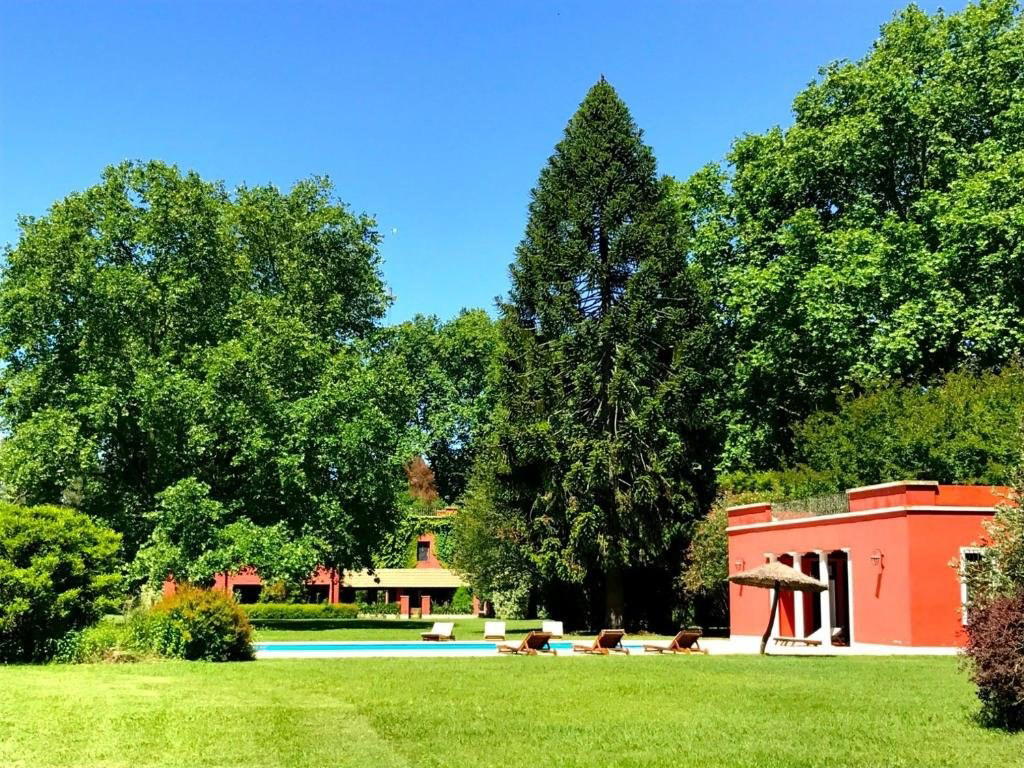
The Architecture of the Argentine Countryside
The Buenos Aires province is cross-hatched with estancias, most of them built in the late nineteenth and early twentieth centuries when cattle and wheat money flowed freely through the Pampas. The leading surviving examples share a recognisable grammar: low-slung hacienda structures, wide shaded patios, and interior timberwork that carries the smell and weight of another era. Estancia La Bandada, sitting on RP41 at kilometre 120 outside San Miguel del Monte, belongs to this tradition and makes no attempt to disguise it. The architecture is the point.
Seven guest rooms occupy the original fabric of the building, with wood-beamed ceilings that predate any designer intervention. This is the actual structure of the place, preserved rather than reproduced. The distinction matters. Converted estancias in Argentina split fairly cleanly between those that have been renovated into something smoother and those that have retained the grain of the original. La Bandada sits in the second category, which explains both its appeal and its particular character. Compared to more polished rural retreats such as Estancia El Ombú de Areco in San Antonio de Areco, La Bandada reads as the more low-key option, a property where the working-farm context remains genuinely present.
What the Space Communicates
The patio is where the architecture comes into focus. Afternoon tea is served there, in the unhurried way that estancia hospitality has always operated: no printed menu, no timed slot, just the open-air structure of the farmyard day. Large old trees shade the poolside area, their canopy scale indicating the age of the planting and, by extension, the age of the property. You cannot manufacture that kind of vertical presence with a landscaping budget; it accumulates over decades on working land.
Inside, paintings by the artist owner are placed throughout the property. This shows the personal hand of the owner in the interiors. Smaller properties with owner-artists tend to read as more coherent environments, and that coherence is visible here in the way the interior objects and the structural fabric relate to each other. For context on how Argentina's broader luxury rural sector approaches design from a different angle, the wine country properties of Mendoza, including Cavas Wine Lodge in Alto Agrelo and Casa de Uco in Tupungato, have moved toward architectural statement-making in ways that La Bandada deliberately does not.
The Working Farm as Context
The estancia functions as a working farm, and that is not background colour. Horses graze within sightline of the communal breakfast table, and guests can ride around the grounds. The relationship between the agricultural setting and the guest experience is immediate rather than symbolic. Argentina's converted-estancia category, at its better end, uses the working-farm structure to ground the stay in something other than the resort logic of amenity accumulation. La Bandada operates in that mode, with a seven-room scale that limits the guest count and keeps the atmosphere closer to a private farmhouse than to a hotel.
That scale, seven rooms at rates from USD 357, positions it within the mid-range of Argentina's rural boutique segment. Properties like Estancia Los Potreros in Rio Ceballos and the Córdoba hills properties appeal to a comparable traveller profile: those who want working-landscape immersion without sacrificing comfort, and who are less interested in the spa-and-infinity-pool format that higher-priced rural hotels in the wine regions have standardised. For that spa-led format, Lodge Atamisque in Tupungato or Awasi Mendoza in Lujan de Cuyo are the relevant comparators.
Food and the Asado Tradition
Family-style dinners built around local produce are the default format, and the classic Argentine barbecue, the asado, appears when conditions and timing allow. The asado is not a restaurant dish; it is a social ritual with its own pace and logic, one that takes several hours from fire-lighting to the final cuts. In the estancia context, it translates naturally because the setting already operates on agricultural time rather than service-industry time. Communal breakfast follows the same communal logic: a generously laid table, shared rather than à la carte, consistent with the property's overall resistance to atomising the guest experience into individually timed services.
Guests who want Buenos Aires's restaurant depth, from the formal dining of properties like the Home Hotel in Buenos Aires or the city's established steakhouses, should treat La Bandada as a distinct register entirely. The food here is anchored to the farm and its seasons, not to urban restaurant technique. That is a feature for the right guest, not a limitation.
Planning the Stay
San Miguel del Monte sits roughly 120 kilometres south of Buenos Aires along RP41, a drive of around 90 minutes from the capital depending on traffic leaving the city.
For those building a wider Argentine itinerary around estancia and rural properties, the category extends well beyond Buenos Aires Province. Estancia Cristina in El Calafate operates in Patagonia with a completely different landscape logic, while House of Jasmines in La Merced Chica represents the Salta end of the spectrum. Wine-country alternatives in Mendoza, including Algodon Wine Estates in San Rafael and Chozos Resort by AKEN Spirit in Agrelo, occupy a different tier and format. For those who want to extend into Patagonia's lake district, Correntoso Lake and River Hotel in Villa La Angostura or Charming Luxury Lodge in San Carlos de Bariloche are worth examining. At the furthest southern reach, Arakur Ushuaia Resort and Spa in Ushuaia offers an entirely different proposition. For those whose itinerary includes the northwest, Colomé Winery in Molinos pairs wine production with high-altitude landscape. The Iguazú end of the country has its own rural logic, leading represented by Awasi Iguazu in Puerto Iguazu.
Side-by-Side Snapshot
Comparable venues nearby, for context on price, style, and recognition.
| Venue | Cuisine | Price | Awards | Notes |
|---|---|---|---|---|
| Estancia La BandadaThis venue — the venue you are viewing | colonial estancia | $$$$ | Michelin 1 Key | Not listed |
| SLS Buenos Aires Puerto Madero | Luxury contemporary design hotel blending Buenos Aires cultural energy with international sophistication, featuring residential towers and curated art collection. | $$$$ | 5-Star | Puerto Madero |
| Casa Lucia | Elegant townhouse hotel blending historic architecture with modern luxury. | $$$$ | 5-Star | Retiro |
| Sofitel Buenos Aires Recoleta | Elegant urban luxury hotel in prestigious Recoleta. | $$$$ | 5-Star | Retiro |
| Park Tower, A Luxury Collection Hotel | Luxury urban tower hotel with sophisticated English-style suites and event spaces. | $$$$ | 5-Star | Retiro |
| L' Orangerie Alvear Palace Hotel | Belle Époque palace with modern French style suites | $$$$ | 5-Star | Recoleta |
Recognition history
Dated appearances from independent guides and award organizations, with the underlying list record or original source where available.
Michelin 1 Key
Michelin
At a Glance
- Rustic
- Scenic
- Cozy
- Quiet
- Elegant
- Romantic Getaway
- Weekend Escape
- Family Vacation
- Garden
- Pool
- Wi Fi
- Room Service
- Concierge
- Garden
- Pool
- Wi Fi
- Room Service
- Concierge
Rustic charm with fireplaces, wood-beamed ceilings, natural light, and a peaceful countryside atmosphere filled with birdsong.