Panama Hotel and Tea House
The Panama Hotel sits at the edge of Seattle's Chinatown-International District, occupying a 1910 building that served as the social hub for the city's Japanese American community before and after WWII internment. Today it operates as a tea house, small hotel, and living memorial — a rare convergence of civic history and overnight lodging that places it in a category apart from Seattle's downtown hotel circuit.

Pearl is the En Primeur Club membership app — saves, bookings, and concierge access live there. Same editors, same standards.
- Address
- 605 South Main St, Seattle, WA 98104
- Phone
- (206) 223-9242
- Website
- panamahotelseattle.net
- Directions
- Get directions
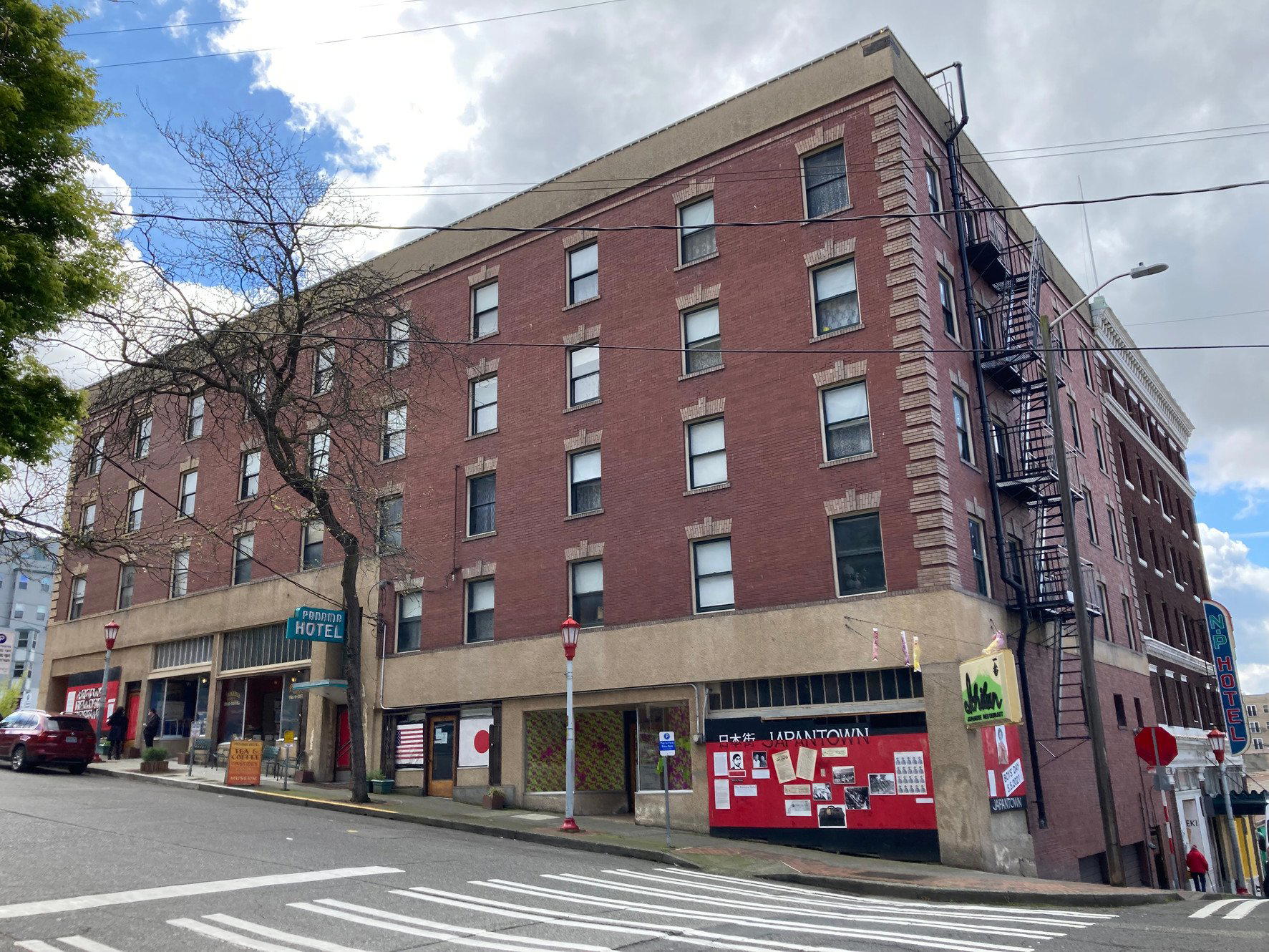
A Building That Carries More Than Guests
Seattle's hotel market divides cleanly between the waterfront luxury tier — where properties like the Four Seasons Hotel Seattle and Lotte Hotel Seattle compete on amenity depth and views — and a smaller category of historically grounded independents that earn their place through provenance rather than polish. The Panama Hotel at 605 South Main Street occupies that second category so completely that comparison to the full-service downtown tier is almost beside the point. This is a 1910 Registered Historic Landmark in the Chinatown-International District, and the building's layered past is present in every corner of the guest experience, from the tea house on the ground floor to the bathhouse artifacts still visible beneath a glass floor panel.
That visibility is the operative detail. The Panama Hotel operated as a bathhouse for Japanese immigrants in the early twentieth century, and during the forced internment of Japanese Americans beginning in 1942, the basement became a storage vault for the belongings of families who believed, correctly, that they would return. Some of those possessions remain. The glass-panel floor in the tea house reveals them directly. Few lodging experiences in the Pacific Northwest place guests this close to a documented, tangible piece of American history, not as a curated exhibit behind rope lines, but as the literal floor beneath your feet.
The Chinatown-International District as a Hotel Address
The neighborhood context shapes the stay in ways that no amount of lobby design can replicate. The Chinatown-International District has operated as a working residential and commercial district for over a century, with a density of Vietnamese, Chinese, Filipino, and Japanese-owned businesses that reflects waves of immigration rather than any single curatorial vision. Staying here means walking out to pho at 8am, finding Japanese grocery staples two blocks over, and returning through streets where the signage shifts language mid-block. For guests arriving from the Fairmont Olympic Hotel tier of downtown Seattle, the contrast is immediate and intentional.
The neighborhood also sits at a practical crossroads. Pioneer Square is a short walk west, the ferry terminals and waterfront are accessible on foot, and light rail connections to SeaTac and Capitol Hill run nearby. Guests who want to cover Seattle's dining and cultural geography without relying on ride-shares find the location logistically sound, even if the immediate surroundings prioritize neighborhood texture over visitor convenience. See our full Seattle restaurants guide for context on what the broader city offers across dining categories.
What the Room Experience Actually Is
Panama Hotel does not position itself against Hotel 1000 or the Ace Hotel Seattle on thread counts or technology integration. The accommodation here is historic-building lodging: rooms shaped by a 1910 structure, with the character irregularities that entails. Ceiling heights, window placement, and room geometry reflect a century-old floor plan rather than a contemporary design brief. Guests who arrive expecting boutique-hotel amenity parity will need to recalibrate. Guests who arrive understanding that the building itself is the primary feature will find the overnight experience coherent with that premise.
What the rooms offer is something harder to replicate than a rainfall shower or a Bluetooth speaker: the specific atmosphere of sleeping inside a building with a documented, unbroken connection to one of Seattle's most consequential communities. The 11th Avenue Inn Bed and Breakfast and Hotel Five offer their own versions of smaller-scale, character-driven Seattle lodging, but neither carries the specific historical weight that makes the Panama's overnight proposition distinct. Among American hotels that function simultaneously as living memorials, the comparison set is genuinely small, closer in spirit to properties like Troutbeck in Amenia, where the building's documented past is central to the guest proposition, than to any Seattle peer.
The Tea House as Anchor
The ground-floor tea house is where most visitors encounter the Panama Hotel first, and for many it remains the primary draw. The format sits within a wider Pacific Northwest tea culture that has grown considerably in the past decade, with Seattle's Asian American communities supporting a range of tea service traditions that extend well beyond the decorative. The Panama's tea house operates within that broader context while also functioning as a community gathering point, a memorial space, and a place where the building's history is most directly legible to first-time visitors through the glass floor installation above the basement artifacts.
For guests considering properties with more elaborate F&B; programming, the Hotel Ballard offers a different neighborhood orientation with its own dining character, and Fairmont Olympic maintains full restaurant service downtown. The Panama's tea house is not a substitute for a full hotel dining program; it is a specific, historically anchored room that rewards slowing down rather than moving through.
Where It Sits in the Wider Independent Hotel Conversation
Properties that carry genuine historical weight without institutional backing occupy a specific and increasingly pressured niche in American hospitality. The Fifth Avenue Hotel in New York City and Raffles Boston operate within that tension at the luxury end, where heritage is a premium differentiator. The Panama Hotel operates without that resource base, which means the guest experience is uneven by the standards of the luxury tier but authentic in ways that no amount of renovation capital can manufacture. Among properties where the visit carries civic significance, where staying, or simply taking tea, constitutes a small act of acknowledgment toward a community's history, the Panama sits in rare company.
For readers mapping a broader American independent hotel itinerary, properties like SingleThread Farm Inn in Healdsburg, Post Ranch Inn in Big Sur, and Auberge du Soleil in Napa each define their identity through place and specificity rather than brand architecture. The Panama Hotel belongs in that broader conversation about what makes a property matter, even if it operates at a fraction of those price points and without comparable amenity depth. See also: Amangiri in Canyon Point, Canyon Ranch Tucson, Kona Village in Kailua Kona, Little Palm Island in Little Torch Key, Sage Lodge in Pray, Aman New York, Aman Venice, Badrutt's Palace Hotel in St. Moritz, Four Seasons at The Surf Club in Surfside, and Hotel Bel-Air in Los Angeles for the wider range of what place-specific lodging can mean across American markets.
Planning Your Visit
The Panama Hotel is located at 605 South Main Street in the Chinatown-International District, within walking distance of Pioneer Square and the International District/Chinatown light rail station. Given the building's scale and historical significance, it attracts both overnight guests and day visitors to the tea house; arriving on weekday mornings offers a quieter engagement with the space. Travelers prioritizing amenity-complete hotel experiences may find properties like Four Seasons Hotel Seattle or Lotte Hotel Seattle a better operational fit. Those for whom the building's documented history is the primary draw should contact the hotel directly, as room availability is limited by the property's scale.
Fast Comparison
| Venue | Price | Awards |
|---|---|---|
| Panama Hotel and Tea HouseThis venue — the venue you are viewing | Not listed | Not listed |
| Four Seasons Hotel Seattle | Not listed | Michelin Guide New Hotels New Hotel · Michelin Selected |
| Hotel 1000 | $300–500 | 1 Michelin Key |
| Lotte Hotel Seattle | Not listed | 1 Michelin Key · Virtuoso Luxury Hotel Partner |
| Thompson Seattle | Not listed | Michelin Selected · Forbes Recommended |
| Tulalip Resort Casino | $100–200 | Forbes Recommended |
Continue exploring
More in Seattle
Hotels in Seattle
Browse all →
Bars in Seattle
Browse all →
Restaurants in Seattle
Browse all →
Details
- Historic
- Cozy
- Intimate
- Weekend Escape
- Historic Building
- Wi Fi
Cozy and evocative with pre-WWII furniture in original rooms and exposed brick walls displaying large black-and-white photos in the tea house.