Monachyle Mhor Hotel
Monachyle Mhor Hotel sits in the Balquhidder Glen, a remote fold of the Southern Highlands where Loch Voil stretches below and the surrounding hills absorb most of the noise the modern world makes. The hotel has built a reputation as a serious dining destination in a part of Scotland where the kitchen tends to follow the land rather than the menu calendar. For travellers prepared to commit to the journey, the reward is a level of quiet and culinary focus that urban alternatives rarely match.

Pearl is the En Primeur Club membership app, where members save venues, book tables and use the concierge.
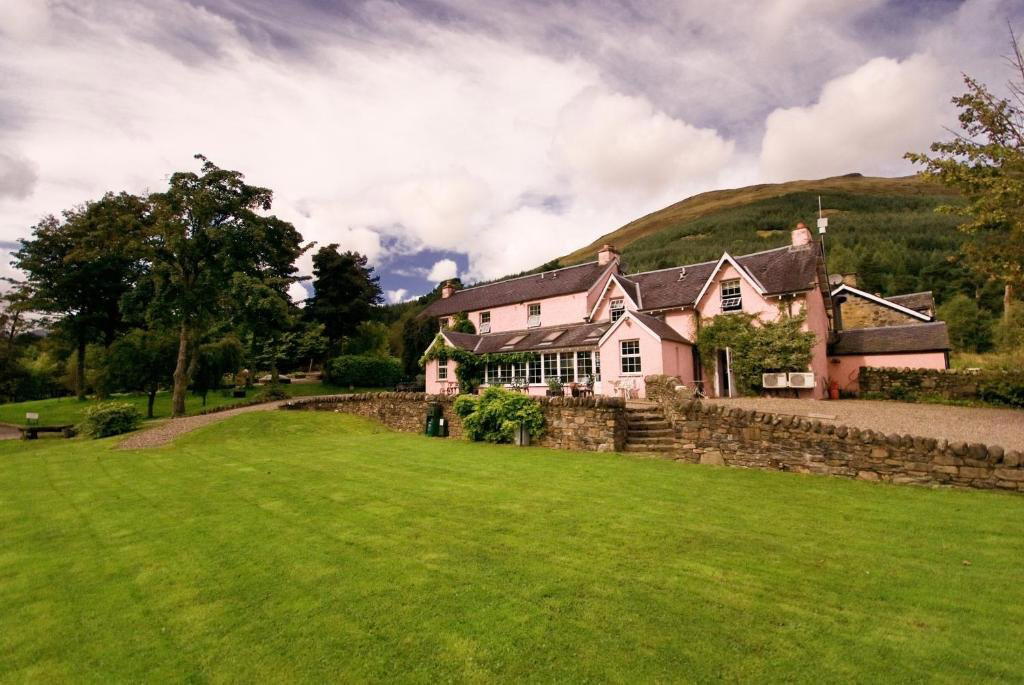
Where the Glen Does the Work
There is a category of Scottish highland property that positions remoteness as its primary credential. Monachyle Mhor Hotel, set at the head of Loch Voil in Balquhidder Glen, belongs to this group but operates with a degree of editorial seriousness that separates it from the tartan-and-taxidermy tier. The approach road alone, a single-track lane that follows the loch shore for several miles north of Balquhidder village, constitutes a form of decompression. By the time the pink-washed farmhouse comes into view against the tree line, the transition from urban tempo to highland pace is largely complete.
Architecturally, the property reads as layered rather than designed from scratch. The original farmhouse structure anchors the site, with additions that have expanded accommodation and dining capacity without erasing the agricultural bones of the building. This approach to rural hospitality development, working with existing fabric rather than replacing it, characterises a number of the more considered highland properties, and distinguishes them from purpose-built lodges that impose a design vocabulary on the landscape rather than drawing from it. For comparison, properties like Langass Lodge in Na H-Eileanan An Iar and Dun Aluinn in Aberfeldy operate within a similar logic: the building serves the setting rather than competing with it.
The Physical Space and Its Logic
Scottish highland hospitality has developed two broadly distinct spatial philosophies in recent decades. The first centres on the grand lodge: formal rooms, high ceilings, staff in uniform, the theatre of aristocratic rural life recreated for a paying audience. Gleneagles in Auchterarder represents this tradition at scale, with all the infrastructure that implies. The second approach, which Monachyle Mhor exemplifies, is closer to the owner-operated farmhouse hotel: fewer rooms, less ceremony, a kitchen that takes its cues from what the glen, the loch, and the surrounding estate can provide.
The distinction matters for how you read the design. At Monachyle Mhor, spaces are intimate rather than impressive. The loch-facing orientation is consistent throughout, and the property's low profile means the view is always the dominant visual element rather than the architecture itself. This is not a building that competes with its surroundings. It frames them. Comparable design logic appears at properties like Hell Bay Hotel in Bryher, where the architectural restraint is similarly deliberate, and at Lifeboat Inn in St Ives, where the relationship between building and water follows a similar principle of orientation over ornamentation.
Room categories at Monachyle Mhor reflect the incremental development of the property. Older rooms in the farmhouse core have a different character from those in later extensions, and guests who have stayed multiple times tend to develop preferences based on outlook and proximity to the dining room rather than room size alone. The loch-facing rooms offer the most direct engagement with the property's primary asset: the water and the hills beyond it.
The Kitchen as Context
In parts of rural Scotland, the relationship between a hotel kitchen and its immediate geography is direct in a way that urban dining rooms cannot replicate. The Southern Highlands around Balquhidder supply venison, lamb, freshwater fish, and foraged material across a calendar that shifts noticeably by season. A kitchen operating within this geography, as Monachyle Mhor's does, is working with ingredients whose provenance is sometimes measurable in miles rather than supply chain documentation. This is not a marketing position unique to this property; it describes a broader shift in highland hotel dining over the past two decades, during which kitchen teams began treating local sourcing as a structural commitment rather than an occasional feature. Properties like The Newt in Somerset and Lime Wood in Lyndhurst have pursued comparable models in English contexts, anchoring their dining to estate-level production systems.
For those comparing Scottish destinations, Burts Hotel in Melrose and Glen Mhor Hotel in Highland represent different points on the spectrum of Scottish kitchen ambition, both credible but operating in less remote settings where the supply geography is more conventional. Monachyle Mhor's position at the end of a long loch road creates a supply constraint that functions simultaneously as a culinary discipline.
The Balquhidder Position
Balquhidder sits roughly equidistant between Stirling and Killin, accessible from the A84 via Kingshouse. The journey from Stirling takes around 45 minutes under normal conditions, from Glasgow somewhat longer. This is not a property you arrive at incidentally. It requires a decision and a drive, which means the guest profile skews toward people who have researched the destination and committed to the remoteness rather than discovering it by accident. This self-selection produces a particular atmosphere in the communal spaces: guests who are present because they chose this specific experience rather than because it was convenient. For the broader context of what the Stirling region offers, our full Stirling restaurants and hotels guide maps the range from city-centre options to outlying properties.
Within Scotland's wider range of owner-operated rural hotels, Monachyle Mhor sits in a peer group that includes The Drovers Inn and Ardbeg House in Port Ellen, properties where the character of the place is inseparable from its physical location and the decisions of the people who run it. The contrast with urban Scottish hospitality options, such as Malmaison Edinburgh or Glasgow Grosvenor Hotel, is not a matter of quality but of category. These are different products oriented toward different trips.
Planning Your Stay
Monachyle Mhor operates within the rhythms of highland hospitality, where demand peaks sharply in late spring and through summer, and again during the autumn deer-stalking and colour season. Guests planning a weekend visit during these windows should expect that the property fills several weeks or months ahead. The quieter winter months offer a different version of the same place: fewer guests, heavier weather, and a kitchen that shifts to heartier register. Booking directly through the hotel's website will give the clearest view of room availability and current dining formats.
For those building a wider Scottish itinerary, the surrounding region contains enough material for several days: Balquhidder churchyard (where Rob Roy MacGregor is buried), the western end of the Trossachs National Park, and the drive to Killin along Loch Tay. Pairing Monachyle Mhor with an urban base in Stirling or Glasgow gives access to both the highland remoteness and the infrastructure of a city stay. Travellers extending further south or east might compare with properties like Estelle Manor in North Leigh or Babington House in Kilmersdon for a sense of how the owner-operated rural hotel category performs in English settings.
Comparable Spots, Quickly
| Venue | Price | Awards |
|---|---|---|
| Monachyle Mhor HotelThis venue (the venue you are viewing) | $200–300 | Not listed |
| Lime Wood | Not listed | 2 Michelin Keys · La Liste Top Hotels |
| Muir, A Luxury Collection Hotel, Halifax | $300–500 | 1 Michelin Key · Forbes 4-Star |
| Raffles London at The OWO | $1,000–1,500 | 3 Michelin Keys · World's 50 Best #28 |
| The Connaught | $1,000–1,500 | 3 Michelin Keys · World's 50 Best #49 |
Continue exploring
More in Stirling
Hotels in Stirling
All hotels in Stirling →
Bars in Stirling
Browse all →
Restaurants in Stirling
Browse all →
Wineries in Stirling
Browse all →
Details
- Romantic
- Scenic
- Cozy
- Rustic
- Elegant
- Intimate
- Romantic Getaway
- Weekend Escape
- Anniversary
- Celebration
- Waterfront
- Garden
- Historic Building
- Panoramic View
- Wi Fi
- Room Service
- Sauna
- Mountain
- Waterfront
- Garden
- Wheelchair Accessible
Warm and inviting with roaring fires, natural materials like wood and slate, eclectic designer furnishings, and dramatic loch and mountain views creating a rustic yet sophisticated highland retreat.