







Bangkok's oldest luxury hotel, operating since 1876 on the Chao Phraya River, holds a position few riverfront properties in Southeast Asia can match. Ranked #7 in the 2025 World's 50 Best Hotels and awarded Michelin 3 Keys in 2024, its 331 rooms, twelve dining outlets, and a river-crossed spa define what long-form institutional hospitality looks like in practice.
A River Address That Has Compounded Over 150 Years
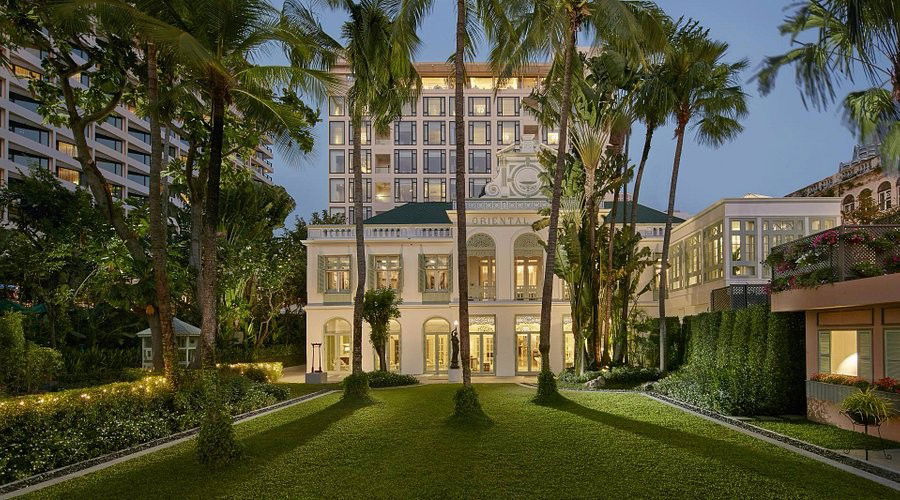
Arriving at 48 Oriental Avenue by river taxi rather than road is the cleaner editorial choice, and not just for atmosphere. Approaching from the Chao Phraya, the white colonial facade of the Authors' Wing appears as it would have to a 19th-century steamship passenger, flanked now by the taller River Wing behind it. The contrast is instructive. Bangkok's luxury hotel market has expanded aggressively over the past decade, with Capella Bangkok, Four Seasons Bangkok at Chao Phraya River, and Rosewood Bangkok all arriving on or near the same riverbank. What sets the Mandarin Oriental apart from those newer arrivals is not sentiment but credential accumulation: a Michelin 3 Keys rating in 2024, a #7 ranking in the 2025 World's 50 Best Hotels (up from #10 in 2023 and #12 in 2024), and 99.5 points from La Liste's Leading Hotels ranking in 2026. That is a depth of institutional recognition that newer properties, however architecturally ambitious, have not yet earned.
The interior registers the same layering. Carved teak, ornate lanterns suspended from the atrium ceiling, and silk fabrics in muted golds are not decorative choices made by a recent rebrand; they reflect a property that has been refining its own visual language for generations. A lotus-flower fountain marks the lobby's acoustic centre, its sound functioning as a low-grade decompression mechanism for anyone arriving from Bangkok's traffic. The hotel occupies three distinct wings, the original 1876 building among them, and the transitions between architectural eras are deliberate rather than concealed.
Where the Dining Program Sits in Bangkok's Competitive Set
Bangkok has become one of Southeast Asia's most pluralistic dining cities, and a hotel with a dozen restaurants and bars is either a genuine asset or a distraction, depending on execution. At Mandarin Oriental Bangkok, the F&B; portfolio spans enough registers to function as a meaningful part of the stay rather than a fallback option. Le Normandie holds a one-MICHELIN-Star, placing it in the upper tier of Bangkok's formal dining alongside a small number of hotel restaurants that have sustained Michelin recognition across multiple cycles. For guests assessing which Bangkok hotel delivers the most credible fine-dining infrastructure under one roof, that single star carries weight that neither Park Hyatt Bangkok nor The Peninsula Bangkok currently matches with an equivalent in-house credential.
The newer Kinu by chef Takagi Kazuo represents the hotel's willingness to add formats that Bangkok's dining market has moved toward rather than simply maintaining legacy outlets. Baan Phraya operates as a classic Thai reference point. Sala Rim Naam, reached by a short shuttle boat crossing the river, combines traditional Thai cuisine with nightly performances of classical Thai dance and music. That physical separation from the main building is functionally useful: it gives the restaurant a sense of occasion that most hotel dining rooms cannot manufacture through interior design alone.
On the Question of Wine and the Cellar Program
A hotel that has hosted Joseph Conrad, Graham Greene, W. Somerset Maugham, Grace Kelly, Elizabeth Taylor, and members of the Thai royal family across its history has also served wine to those guests across that same arc of time. Institutional hotel cellars in this category tend to accumulate depth through longevity rather than through a single sommelier's editorial vision, and Mandarin Oriental Bangkok's program reflects that model. Le Normandie's French-anchored format provides the most focused context for the cellar: classic French cuisine at the starred level in Bangkok requires a Bordeaux and Burgundy spine, and the restaurant's sustained Michelin recognition implies that the wine program has been maintained at a level consistent with that recognition. For guests whose primary criterion is a deeply indexed cellar with senior sommelier guidance, the most efficient approach is to engage Le Normandie specifically rather than treating the broader hotel bar program as equivalent. The hotel's position in the 99.5-point La Liste bracket for 2026 also signals that the overall hospitality program, of which wine service is a component, is being assessed at a peer level with the top tier of global hotel dining. See our full Bangkok restaurants guide for how the city's wine-forward dining options compare beyond the hotel.
The Room Configuration and What It Implies
The 331-key count is relevant context. Properties like The Siam, with its far smaller footprint, operate in a different service model where staff-to-guest ratios are structurally higher. Mandarin Oriental Bangkok compensates through universal butler service across all room categories, nightly turndown, and walk-in shower plus separate deep-soaking bathtub as standard across the portfolio. The rooms draw on teak joinery and silk fabrics in a palette that reads as specifically Thai rather than generically Asian-luxury. Most face the Chao Phraya through oversized French windows; rooms in the courtyard-facing positions offer a quieter alternative for guests prioritising sleep over panorama.
The suites extend those furnishings into separate living areas, twin vanities, and balconies. The hotel's guest history of foreign dignitaries, celebrities, and Thai royal family members is not incidental background: it reflects a service culture calibrated for guests who expect anticipatory rather than reactive hospitality. At a published rate starting around $668 per night, the property sits in Bangkok's leading pricing tier, above The Sukhothai Bangkok and at peer level with The Okura Prestige Bangkok on a base-rate basis, though suite categories vary significantly across the competitive set.
The Spa and the Logic of Crossing the River
Spa operates on the opposite bank of the Chao Phraya from the main hotel, accessed by the same shuttle boat used to reach Sala Rim Naam. That separation creates a spatial break from the hotel that most urban spas housed within their parent property cannot replicate. The treatment program includes CBD-oil-infused massage, ice bath protocols, and herb-based therapies sourced from northeastern Thailand's Isan region. The Isan sourcing is a specific regional reference rather than a generic appeal to Thai botanicals, and it places the spa's ingredient logic within a tradition of northeastern herbal medicine that operates somewhat differently from the central Thai and royal court traditions more commonly cited in Bangkok spa marketing.
Planning the Stay: Timing, Access, and Context
Bangkok's cool season, running from mid-November through mid-February, is the practical window for maximising the hotel's outdoor and riverside dimensions. Humidity and heat outside that window are not prohibitive, but the courtyard gardens, riverside terrace dining, and the boat journey to the spa and Sala Rim Naam are materially more comfortable in cooler months. The hotel's Saphan Taksin BTS station is walkable from the property, giving access to the Silom and Sukhumvit corridors without relying on road transport. The Chao Phraya ferry pier adjacent to the hotel connects directly to Wat Pho, Wat Arun, and the Grand Palace, making the riverside location genuinely functional for temple visits rather than merely scenic.
The Oriental Thai Cooking School operates within the hotel and runs classes that draw on the property's long association with Thai culinary tradition. For guests oriented toward wine and dining, advance coordination with Le Normandie for cellar access or sommelier consultation is advisable given the restaurant's reputation and the hotel's sustained Michelin recognition. For broader Thailand context, the country's luxury hotel tier extends well beyond Bangkok: Amanpuri in Phuket, Four Seasons Resort Chiang Mai, Phulay Bay, A Ritz-Carlton Reserve in Krabi, Six Senses Yao Noi in Phang Nga, Samujana Villas in Koh Samui, Soneva Kiri in Trat, Anantara Golden Triangle in Chiang Rai, Pimalai Resort & Spa in Koh Lanta, and Aleenta Resort & Spa in Pranburi each address a different format and geography. The Bangkok picture is covered in our full Bangkok hotels guide, with bars, wine, and experiences guides rounding out the city coverage.
For comparative reference outside Thailand, Mandarin Oriental Bangkok occupies a position in its hotel group's portfolio analogous to what Aman New York, The Fifth Avenue Hotel, or Aman Venice represent in their respective cities: a property whose identity is inseparable from its specific urban address and whose accumulation of history is as much a practical feature as any amenity.
Frequently Asked Questions
- What is the most popular room type at Mandarin Oriental Bangkok?
- River-facing rooms in the River Wing draw consistent preference for their Chao Phraya views through oversized French windows. All 331 rooms include butler service and the standard teak-and-silk Thai design language, but the panoramic aspect commands the highest demand among guests choosing between courtyard and river orientations. The hotel's sustained #7 ranking in the 2025 World's 50 Best Hotels and Michelin 3 Keys recognition in 2024 signal that room quality across categories is maintained at a level consistent with that peer set.
- What is the defining characteristic of Mandarin Oriental Bangkok?
- Institutional depth at a specific city address over 150 years of continuous operation, with award credentials that have accumulated rather than been manufactured: Michelin 3 Keys (2024), #7 in the 2025 World's 50 Best Hotels, and 99.5 points from La Liste in 2026. No other Bangkok hotel combines that breadth of current recognition with that length of operating history on the same riverside site.
- Should I book Mandarin Oriental Bangkok in advance?
- Yes, particularly for cool-season travel between mid-November and mid-February, which is the highest-demand window given Bangkok's climate. The hotel's consistent top-ten World's 50 Best Hotels placement and its position as Bangkok's oldest luxury hotel create sustained occupancy pressure. Le Normandie, the one-MICHELIN-Star restaurant, warrants a separate reservation made well ahead of arrival. The hotel's base rate from around $668 per night reflects peak-tier Bangkok pricing, and preferred room categories sell out at that tier with meaningful lead time.
- When does Mandarin Oriental Bangkok make the most sense to choose?
- For guests whose stay combines cultural sightseeing, serious dining, and a spa program, the hotel's riverside location is its most practical attribute: the adjacent Chao Phraya ferry pier connects to Wat Pho, Wat Arun, and the Grand Palace, while the BTS Saphan Taksin station is walkable. The cool season from mid-November to mid-February maximises the outdoor dimensions. Against newer Bangkok luxury arrivals with comparable pricing, the hotel's Michelin 3 Keys rating and World's 50 Best Hotels position provide the clearest external validation for the rate premium.
- Does Mandarin Oriental Bangkok have a credible wine program at its fine-dining level?
- Le Normandie, the hotel's one-MICHELIN-Star French restaurant, operates the most focused wine context within the property. A sustained Michelin star in a French-format restaurant at this price tier implies a cellar maintained at a standard consistent with that recognition, with Bordeaux and Burgundy forming the natural structural core. Guests seeking sommelier-guided wine experiences should engage Le Normandie directly rather than approaching the question through the broader hotel bar program.
Just the Basics
A compact comparison to help you place this venue among nearby peers.
| Venue | Notes | Price |
|---|---|---|
| Mandarin Oriental Bangkok | This venue | |
| Capella Bangkok | Michelin 2 Keys | |
| Rosewood Bangkok | Michelin 2 Keys | |
| Park Hyatt Bangkok | Michelin 2 Keys | |
| The Peninsula Bangkok | Michelin 2 Keys | |
| Anantara Siam Bangkok Hotel |
Preferential Rates?
Our members enjoy concierge-led booking support and priority upgrades at the world's finest hotels.
Access the Concierge