Anantara Golden Triangle Elephant Camp & Resort





2 Michelin Keys · La Liste Top Hotels · Mr & Mrs Smith Seal of Approval
At the confluence of Thailand, Laos and Myanmar, Anantara Golden Triangle Elephant Camp & Resort occupies a forested ridge above the Mekong with views across all three countries. The property holds Chiang Rai's first and only Two Michelin Keys designation and its sole Virtuoso membership, placing it in a distinct tier among northern Thailand's luxury resorts. Rates from $1,840 per night reflect both the remoteness and the depth of programming on offer.

Pearl is the En Primeur Club membership app, where members save venues, book tables and use the concierge.
Where Three Countries Meet: The Setting at Golden Triangle
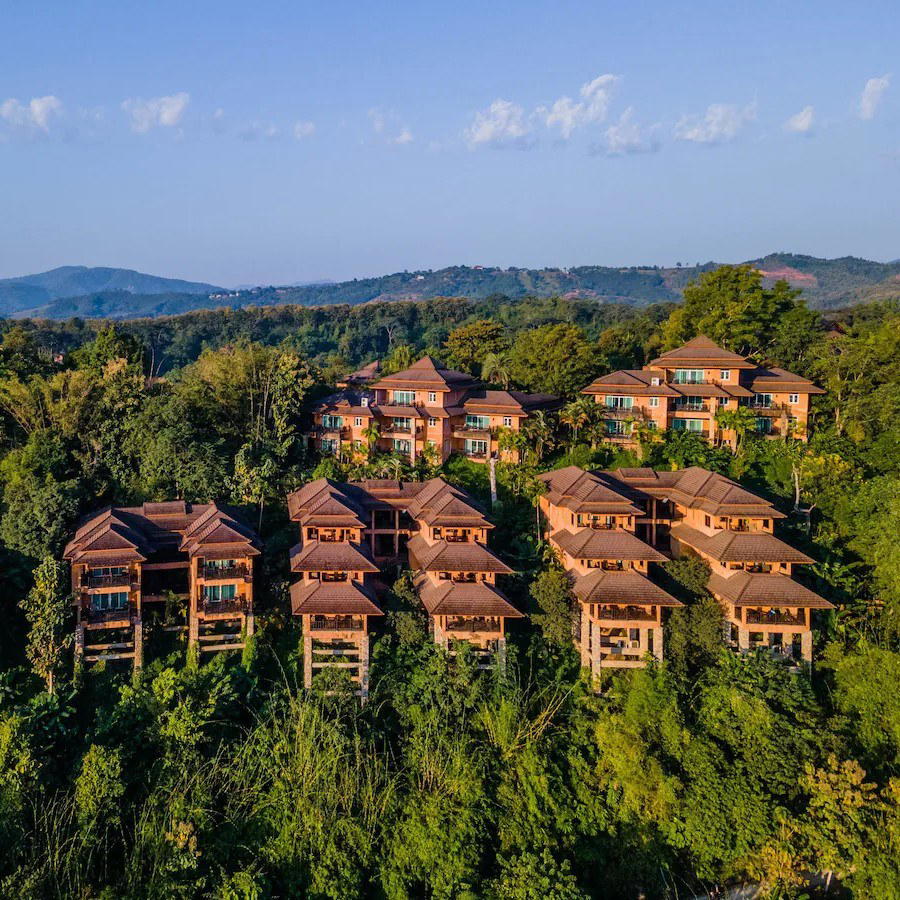
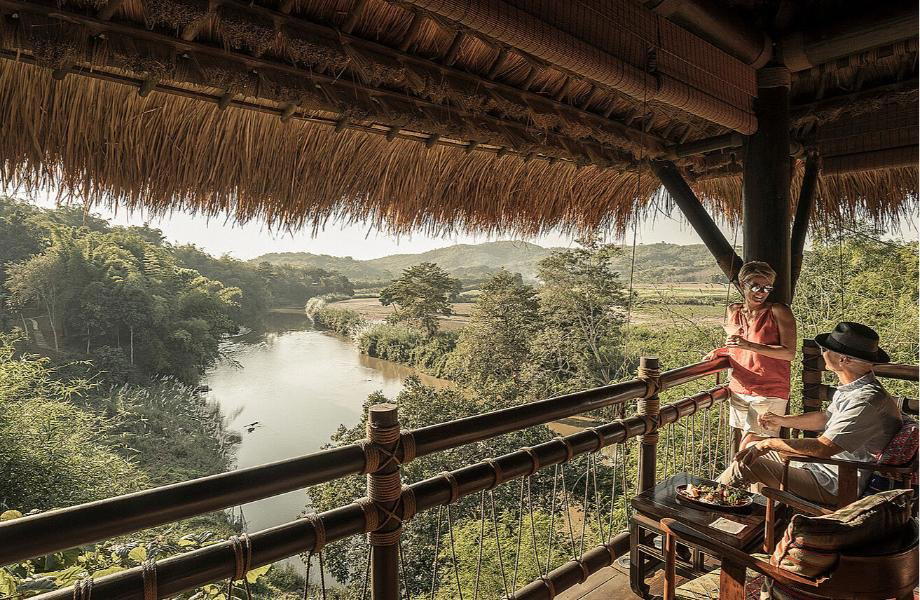
Approach Anantara Golden Triangle from the road that climbs the wooded ridge above Sop Ruak, and the geography announces itself before the resort does. At the precise point where the Mekong receives the Ruak River, the borders of Thailand, Laos and Myanmar converge on the water below. The resort sits above this confluence on forested high ground, positioned so that the three-country panorama functions not as a backdrop but as the organising principle of the entire property. Almost every public space and a significant proportion of guest rooms face the river bend, meaning the view is less a feature of certain rooms and more the architectural logic of the whole site.
This kind of geographic specificity is rare in Thai luxury hospitality, where most high-end properties are beach-fronting or city-centred. The Golden Triangle's interior setting places it in a smaller category alongside jungle-anchored properties in the north, including the Four Seasons Tented Camp Golden Triangle, which operates on comparable terrain a short distance away. The two properties represent the best of what this very specific geography can support: remote, river-view, conservation-linked luxury that has no direct equivalent in the beach resort circuits of Phuket or Krabi.
Design in Context: Modern-Eastern Materiality on a Jungle Ridge
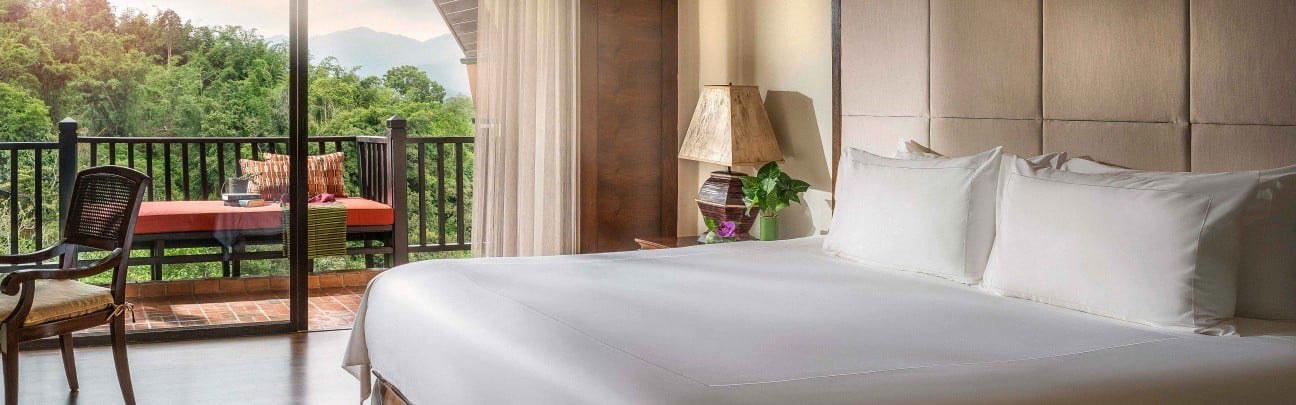
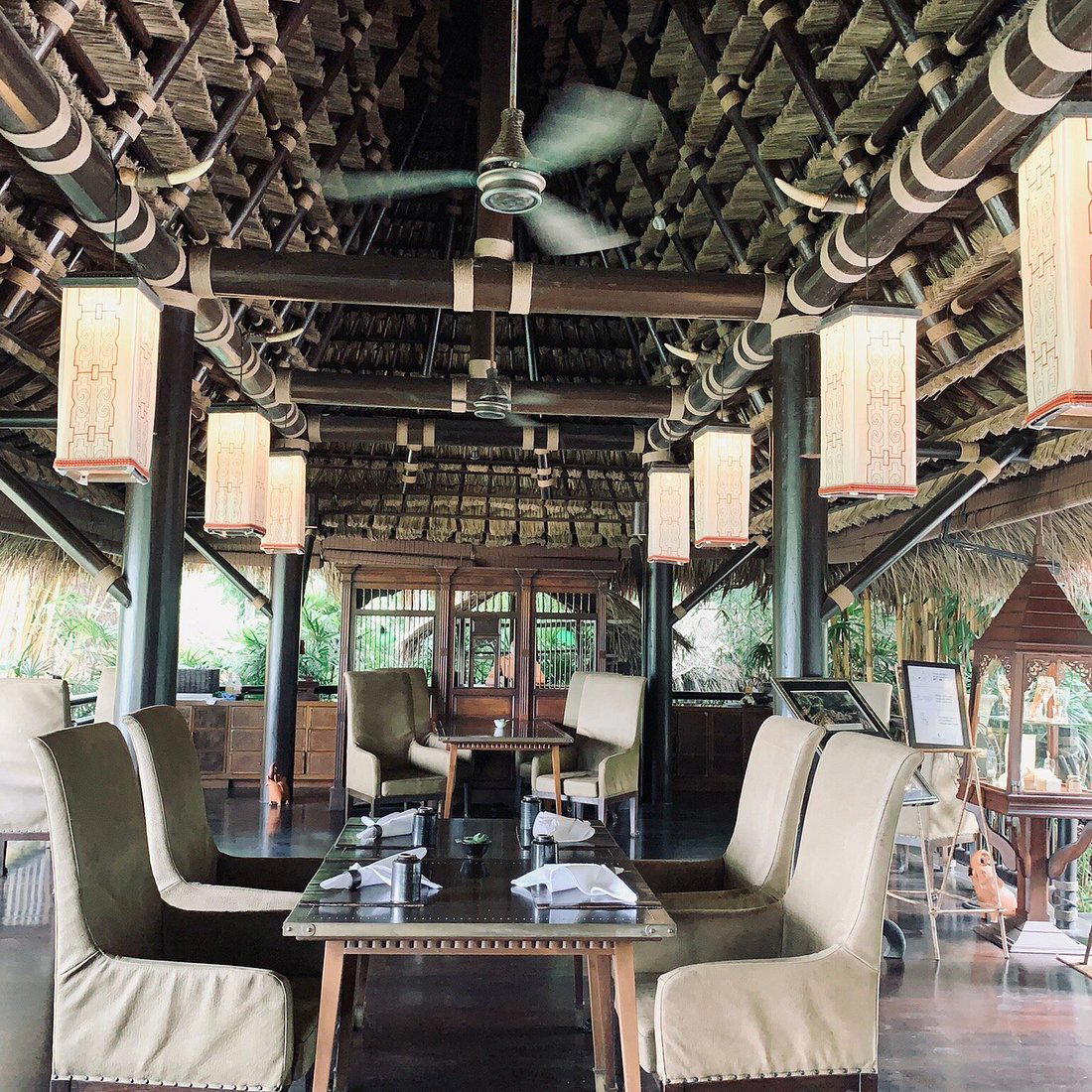
The resort's architecture navigates the tension between its ageless natural setting and the demands of contemporary luxury travel. The design language draws on a modern-Eastern vocabulary: teak and terrazzo floors anchor the rooms and suites without tipping into pastiche, while sprawling bathrooms with two-person bathtubs reflect the standard expectations of the international luxury market rather than any strict regional tradition. The effect is deliberate contrast rather than seamless integration. Guests are not asked to rough it in exchange for the wilderness view; the interiors make clear that the jungle remains outside, where it belongs.
The 61-key total, spread across 40 deluxe rooms, 15 suites and pool suites, 6 family suites and family pool suites, and 2 luxury tents, keeps the property at a scale where the ridge setting feels shared rather than crowded. The two luxury tents, in particular, represent a design category that northern Thailand's lodge-format properties have developed in response to a specific traveller profile: guests who want proximity to the natural environment without sacrificing the service depth of a full-scale hotel. Properties like Soneva Kiri and Six Senses Yao Noi have refined similar approaches in coastal contexts; here the format is applied to a landlocked jungle environment where the experiential premium comes from exclusivity of location rather than beach access.
The Dusk-to-Dawn Bubble and Canopy Dining: Dining Architecture as Experience
Thai luxury dining has progressively moved toward formats where the setting carries as much weight as the food itself. Anantara Golden Triangle applies this logic at two distinct scales. The Canopy treetop dining format lifts guests above the forest floor to eat at height, with the river panorama and the canopy itself framing the meal. The Jungle Bubble runs from dusk to dawn, positioning guests for dinner and breakfast within transparent enclosures in close proximity to the elephant herd. These are not gimmicks appended to a conventional restaurant programme; they are the primary dining architecture of the property.
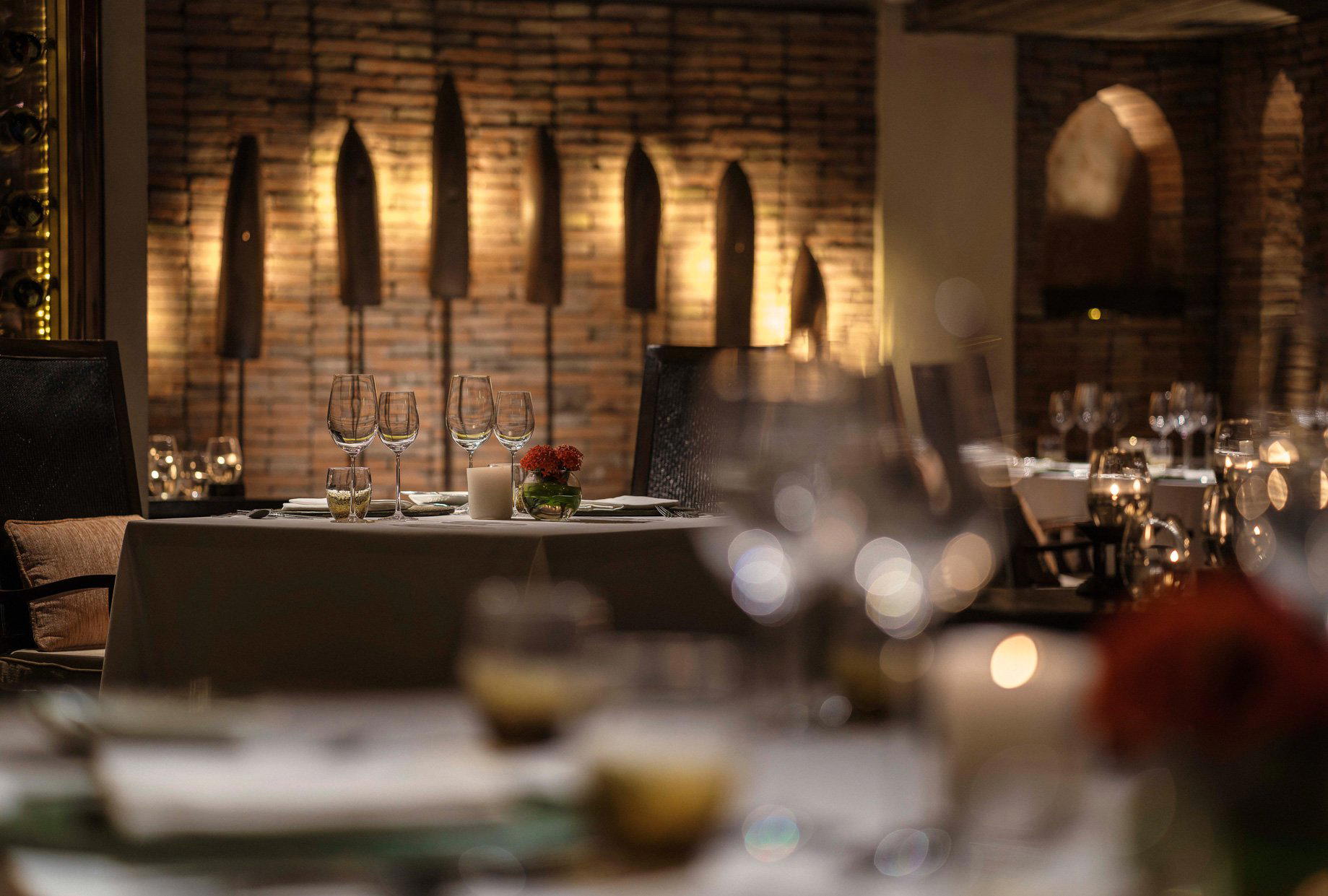
The ground-level restaurant, Samsarn, takes a different approach, framing the Golden Triangle's culinary heritage through the serene physical setting of the ridge. Northern Thai cuisine occupies a distinct regional tradition from the central Thai cooking that dominates Bangkok hotel dining, drawing on Lanna culinary history and cross-border influences from the Shan States and Yunnan. A property positioned at the literal intersection of those border cultures has obvious material to work with, and Samsarn's framing as a space for the region's heritage reflects the broader editorial logic of the resort: the geography is the justification for everything else.
Credentials and Competitive Position
For reference, properties like Mandarin Oriental Bangkok and Amanpuri in Phuket represent the Thai end of the Michelin Keys cohort in their respective settings. In Chiang Rai, this recognition carries a market-positioning implication: the property does not compete with the mid-range resort stock of the north but is positioned as the designated luxury anchor for a province that has historically been underserved by that tier.
The Virtuoso membership reinforces this positioning. As the only Virtuoso member hotel in Chiang Rai, the property accesses a travel agent network that routes high-spend international travellers toward specific properties in each destination. This distribution advantage matters in a location where walk-in or spontaneous booking is structurally unlikely given the remoteness of the site. La Liste placed the hotel at 91 points in its 2026 rankings, adding a second layer of international editorial recognition beyond the Michelin credential. Minor Hotels, the parent group, operates the Anantara brand across a range of settings; for further context on how the brand performs in other Thai environments, see Anantara Layan Phuket Resort, Anantara Hua Hin Resort, and Anantara Rasananda Koh Phangan Villas.
The Elephant Programme: Conservation as Core Infrastructure
Elephant programming in northern Thailand ranges from facilities with limited welfare oversight to conservation-linked camps with research mandates. Anantara Golden Triangle sits at the more credentialled end of that spectrum, operating what it describes as an award-winning elephant camp with a scientific research and conservation component. The distinction matters because it changes the nature of the guest relationship with the animals: the framing is participatory and educational rather than purely recreational, which aligns the property with a traveller profile increasingly attentive to welfare standards in wildlife experiences.
The Golden Triangle Explorer package consolidates the property's programming into a structured format: elephant interaction, spa, cooking, and cultural experiences across a defined stay. The Jungle Bubble dusk-to-dawn format overlaps with the elephant programme, offering dinner and breakfast in proximity to the herd. These two formats together constitute what differentiates the property from resort-only luxury options in northern Thailand, including Four Seasons Resort Chiang Mai, which competes in the same tier but without the wildlife dimension.
Facilities and Physical Scope
Beyond the headline programming, the property's infrastructure covers a fitness centre with squash and tennis courts, a swimming pool, the Opium Terrace bar, and a spa with five treatment rooms offering traditional Thai massage alongside aromatherapy and Ayurvedic treatments. This breadth is consistent with the expectations of the international luxury market for extended stays: a guest spending multiple nights at a remote property needs more than a single draw to remain on-site. The facility depth, combined with the multi-day programming packages, reflects a deliberate strategy to extend average length of stay beyond what a pure sightseeing destination would generate.
Planning a Stay: Logistics and Rates
Chiang Rai International Airport receives several daily connections from Bangkok, making the city accessible from the capital in under two hours by air. From the airport, the resort requires approximately one hour by road, with private transfer available on arrangement. The combination of flight and transfer time means that Anantara Golden Triangle is realistically positioned as a dedicated destination stay rather than a stop within a broader northern Thailand circuit, though pairing it with Chiang Mai adds a city dimension without significant logistical complexity.
Rates begin at $1,840 per night, consistent with the property's positioning at the top of Chiang Rai's accommodation market. At that rate, the per-night cost is justified only if guests engage with the elephant programme, the structured experience packages, and the landscape itself. Guests approaching it purely as a luxury room product will find properties like Phulay Bay, A Ritz-Carlton Reserve in Krabi or Samujana Villas in Koh Samui offer comparable room quality in settings with more inherent variety. The case for Anantara Golden Triangle rests on what surrounds the room, not on the room itself. For a broader view of the Chiang Rai dining and hospitality scene, see our full Chiang Rai guide.
Comparable Venues
Comparable venues nearby, for context on price, style, and recognition.
| Venue | Cuisine | Price | Awards | Notes |
|---|---|---|---|---|
| Anantara Golden Triangle Elephant Camp & ResortThis venue (the venue you are viewing) | Remote jungle mountain sanctuary with storied history and modern luxury | Not listed | 2 Michelin Keys · La Liste Top Hotels | Not listed |
| Four Seasons Tented Camp Golden Triangle, Thailand | luxury tented camp in jungle setting | $1,000–1,500 | La Liste Top Hotels | Golden Triangle |
| Katiliya Mountain Resort and Spa | Contemporary luxury mountain resort with residential villa architecture blending modern amenities with traditional Thai design elements and natural materials. | $100–200 | Michelin Selected | Mae Chan |
| Pa Sak Tong | ultra-luxury private estate villa | $1,500–2,500 | Michelin Selected | Maekorn |
| Riva Vista Riverfront Resort Chiang Rai | Contemporary resort blending modern and Lanna vernacular architecture | Not listed | Michelin Selected | Rim Kok |
| Athita The Hidden Court Chiang Saen Boutique Hotel | Traditional Lanna architecture with modern comforts, family-owned boutique preserving Chiang Saen heritage. | Not listed | Michelin Selected · Tablet Hotels Best New Hotel Designs (Asia) | Chiang Saen |
Recognition history
Dated appearances from independent guides and award organizations, with the underlying list record or original source where available.
Michelin 2 Keys
Michelin
La Liste Top Hotels
La Liste
Mr & Mrs Smith Seal of Approval
Mr & Mrs Smith
Travel + Leisure 100 Favorite Hotels in the World #37 · No. 37
Travel + Leisure · 2026 Travel + Leisure 100 Favorite Hotels in the World
Virtuoso Luxury Hotel Partner
Virtuoso
Full recognition history (7 entries)
Michelin 2 Keys
Michelin
Michelin 2 Keys
Michelin
Anantara Golden Triangle Elephant Camp & Resort
Featured Guides
Continue exploring
More in Chiang Rai
Hotels in Chiang Rai
All hotels in Chiang Rai →
Details
- Scenic
- Quiet
- Elegant
- Rustic
- Sophisticated
- Honeymoon
- Romantic Getaway
- Family Vacation
- Wellness Retreat
- Infinity Pool
- Panoramic View
- Private Villa
- Wi Fi
- Pool
- Spa
- Fitness Center
- Room Service
- Concierge
- Tennis
- Sauna
- Bicycle Rental
- Mountain
- Waterfront
Serene and tranquil jungle sanctuary with peaceful riverside retreat, soundproofed rooms, and relaxing atmosphere praised for tranquility and privacy.