Eco Omo Lodge sits in Jinka, the gateway town for travel into Ethiopia's Omo Valley and its concentration of indigenous communities. For travellers moving between the tribal south and the broader Ethiopian circuit, the lodge occupies a practical and atmospheric position in a region where considered accommodation remains scarce. It represents a grounded option in one of East Africa's most demanding and rewarding travel corridors.

Pearl is the En Primeur Club membership app, where members save venues, book tables and use the concierge.
Where the Omo Valley Begins
Jinka is not a destination in the conventional sense. It is a threshold. The town sits at the northern edge of the South Omo Zone, and for travellers heading deeper into the valley to visit the Mursi, Ari, and Banna communities, it functions as the last reliable logistical base before roads narrow and infrastructure thins. Accommodation in this tier of travel is rarely evaluated against international benchmarks; it is evaluated against what the region offers, and what the journey demands. Eco Omo Lodge operates in that context, positioned as a structured, lodge-format stay in a town where the alternative is often significantly more basic.
For broader orientation across Ethiopia's lodge circuit, our full Jinka restaurants guide maps the town's options, and the lodge sits within a wider regional travel pattern that also includes Evangadi Lodge in Turmi further south, and Sora Lodge as a direct Jinka peer.
The Physical Logic of the Lodge
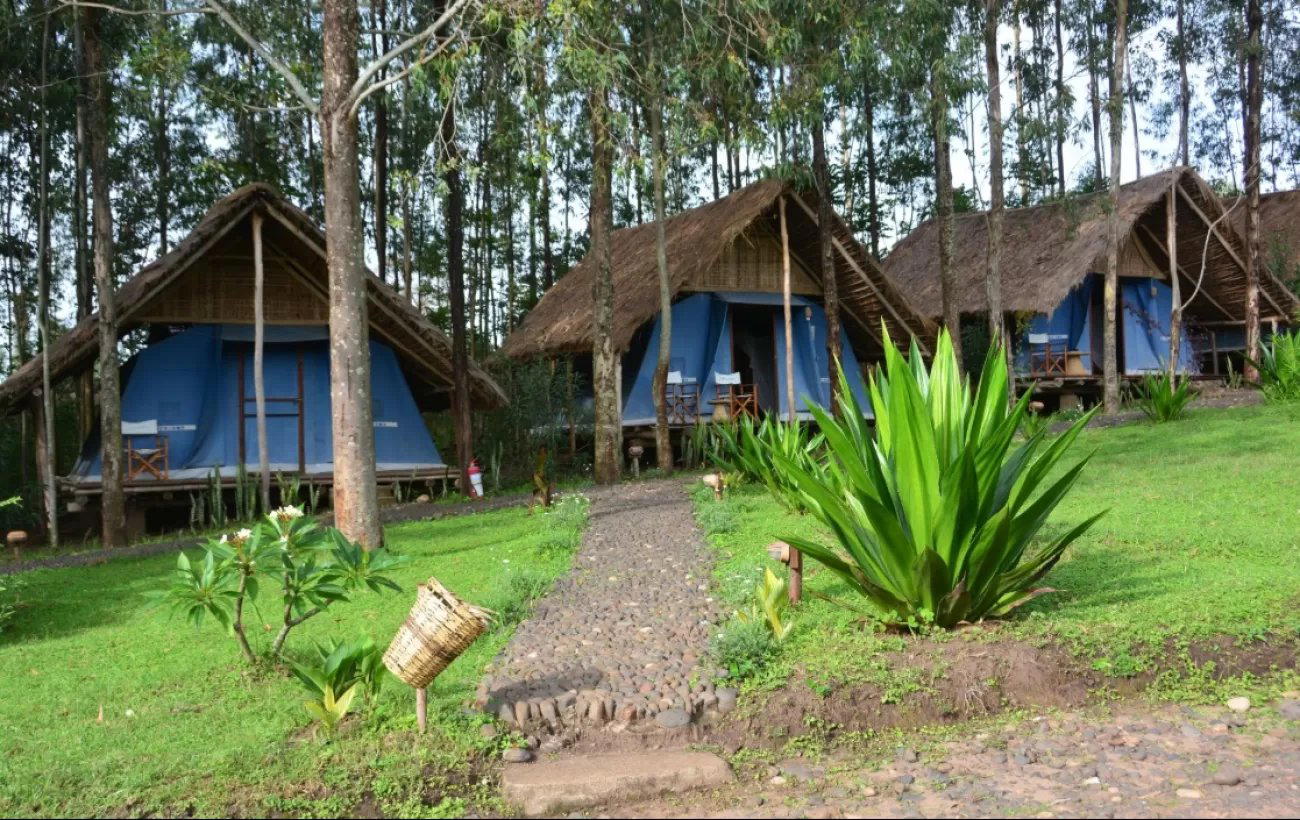
Lodge architecture in the Omo Valley has developed along a consistent logic: structures built low, materials drawn from the surrounding environment, and design that acknowledges the climate rather than fighting it. Thatched roofs, open-sided communal spaces, and shaded walkways are not aesthetic choices so much as functional responses to heat, dust, and the absence of sophisticated building infrastructure. Eco Omo Lodge follows this regional vernacular, which places it within a broader category of East African eco-lodges where the physical environment is the primary design brief.
This approach to building contrasts sharply with the architecture of properties like Amangiri in Canyon Point or Castello di Reschio in Lisciano Niccone, where design operates as a primary differentiator and a significant driver of the premium. In Jinka, design serves survival and comfort under difficult conditions. That is its own discipline, and in a region where the landscape is this extreme, a lodge that reads its environment accurately earns its position.
The lodge's setting in the Omo Valley region means that the surrounding terrain is genuinely part of the proposition. The area around Jinka sits at moderate elevation in the Ethiopian highlands before descending toward the lower, hotter valley floor, which means temperatures are more manageable than at lower-altitude camps further south. For travellers arriving from Addis Ababa, where properties from Ethiopia's growing hospitality development pipeline are covered in our guide to planned hotels in Addis Ababa, the shift to Jinka's lodge format is considerable. That shift is part of the journey's point.
Ethiopia's southern tourism corridor has a small but consistent tier of lodges that operate above the basic guesthouse level without reaching international luxury classification. Sora Lodge and Eco Omo Lodge represent that middle tier in Jinka specifically. Both are reviewed by travellers making the Omo Valley circuit as bases for day trips to communities accessible from the town, including visits facilitated through the Mago National Park system, which requires guide and permit arrangements typically handled through lodge contacts or local operators.
The comparison set for Eco Omo Lodge is therefore not the palace hotels of Europe such as Hotel Du Cap-Eden-Roc or Badrutt's Palace Hotel in St. Moritz, nor the urban luxury of Cheval Blanc Paris or Aman New York. Within that set, the lodge functions as a gateway property: the place where travellers orientate themselves before the harder parts of the journey begin.
For those extending their Ethiopian itinerary northward, the developing lodge circuit in cities like Bahir Dar, Hawassa, and Jimma represents the wider trajectory of Ethiopian hospitality development. Eco Omo Lodge operates in a more established, if more remote, part of that same story.
The Omo Valley as Context
The broader appeal of Jinka as a base is inseparable from what the Omo Valley represents anthropologically. The South Omo Zone contains one of the highest concentrations of distinct indigenous groups in Africa, and access to these communities has made the region a significant draw for culturally motivated travellers, researchers, and photographers for several decades. The infrastructure of lodges, guides, and permits that has grown around this interest is still developing, and the quality of that infrastructure varies considerably by location.
Travelling from Jinka to more remote lodge properties such as Evangadi Lodge in Turmi or Dorze Lodge in the highlands above Arba Minch requires planning around road conditions and seasonal access. The dry season window, broadly October through June, remains the practical travel window for most of the circuit, with the wettest months between July and September making several routes unreliable. This temporal constraint shapes the booking pattern at Jinka lodges, which see concentration of demand during the dry months from travellers combining the Omo Valley with Lalibela, the Danakil, or Addis Ababa.
Planning Your Stay
Travellers arriving in Jinka typically fly from Addis Ababa on domestic Ethiopian Airlines routes to Jinka Airport, which has limited but functional connections on the Ethiopian domestic network. The flight takes under two hours and removes the substantial overland journey that was historically the only option. Lodge stays in Jinka work leading when paired with advance guide and permit arrangements for Mago National Park visits, as availability is not guaranteed on arrival. For the broader lodge circuit, spending two to three nights in Jinka before moving south toward Turmi and Key Afer covers the main community visit windows without compressing the itinerary.
For travellers with a longer Ethiopia itinerary, the contrast between the Omo circuit and the international-standard properties available in Addis Ababa, or globally competitive properties like Hotel Esencia in Tulum or La Réserve Paris, is stark. That contrast is not a weakness of the Omo experience; it is structurally inseparable from what makes the journey worthwhile. The lodge format here asks you to reorient your expectations, and the region rewards that reorientation.
Details
- Rustic
- Scenic
- Cozy
- Romantic Getaway
- Weekend Escape
- Garden
- Wi Fi
- Restaurant
- Spa
- Massage
- Garden
Peaceful and serene atmosphere surrounded by lush gardens and nature, blending traditional Ethiopian architecture with eco-conscious design.