Evangadi Lodge sits in Turmi, a small town in Ethiopia's Lower Omo Valley and a base for visiting Hamer communities during their cattle-jumping and bull-jumping ceremonies. The lodge places visitors close to one of Africa's most ethnographically concentrated regions, where lodge architecture and setting reflect the surrounding landscape rather than importing an international hotel aesthetic.

Pearl is the En Primeur Club membership app, where members save venues, book tables and use the concierge.
Where the Lower Omo Valley Begins to Make Sense
The Lower Omo Valley is one of the few places in sub-Saharan Africa where the built environment of a lodge still yields to its surroundings rather than imposing on them. Turmi sits at the southern end of this corridor, roughly equidistant between the tribal ceremony circuits of the Hamer and the wildlife terrain that pushes toward the Kenyan border. Evangadi Lodge occupies a position in this town that makes it a practical and physical anchor for the region, a structure that reads as part of the settlement rather than a foreign object dropped into it.
The architecture of lodges in this part of Ethiopia tends to follow one of two approaches: the tented camp model, which signals transience and safari adjacency, or the fixed-structure approach, which commits more fully to place. Evangadi Lodge belongs to the latter category. Its construction draws on local materials and building conventions that align with the vernacular of the Omo Valley rather than replicating the polished timber-and-canvas vocabulary imported from East African safari circuits. That distinction matters in a region where the physical environment, including the red dust roads, the acacia scrub, and the compound-style settlements of the Hamer, forms a coherent visual world that rewards engagement rather than retreat.
Turmi and What It Represents in the Omo Circuit
Turmi functions as the most accessible entry point to the southern Omo for travellers moving overland from Jinka or arriving via the small airstrip that serves the region. The town itself is small, with a weekly market that draws Hamer, Banna, and occasionally Karo communities from the surrounding area. That market, typically held on Mondays, is one of the most direct ways to observe the region's inter-community exchange outside of ceremonies, and the lodge's location in Turmi puts guests within walking distance of it.
The broader context of the Lower Omo is one of the most ethnographically dense regions on the continent, with more than a dozen distinct communities occupying a relatively compressed area. Access to bull-jumping ceremonies, Hamer whipping rituals associated with these rites of passage, and the daily life of semi-nomadic communities depends heavily on timing and local knowledge. Staying in Turmi, rather than attempting the region as a day excursion from a more distant base, is the structural decision that makes sustained engagement possible. For context on how the southern Ethiopia lodge tier is developing, the Eco Omo Lodge in Jinka represents the northern anchor of a comparable approach, positioned closer to the Mursi territory while Evangadi Lodge serves the Hamer corridor.
Design Logic in a Remote Setting
Remote lodge design in East Africa has split over the past decade into two visible trajectories. The first follows international design language, with infinity pools, curated lighting, and architectural gestures borrowed from Bali or the Maldives. The second works with local precedent, using the proportions, materials, and spatial organisation of surrounding communities as a design brief. The better lodges in the Omo Valley tend toward the second approach, partly because the remoteness makes supply-chain complexity unworkable, and partly because the cultural setting makes the first approach look incongruous in a way it might not elsewhere.
Evangadi Lodge's physical presence in Turmi reflects the constraints and opportunities of its location. Construction in this part of Ethiopia draws on locally available stone, timber, and the compound-style spatial logic of the communities nearby. The result tends toward structures that sit low in the landscape, that prioritise cross-ventilation over mechanical cooling, and that orient communal spaces toward the surrounding terrain rather than inward toward a pool or bar as the social centre. This is not minimalism as a design choice imported from elsewhere; it is a response to a specific physical and cultural environment.
For travellers accustomed to lodges where architecture is a primary selling point, properties like Amangiri in Canyon Point or Castello di Reschio in Lisciano Niccone represent how design-led accommodation works when budgets and supply chains are unconstrained. Evangadi Lodge operates in a categorically different context, where the architectural achievement is calibrated against what is possible in one of Africa's most remote and logistically demanding regions, not against what is achievable in Umbria or Utah.
Planning a Stay: Practical Realities
The Lower Omo Valley requires more logistical preparation than most African destinations. Turmi is accessible by road from Arba Minch, a journey of several hours on routes that vary significantly with the season. The dry season, roughly October through February, offers the most reliable road conditions and the highest likelihood of encountering Hamer ceremonies. The wet season brings access difficulties but fewer visitors, and some travellers find the landscape more visually compelling when the vegetation responds to rainfall.
Booking infrastructure in this region is less formalised than in more developed tourism circuits. There is no website or phone number in the current public record for Evangadi Lodge, which reflects the general pattern for small properties in the southern Omo rather than a specific deficiency. The most reliable approach is to book through an Ethiopia-specialist operator who maintains direct relationships with lodges in the region and can confirm availability, arrange guide services, and coordinate the local transport that access to ceremonies requires. Attempting to self-organise without local knowledge is technically possible but significantly reduces what the region offers.
The broader Ethiopia lodge network is at an early stage of formalisation. Properties currently in development across the country, including planned hotels in Addis Ababa, Bahir Dar, Hawassa, and Jimma, suggest that the national accommodation tier is moving toward greater formalisation, which may eventually improve booking transparency in the south as well. The Dorze Lodge in South Ethiopia Regional State represents another point on the same trajectory, with a fixed-structure approach in a culturally significant area. For a full picture of where Turmi sits within the regional accommodation picture, our full Turmi guide maps the options in more detail.
The Case for This Location
The Lower Omo Valley draws a specific category of traveller: one who is less interested in wildlife volume than in cultural specificity, and who accepts logistical difficulty as part of the experience rather than a problem to be engineered away. The region has appeared in serious travel and anthropological writing for decades precisely because access has never been easy, and because the communities living there have maintained cultural practices that are increasingly rare elsewhere on the continent.
Turmi is the right base for anyone whose primary interest is the Hamer community and the ceremony calendar that structures life in the southern Omo. Evangadi Lodge's position in the town, rather than on a remote concession further from the community, reflects an architectural and operational philosophy that prioritises proximity and integration over separation and spectacle. That is a coherent position in a region where the gap between lodge and community is itself a design choice with consequences for what the visit produces.
Details
- Cozy
- Rustic
- Scenic
- Weekend Escape
- Garden
- Restaurant
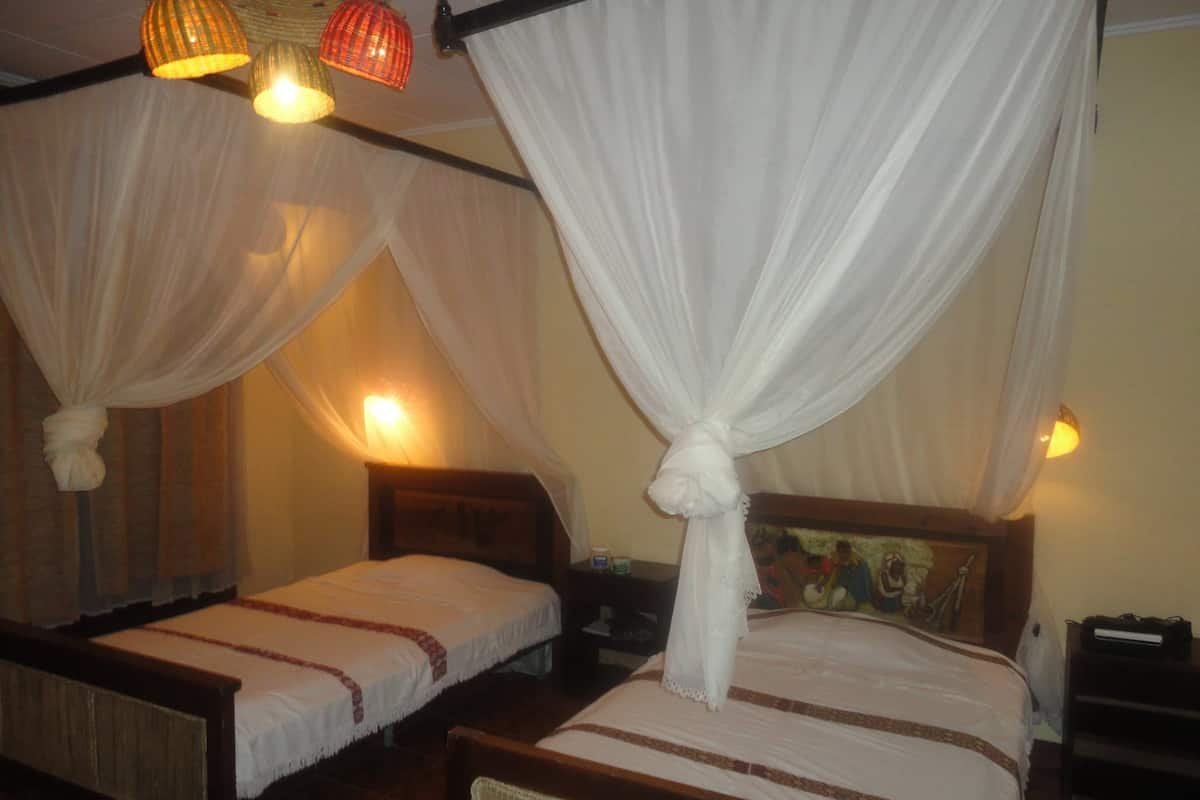
Warm, inviting, and cozy atmosphere reflecting local culture with artistic furnishings and shaded acacia woodland.