
Set along Hangzhou's Zijingang Road, Banyan Tree Hangzhou occupies a lake-facing compound where ivory villas rise above water and every suite begins at 1,291 square feet. The property operates through a design logic that foregrounds Han antiques, local materials, and landscape framing rather than grand-hotel spectacle. Three restaurants, a treatment-focused spa drawing on Longjing tea traditions, and highly flexible dining arrangements give it a distinct position among Hangzhou's luxury lake properties.
A Property That Reads as Landscape First, Hotel Second
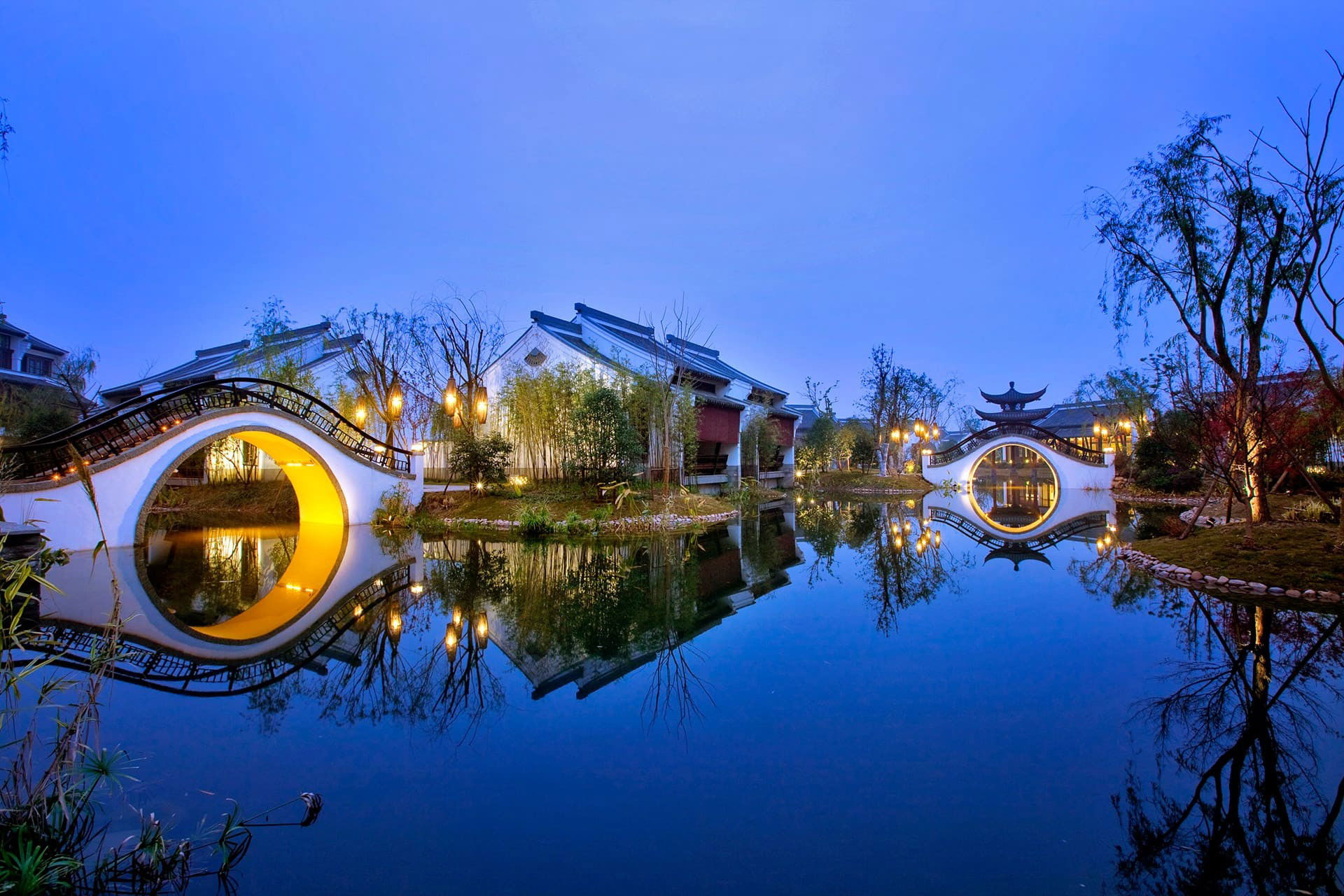
West Lake's luxury accommodation market has developed along two distinct lines: the large-footprint international brand hotel, positioned for business travel and group bookings, and the villa-format retreat that treats the lake itself as the primary amenity. Banyan Tree Hangzhou belongs firmly to the second category. Arriving along Zijingang Road, the property presents as a collection of ivory villas arranged around water rather than a single monolithic tower — a compositional choice that shapes every aspect of the experience that follows. The Banyan Tree Holdings approach at this address prioritises spatial immersion over lobby spectacle, though the lobby itself makes an immediate architectural statement: high-beam ceilings, standing lamps positioned for warm ambient pools, and crimson-hued rugs that anchor the room in a palette that references Chinese interiors without resorting to pastiche.
Within Hangzhou's competitive set of lake-adjacent luxury properties, this villa-compound format places Banyan Tree in a peer group that includes Amanfayun and the Four Seasons Hotel Hangzhou at West Lake, both of which pursue similarly immersive site relationships. The Park Hyatt Hangzhou and Conrad Hangzhou occupy a different position — more vertical, more urban in their orientation, and less dependent on the property's relationship to water as an organising design principle.
The Architecture of the Rooms
What distinguishes Banyan Tree Hangzhou's accommodation strategy is the floor-area baseline it sets. In a market where luxury is often signalled through views and finish quality, the property instead uses scale as its primary credential: the Water Terrace Suite, described as the smallest unit on the property, measures 1,291 square feet. That figure sets the entry point significantly above what most competitor hotels offer at comparable tiers. For a frame of reference, premium rooms at many five-star urban hotels in China run between 500 and 700 square feet; Banyan Tree's smallest offering here nearly doubles that.
The design language inside the suites does not attempt to compete with contemporary minimalism. Han antiques and murals appear throughout the accommodation range, creating interiors that carry an archaeological weight , objects and imagery that situate the guest in a specific Chinese cultural moment rather than a generic luxury register. This approach holds from the Water Terrace Suites through to the 1,937-square-foot Spa Sanctuary Villa, a unit that integrates wellness infrastructure directly into the private living space. At the leading of the range, the Presidential Villa extends across more than 4,000 square feet and includes three bedrooms and a private outdoor pool, configuring itself as a self-contained compound rather than an oversized hotel room.
The framing of the lake from villa terraces and interior vantage points is a consistent feature across the accommodation range. Views across the property capture the full visual logic of the development: ivory villa rooftops, reflecting water, and the soft hills beyond , a composition that shifts with light conditions through the day and changes character significantly across Hangzhou's four distinct seasons. Spring, when the West Lake area is in full bloom and the surrounding tea plantations begin their first harvest, is widely considered the period of peak visual drama for the region.
The Spa's Regional Specificity
Banyan Tree operates one of the more geographically specific spa programs in its China portfolio at this address. Rather than defaulting to a generic wellness menu, Banyan Tree Spa Hangzhou structures its treatments around the Longjing tea tradition for which the broader Hangzhou region is documented across centuries of Chinese tea culture. Longjing (Dragon Well) tea, grown in the hills immediately west of the city, carries both agricultural and ceremonial significance in this context , making its appearance in spa treatments a reference to local cultural heritage rather than a decorative ingredient choice.
Two signature treatments ground the program in this tradition: the Longjing Tea Cold Scrub, positioned for sensitive skin concerns, and the Longjing Tea Healer, described as targeting toxin removal and reduction of skin inflammation. The spa menu also addresses a broader range of concerns differentiated by client profile, with the treatment list structured to distinguish between issues specific to different guests. This level of menu specificity is more common in destination spa properties than in hotel spas, and it positions Banyan Tree Hangzhou's wellness offering at the more serious end of the hotel-spa spectrum.
Three Restaurants and a Flexible Dining Framework
The property operates three restaurants, though the formal dining infrastructure is supplemented by an arrangement system that significantly extends the functional scope of where and how meals can be taken. Private barbecue settings under tented structures, meals served on boat trips through the lake glades, and other bespoke configurations can be organised through the hotel's staff. This flexibility shifts the dining offer from a fixed restaurant format toward something closer to a private event service , a distinction that matters in a property where the landscape itself is the defining asset. Guests who prioritise the outdoor environment over indoor dining rooms will find this framework accommodating in a way that more conventional restaurant-focused hotels are not.
For broader dining context in the city, our full Hangzhou restaurants guide maps the range from traditional Hangzhou cuisine to the newer wave of contemporary Chinese restaurants that have developed alongside the city's expanding technology sector.
Where Banyan Tree Hangzhou Sits in the Wider Market
Hangzhou's luxury hotel supply has grown substantially over the past decade, with the West Lake corridor in particular attracting properties from multiple international groups. Fuchun Resort Hotel Fuyang takes the resort-retreat format in a different geographic direction, moving away from the lake toward the Fuyang river valley. Qiushui Villa and Hangzhou Muh Shoou Xixi Hotel occupy more locally inflected positions in the market. Midtown, Hangzhou sits squarely in the business-hotel tier. Banyan Tree's distinguishing argument is spatial: rooms that begin where most competitors' premium suites end, a design language that foregrounds Chinese material culture, and a site relationship to water that is built into the architecture rather than offered as a view from a tower window.
Within the broader Banyan Tree Holdings network in China, this property sits in a peer group alongside Banyan Tree Chongqing Beibei and Banyan Tree Ringha in Shangrila, each of which takes a similarly site-specific approach to its location. Across China more broadly, design-led properties pursuing this kind of cultural and environmental specificity include Aman Summer Palace in Beijing, Amanyangyun in Shanghai, and Amandayan in Lijiang , all of which use heritage architecture or landscape positioning as their primary differentiator rather than brand scale.
Planning a Stay
The property is located at 21 Zi Jin Gang Lu in the Xi Hu district, placing it within the West Lake administrative area rather than in Hangzhou's commercial centre. Access from Hangzhou East Railway Station, which serves high-speed rail connections from Shanghai (approximately 45 minutes), takes around 30 to 40 minutes by car depending on traffic. Spring (March to May) and autumn (September to November) are the periods when the West Lake region performs at its visual and agricultural peak, with the spring Longjing harvest season carrying particular relevance given the property's spa program. Summer months bring humidity and occasional rain; winter offers a quieter, cooler visit with occasional mist across the lake that alters the landscape character significantly.
The Google rating of 4.1 across 59 reviews reflects a relatively small review base for a property of this type, which is consistent with a villa-format luxury property drawing a lower volume of guests than larger hotel operations. For a broader view of Hangzhou's accommodation options, our full Hangzhou hotels guide covers the full spectrum. Further context on what the city offers beyond accommodation is available through our Hangzhou bars guide, our Hangzhou wineries guide, and our Hangzhou experiences guide.
Frequently Asked Questions
What is the most popular room type at Banyan Tree Hangzhou?
Spa Sanctuary Villa, at 1,937 square feet, is likely the most requested unit for guests prioritising wellness alongside accommodation , it integrates spa infrastructure directly into the private living space. For those seeking maximum scale, the Presidential Villa covers more than 4,000 square feet with three bedrooms and a private outdoor pool. Even the entry-level Water Terrace Suite, at 1,291 square feet, is larger than the premium-tier rooms at most comparable hotels in the West Lake area.
What makes Banyan Tree Hangzhou worth visiting?
Case rests on three factors that compound each other: the spatial scale of the accommodation (the smallest unit on the property begins at 1,291 square feet), the property's physical relationship to the lake , villa rooftops, water reflections, and surrounding hills that create a coherent visual environment rather than a hotel set against a backdrop , and a spa program grounded in the Longjing tea tradition specific to this region of Zhejiang. Hangzhou is already a city with a documented luxury hotel market; what Banyan Tree adds is a villa-compound format that treats the landscape as load-bearing architecture.
A Quick Peer Check
These are the closest comparables we have in our database for quick context.
| Venue | Cuisine | Price | Awards | Notes |
|---|---|---|---|---|
| Banyan Tree Hangzhou | **Our Inspector's Highlights With high-beam ceilings, standing lamps and crimson-hued rugs all about the lobby, you immediately experience a sense of time and place at the property. The views are stunning all around the property. From almost every corner, you can capture a fairytale-like landscape filled with darling ivory villas that are surrounded by a picture-perfect lake.** **Things to Know A thorough list of traditional practices at Banyan Tree Spa Hangzhou addresses issues specific to women and men. But no matter the sex or area of concern, services like the Longjing Tea Cold Scrub (calms sensitive skin) and the Longjing Tea Healer (removes toxins and reduces skin inflammation) have major benefits. While Banyan Tree Hangzhou’s three restaurants are impressive, specially arranged meals can be set up all around the property. It doesn’t matter if you envision a private barbecue under a tent or want a sensual meal for two on a boat ride through the glades, the staff can organize it.** **Treatments:** The Rooms Understated dwellings are filled with Han antiques and murals — and that goes from the 1,291-square-foot Water Terrace Suites (amazingly, the smallest unit on the property) to the 1,937-square-foot Spa Sanctuary Villa. If you pony up for the almost-overwhelming Presidential Villa, you’ll be rewarded with three bedrooms, an outdoor pool and more than 4,000 square feet of fabulousness. **Amenities:** 2 Westbrook Resort, Zijingang Road, Hangzhou, Zhejiang, China, 310030 | This venue | ||
| Amanfayun | ||||
| Conrad Hangzhou | ||||
| Four Seasons Hotel Hangzhou at West Lake | ||||
| Park Hyatt Hangzhou | ||||
| Fuchun Resort Hotel Fuyang |
Preferential Rates?
Our members enjoy concierge-led booking support and priority upgrades at the world's finest hotels.
Access the Concierge