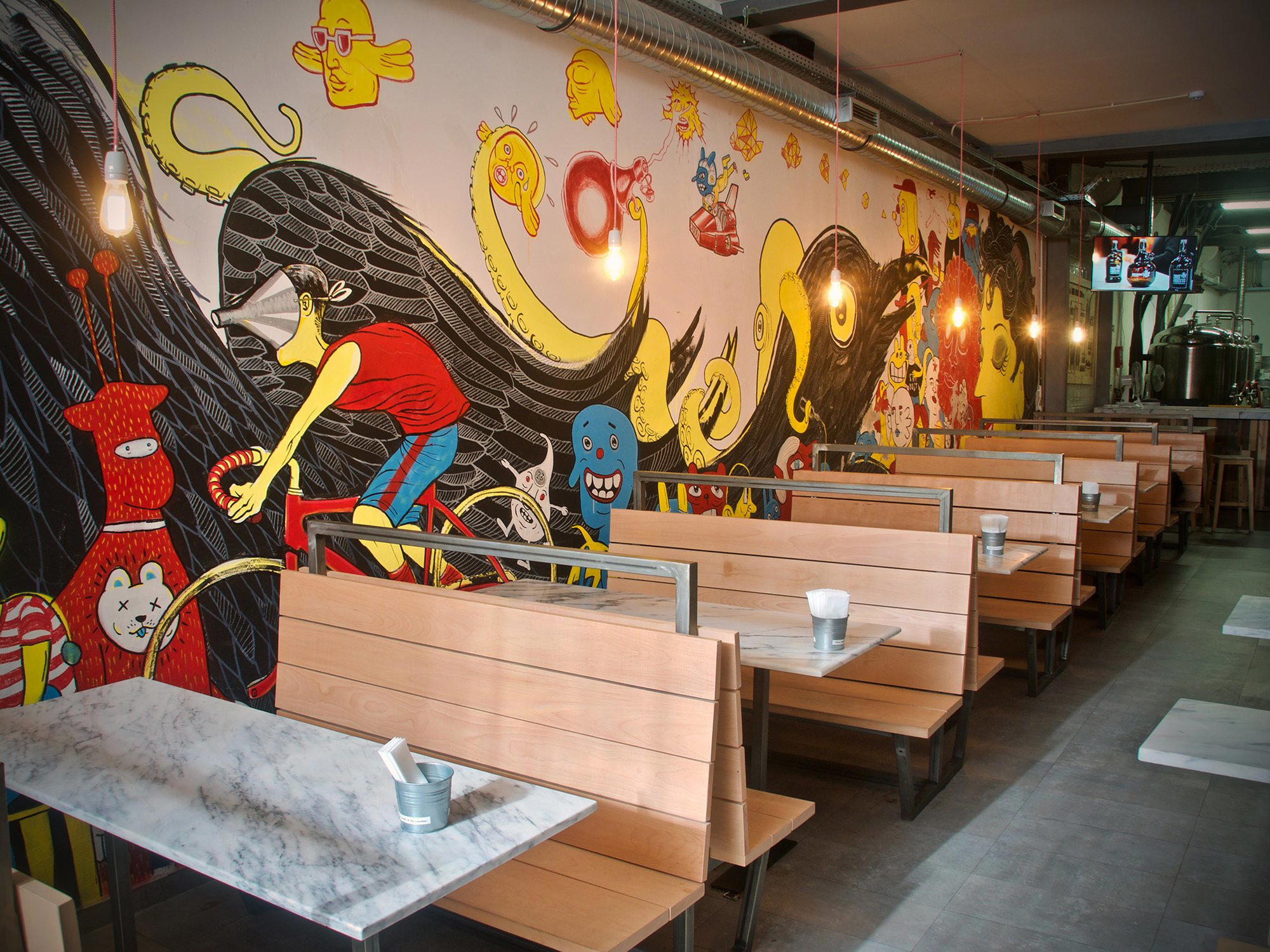
Dois Corvos Marvila Taproom occupies a working industrial space on Rua Cap. Leitão in Lisbon's eastward-shifting Marvila district, where the brewery's own tanks sit behind the bar. The format is direct: rotating taps, no ceremony, and a crowd that spans neighbourhood regulars and beer-focused visitors drawn to one of Lisbon's more credible craft operations.

Pearl is the En Primeur Club membership app, where members save venues, book tables and use the concierge.
Marvila's Craft Axis
Lisbon's drinking culture has reorganised itself more than once in the past decade. The city moved from wine-and-ginjinha conservatism through a cocktail phase anchored in Bairro Alto and Príncipe Real, venues like Red Frog pushed that conversation toward technical seriousness, and has since developed a third current: neighbourhood-rooted craft brewing, concentrated in the industrial parishes east of the city centre. Marvila sits at the middle of that current. Warehouses that stored cod and cork now house fermentation tanks, and the streets around Rua Cap. Leitão read less like a bar district than a working production zone where the taproom happens to be the front room of the brewery.
Dois Corvos, which translates as Two Ravens, established itself as part of the first wave of Portuguese craft breweries to operate at a scale that could sustain a dedicated taproom rather than just a farmers'-market presence. The Marvila address at Rua Cap. Leitão 94 is a brewery-first space: what you encounter at the bar is drawn directly from what is fermenting metres away. That proximity between production and service is the defining logic of the format, and it shapes everything from the beer range to the atmosphere.
The Space and What It Signals
Industrial spaces repurposed for hospitality tend to resolve one of two ways: self-conscious design that fights the architecture, or an honest acknowledgment of what the room actually is. The Marvila Taproom belongs to the second category. Exposed structure, production equipment in eyeline, and a layout that does not perform warmth it has not earned. The room functions as a working brewery that admits visitors rather than a bar that deploys brewery aesthetics as decoration. That distinction matters to the kind of drinker who chooses to make the trip east.
Marvila itself has shifted considerably over the past five years. Alongside Beato and Xabregas, it now holds a concentration of creative-industry tenants, food halls, and production-led hospitality that has drawn a younger, internationally connected crowd without fully shedding its working-class residential character. The taproom sits in that overlap, drawing both the neighbourhood's newer occupants and visitors who have tracked Dois Corvos through the Portuguese craft beer circuit. For a point of comparison in how craft drinking culture is developing across Portugal, Base Porto in Porto represents how the northern city has handled a similar industrial-to-hospitality transition.
Behind the Bar: Range and Rotation
The editorial angle most relevant here is not which specific beers are pouring on any given afternoon, tap lists rotate and any named beer risks being absent by the time you read this, but rather what the bar's approach to range signals about the brewery's position in the Portuguese craft sector. Dois Corvos has operated across multiple beer categories rather than anchoring identity to a single style. That breadth, typical of breweries that emerged in the early-to-mid 2010s with one eye on American and northern European craft models, places it in a different competitive conversation from the single-style producers who have appeared more recently.
The person behind the bar at a taproom of this type functions differently from a cocktail bartender or a sommelier. The role is closer to guide than to technician: the expectation is that staff can articulate what is currently fermenting, what is seasonal, what is experimental, and how the current tap list relates to the brewery's wider output. That floor-level knowledge, the ability to connect a visitor's preference to a pour that is actually in the tank this week, is the hospitality proposition at a production taproom, and it is the signal that distinguishes serious operations from those using craft vocabulary without the substance. Lisbon's bar scene has examples of both; venues like A Cabreira and the long-standing A Ginjinha represent different ends of the city's drinking tradition, each with its own form of depth. The taproom format at Dois Corvos asks something different of its staff: product knowledge that is alive and current rather than fixed and historical.
Seasonal and experimental releases are a regular part of the output. Styles that pass through the tap list include IPAs built with Portuguese-grown ingredients, farmhouse and saison formats that respond to the country's warmer fermentation climate, and darker winter releases that mark a deliberate departure from the light-lager default that dominated Portuguese beer culture before the craft wave arrived. The rotation means return visits have a different character from the first, which is both the appeal and the logistical challenge for visitors with limited time in the city.
Marvila in the Wider Lisbon Drinking Map
A taproom visit works well when placed in context rather than treated as a standalone destination. Marvila's concentration of food and drink operators means an afternoon in the area can move through several formats without needing to cross the city. The district pairs logically with a visit to the nearby LX Factory precinct or the riverfront further west, and those planning a full Lisbon drinking itinerary will find that combining the taproom with a cocktail stop in Príncipe Real or Bairro Alto gives a more complete picture of where the city's drinking culture currently sits. Our full Lisbon restaurants and bars guide maps that broader circuit.
Beyond Lisbon, the Portuguese craft beer and independent bar conversation extends along the Atlantic coast. Bar do Guincho in Alcabideche and Bar e Duna da Cresmina in Cascais E Estoril represent the coastal leisure end of that spectrum, while Estoril sits at a different register entirely. In the Algarve, Epicur Wine Boutique and Food in Faro takes a wine-led approach to independent drinking culture, and in the Atlantic islands, Venda Velha in Funchal illustrates how Madeiran hospitality handles independent operator formats. For a point of comparison outside Portugal entirely, Bar Leather Apron in Honolulu shows what craft-serious bar programming looks like in a very different Pacific context. And closer to Lisbon, the seafood-led drinking culture at A Marisqueira do Lis represents another strand of how the city's drinking and eating traditions overlap.
Planning a Visit
The taproom is located at Rua Cap. Leitão 94, in the heart of Marvila's production district. It sits within walking distance of the area's other creative tenants, and is accessible by metro (Oriente station) or tram from the city centre. Given that tap lists rotate, there is no reliable way to confirm specific pours in advance; the taproom format by design rewards presence over planning. No booking infrastructure applies to a space of this type, and the pricing structure reflects brewery-direct margins rather than bar markups, which positions it at the more accessible end of the Lisbon drinking price range. Weekend afternoons draw the largest crowds; mid-week visits during the late afternoon offer a calmer read of both the space and the beer range.
Style and Standing
Comparable options at a glance, pulled from our tracked venues.
| Venue | Price | Awards |
|---|---|---|
| Dois Corvos Marvila TaproomThis venue (the venue you are viewing) | $10–20 | Not listed |
| Red Frog | $10–20 | World's 50 Best #94 · Falstaff Bar - 95 Falstaff Points |
| Black Sheep | $10–20 | Star Wine List |
| Boca D'uva | $30–50 | Star Wine List |
| Cinco Lounge | $20–30 | Top 500 Bars Best Bars #458 · Falstaff Bar - 94 Falstaff Points |
| Club des Châteaux | $30–50 | Star Wine List |
Continue exploring
More in Lisbon
Bars in Lisbon
All bars in Lisbon →
Restaurants in Lisbon
All restaurants in Lisbon →

Details
- Industrial
- Trendy
- Lively
- Group Outing
- Casual Hangout
- Standalone
- Communal Tables
- Booth Seating
- Craft Beer
Current opening hours
- Monday
- Closed
- Tuesday
- 3–11 PM
- Wednesday
- 3–11 PM
- Thursday
- 3–11 PM
- Friday
- 3 PM–1 AM
- Saturday
- 3 PM–1 AM
- Sunday
- 3–11 PM
Hours can change for holidays and private events. Hours as of .