
Weingut Egon Müller operates from the historic Scharzhof estate in Wiltingen, at the heart of the Saar's most celebrated Riesling territory. The estate's Scharzhofberger wines occupy a reference position in German wine, where the interaction of slate soils and the river's cold microclimate produces a tension between acidity and residual sweetness that defines the regional style. Recognised with a Pearl 5 Star Prestige award in 2025, the estate sits at the upper tier of Germany's fine wine hierarchy.
 Discover on Pearl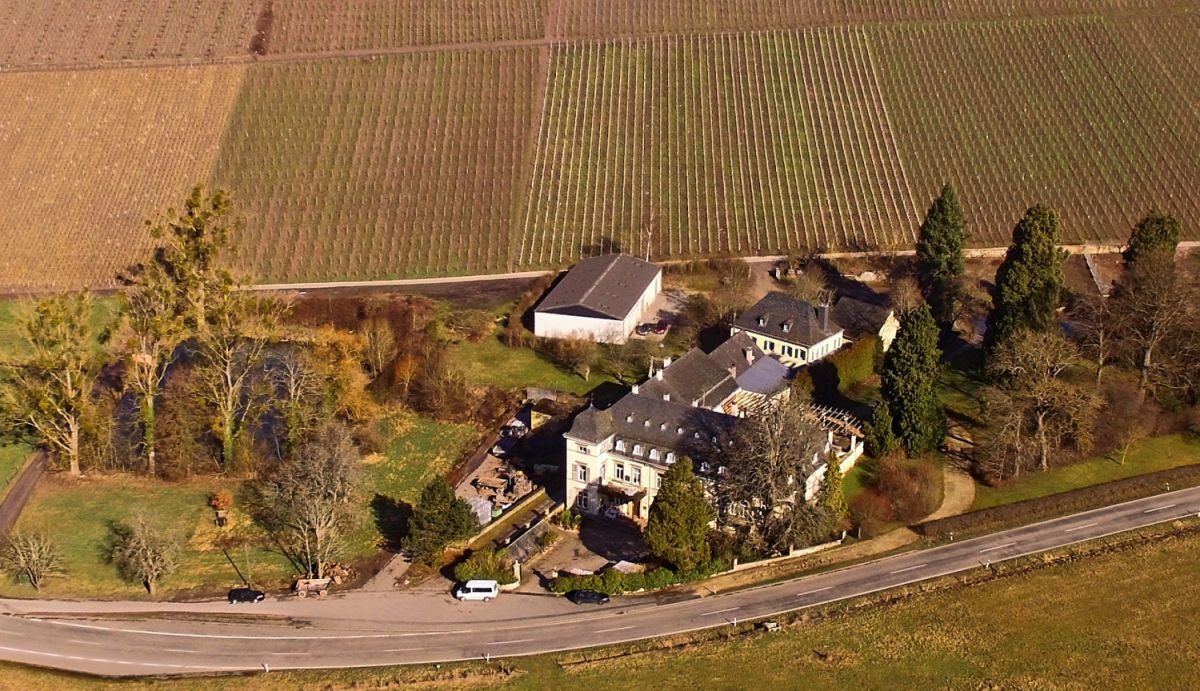
The Saar's Cold Logic: What the Scharzhofberger Tells You About a River Valley
There is a particular quality of light in the Saar valley in late October, when the harvest runs long into the days that turn grey by mid-afternoon. The vineyards above Wiltingen face south and southeast, tilted at angles that maximise every hour of a sun that never climbs especially high. The Scharzhofberger is an unbroken monopole vineyard, a single expanse of grey-blue Devonian slate that rises steeply from the valley floor, and it has been shaping the character of German Riesling for longer than most wine regions have existed in their current form. Weingut Egon Müller works from the Scharzhof, a classically proportioned estate building at the foot of that slope, and the wines made here are the primary reason serious collectors keep returning to the Saar.
Terroir First: What Devonian Slate Actually Does
The geology argument for the Saar is not abstract. Devonian slate, the dominant substrate across the Scharzhofberger, absorbs and retains warmth during the day and radiates it back through cool nights. In a valley where summer temperatures run several degrees lower than in the Mosel proper, that thermal contribution from the soil can be the difference between a grape that ripens fully and one that closes early. The result, in most vintages, is a wine of extraordinary nervous energy: high natural acidity, often residual sugar at Spätlese and Auslese levels, and an extract that keeps both in suspension without either dominating. This tension is not a stylistic choice — it is the direct expression of what the ground does to the grape when conditions align.
The shortlist, unlocked.
Hard-to-book tables, cellar releases, and concierge-planned trips.
Get Exclusive Access →The cold of the Saar also extends the ripening window considerably. Grapes harvested in late October or even November, particularly for the higher Prädikat categories, have had months to accumulate complexity while retaining the acidity that gives Saar Riesling its characteristic grip. The finest Trockenbeerenauslese and Eiswein productions from this vineyard are not so much rare commodities as they are extreme expressions of what that cold logic produces when conditions push to their limit. Production quantities at those levels are small enough that the wines enter secondary markets almost immediately, which is part of why Egon Müller's auction results have become reference data points for the German fine wine category globally.
Where the Estate Sits in the German Fine Wine Hierarchy
Germany's classification of wine estates does not have a single, universally adopted framework equivalent to Bordeaux's 1855 classification or Burgundy's Premier and Grand Cru hierarchy, but the market has produced its own ordering. The VDP (Verband Deutscher Prädikatsweingüter) provides a vineyard classification structure through its Grosse Lage designation, and the Scharzhofberger appears consistently at the leading of evaluations when critics and traders assess German Riesling against international benchmarks. Weingut Egon Müller's Pearl 5 Star Prestige recognition in 2025 places it among a small group of German estates that operate at what the market treats as a reference tier.
For comparison, other German estates producing at significant critical levels include properties from across the country's wine regions: Kloster Eberbach in Eltville, one of the oldest continuously operating wine estates in Germany with its roots in Cistercian viticulture, and Schloss Vollrads in Oestrich-Winkel, which has documented production records stretching back centuries. In the Pfalz, estates such as Weingut A. Christmann in Neustadt an der Weinstraße and Weingut Bassermann-Jordan in Deidesheim represent the southern expression of German Riesling, where the warmer climate produces riper, broader profiles. The Saar's cold-climate style, as expressed at Egon Müller, is a distinct argument within that conversation rather than simply a northern variant of the same wine. For producers working in the Nahe, Schlossgut Diel in Rümmelsheim offers a parallel reference point. Across the Rheinhessen, Weingut Battenfeld-Spanier in Hohen-Sülzen and Weingut Bürgerspital zum Heiligen Geist in Würzburg extend the map of serious German wine production further.
Within Wiltingen specifically, Weingut Van Volxem represents the most substantive comparison case in the village: a large-format estate with significant Scharzhofberger holdings that has pursued a drier, more mineral-forward style in recent years. The two estates illustrate how the same vineyard can be interpreted differently, and tasting across both is instructive for understanding the range the Scharzhofberger can accommodate.
The Range: From Kabinett to Trockenbeerenauslese
The Prädikat system structures the estate's range according to must weight at harvest, which in the Saar's cool conditions does not translate mechanically to alcohol or sweetness. A Kabinett from the Scharzhofberger is typically light in body and low in alcohol, with acidity that can seem severe in the first years after release; the residual sugar is minimal but present, and it functions as a buffer rather than a flavour element. Moving up through Spätlese and Auslese, the sugar and extract both increase, and the wines become progressively longer-lived. Auslesen from a strong vintage can require a decade to begin revealing their secondary development. The Beerenauslese, Trockenbeerenauslese, and Eiswein categories are produced only when conditions allow, and they represent the Saar's most extreme argument for why cold-climate viticulture produces a category of wine that warm-climate regions cannot replicate. In a warm vintage, a TBA may not be produced at all — which is part of what gives the rare productions their status in the market.
Planning a Visit to Wiltingen and the Schar Valley
Wiltingen sits in the Saar valley approximately south of Trier, which serves as the main regional transport hub with rail connections to larger German cities. The village itself is small, and the Scharzhof estate is located along the Scharzhofstraße at the edge of the vineyards. The Saar wine route offers a logical framework for visiting multiple producers across the valley, and autumn, particularly September through November during and after harvest, is the period when the region is most active and the vineyards are at their most visually arresting. Visitors planning time in the area will find additional context through our full Wiltingen wineries guide, and broader Wiltingen planning resources are available through our full Wiltingen restaurants guide, our full Wiltingen hotels guide, our full Wiltingen bars guide, and our full Wiltingen experiences guide.
For context beyond the Mosel-Saar-Ruwer region, the German fine wine world extends to estates in Franconia and Spain's equivalent terroir-driven producers: Abadía Retuerta in Sardón de Duero provides an instructive contrast between the continental cold of the Duero and the Saar's northern chill. For those whose interests extend to spirits alongside wine, Aberlour in Aberlour represents a different but equally site-specific production tradition in the Speyside region of Scotland.
FAQ
- Is Weingut Egon Müller more low-key or high-energy?
- The estate is decidedly low-key. Wiltingen is a quiet village in a rural valley, and the Scharzhof operates without the visitor infrastructure of larger wine tourism destinations. The estate's recognition, including its Pearl 5 Star Prestige award in 2025, reflects critical and market standing rather than profile-raising hospitality programming. Visitors looking for a high-energy tasting experience with entertainment elements will not find that here. Those who come specifically to understand how a single vineyard and its slate geology produce wines that trade at auction against the world's most sought-after bottles will find it exactly what it should be.
- What wines should I try at Weingut Egon Müller?
- The Scharzhofberger is the estate's primary statement, and the Riesling range from Kabinett through Auslese represents the clearest way to read how the vineyard's slate soils and the Saar's cold microclimate express themselves across different harvest conditions. The Spätlese is typically the most accessible entry point into the estate's style. The higher Prädikat categories, Beerenauslese, Trockenbeerenauslese, and Eiswein, are produced selectively and carry prices that reflect both scarcity and the auction market's sustained appetite. The estate holds Pearl 5 Star Prestige recognition in 2025, which positions these wines in the upper tier of German fine wine production. For a different angle on the same village's output, Weingut Van Volxem offers a drier, more mineral-forward interpretation of the Scharzhofberger that provides useful comparison context.
Peer Set Snapshot
These are the closest comparables we have in our database for quick context.
| Venue | Awards | Notes |
|---|---|---|
| Weingut Egon Müller | Pearl 5 Star Prestige | This venue |
| Weingut Van Volxem | Pearl 3 Star Prestige | |
| Bethel Heights Vineyard | Pearl 2 Star Prestige | |
| Cristom Vineyards | Pearl 2 Star Prestige | |
| Domdechant Werner’sches Weingut | Pearl 2 Star Prestige | |
| Evening Land Vineyards | Pearl 1 Star Prestige |
Access the Cellar?
Our members enjoy exclusive access to private tastings and priority allocations from the world's most sought-after producers.
Get Exclusive AccessThe shortlist, unlocked.
Hard-to-book tables, cellar releases, and concierge-planned trips.
Get Exclusive Access →