

World's 50 Best #30 · Falstaff Winery - Listed
At 3,111 metres above sea level, Bodega Colomé operates at an altitude that defines everything the wines become. The Altura Máxima vineyard, among the highest commercially farmed plots on earth, produces Malbec and Torrontés shaped by ultraviolet intensity, wide diurnal swings, and soils that no lower-altitude appellation can replicate.

Pearl is the En Primeur Club membership app — saves, bookings, and concierge access live there. Same editors, same standards.
- Address
- Ruta Prov. 53 Km 20, Molinos, Salta, 4419, Argentina
- Phone
- +543868494200
- Website
- bodegacolome.com
- Directions
- Get directions
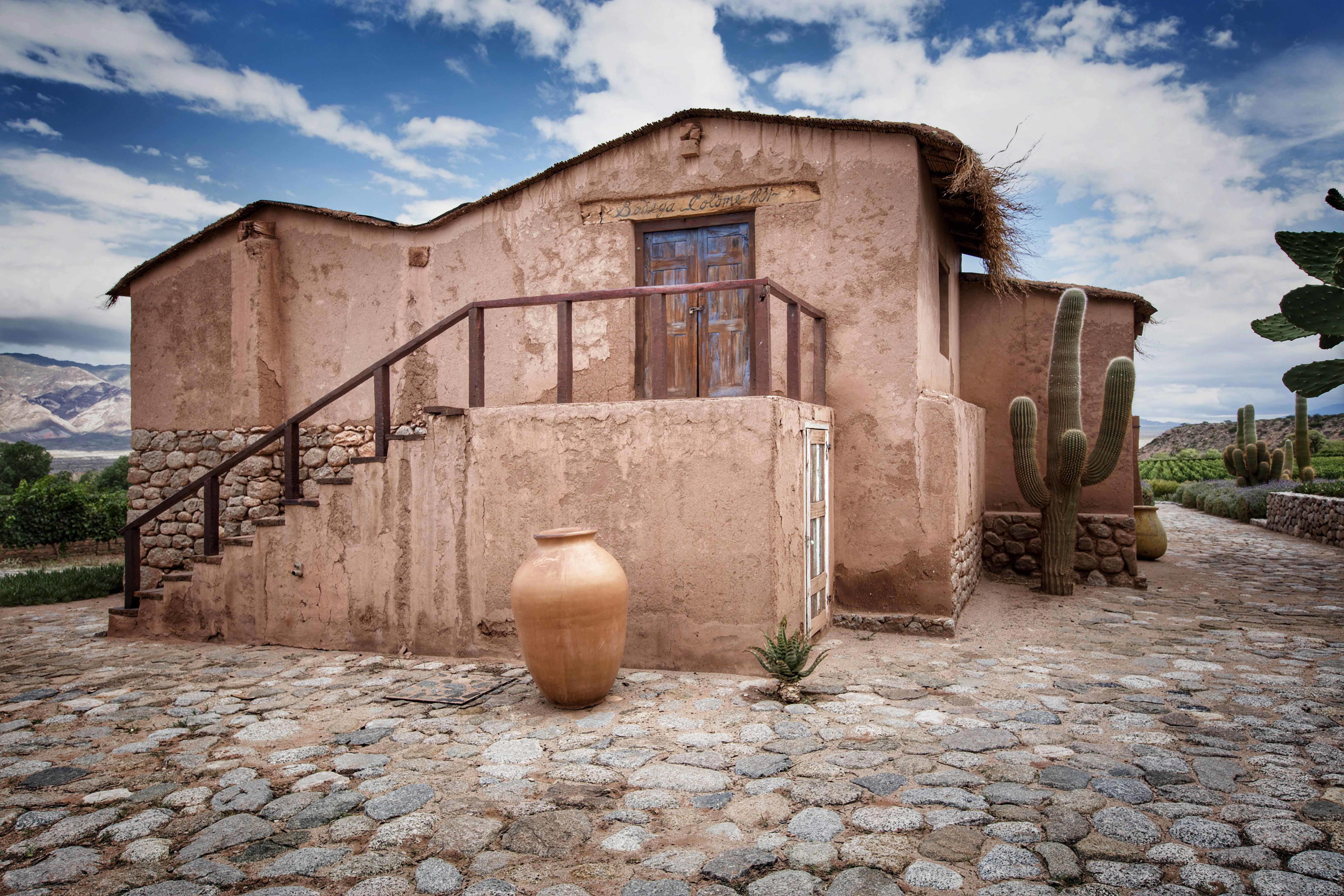
Where Altitude Is the Winemaker
The road to Molinos climbs through the Calchaquí Valleys with the kind of gradual insistence that makes elevation feel earned. By the time you reach Bodega Colomé, the air is thin, the light is sharp, and the landscape has shed every association with conventional wine country. There are no rolling green hills here, no temperate afternoons. What surrounds you instead is arid canyon terrain, pre-Columbian agricultural terraces on the hillsides, and a sky so saturated with UV radiation that the vines, to survive, have developed survival strategies that express themselves directly in the glass. This is the defining logic of high-altitude viticulture in Salta's Calchaquí Valleys: the environment does not merely influence the wine — it authors it.
Colomé's Altura Máxima vineyard sits at 3,111 metres above sea level. For context, Mendoza's celebrated high-altitude plots around Luján de Cuyo typically leading out between 900 and 1,200 metres. Operations like Terrazas de los Andes in Mendoza and Bodega DiamAndes in Tunuyán make altitude a central part of their identity, and with good reason — elevation at those levels already produces measurable shifts in acidity retention and skin phenolic development. At 3,111 metres, the variables are operating at a categorically different order of magnitude.
The Terroir Case: What Extreme Altitude Actually Does
High-altitude viticulture rests on a cluster of interacting conditions that become progressively more pronounced as elevation increases. Ultraviolet radiation intensifies, at 3,000 metres and above, UV exposure is dramatically higher than at sea level, prompting vines to produce more anthocyanins and polyphenols as a form of cellular protection. Those same compounds give wines deeper colour, more pronounced tannin structure, and aromatic complexity that accumulates slowly under stress rather than ripening quickly in warmth.
The diurnal temperature range in Salta's valleys is extreme even by Andean standards. Days can climb into the high twenties Celsius while nights drop sharply, sometimes by more than twenty degrees. That thermal contraction happens during the critical hours when sugar metabolism slows and acids are preserved. The result is wines that can achieve physiological ripeness, developed tannins, resolved bitterness, without surrendering freshness or tipping into the jammy fruit profiles that plagued many southern hemisphere Malbecs in their early commercial phase.
Soils at this altitude are typically poor, rocky, and well-drained, forcing vines into deep root systems that pull mineral character from parent rock rather than topsoil nutrients. In the Calchaquí Valleys specifically, alluvial deposits mix with ancient volcanic material, adding a mineral signature that distinguishes the regional profile from both Mendoza expressions and from the approach taken by producers further south in Patagonia, such as Bodega Chacra in Mainqué, where the terroir argument runs through Río Negro's gravel beds rather than altitude.
Colomé in Its Regional Context
Salta's wine identity has always been defined partly by remoteness. The Calchaquí Valleys are difficult to reach from Buenos Aires, a flight to Salta city followed by a multi-hour drive through mountain roads is the standard approach, and that friction has historically kept the region from the volume-driven commercial pressures that shaped Mendoza's development. That separation has also allowed producers to position around terroir specificity rather than price competition.
Within Salta, Colomé occupies a different tier from the Cafayate-centric operations that dominate regional production. Cafayate sits at roughly 1,700 metres, produces well-regarded Torrontés and Malbec, and hosts operations including Bodega El Esteco in Cafayate, which operates at a larger scale with broader commercial reach.
For comparison with operations at the other end of the country's stylistic range, Mendoza-based producers like Bodega Norton in Luján de Cuyo, Escorihuela Gascón in Godoy Cruz, and Bodega Bressia in Agrelo each make strong cases for lower-altitude Mendoza terroir, but none are competing for the same altitude-driven profile. Colomé's competition, if it can be called that, is a very small group of producers globally who farm above 2,500 metres.
Planning a Visit to Molinos
Reaching Bodega Colomé requires commitment. Molinos is a small Andean village in the Salta province, and the winery sits approximately 20 kilometres from the village centre along Provincial Route 53. The nearest city with regular flight connections is Salta, from which the drive to Molinos takes roughly four hours through increasingly remote terrain. Visitors should account for altitude acclimatisation, arriving from sea level and moving quickly to 3,000-plus metres can produce genuine physiological effects, and a day in Salta city before travelling further into the valleys is advisable for most travellers.
The region receives its lowest rainfall during the dry season between May and September, which coincides with the period when the Andean light is sharpest and the road conditions most reliable. Harvest in Salta typically occurs earlier than Mendoza, February into March, driven by the intensity of UV at altitude accelerating phenolic development despite relatively cool temperatures. Visiting during harvest gives access to the winery in full operation, though pre-harvest visits in January also offer the vineyard at its most visually dramatic.
For those building a broader Argentine wine itinerary, Colomé works as an extreme-altitude counterpoint to the Mendoza circuit. Producers such as Rutini Wines (La Rural) in Tupungato, Bodega Antigal in Maipú, Familia Schroeder in San Patricio del Chañar, and Bodega Trapiche in El Trapiche each represent distinct Mendoza or Neuquén expressions, and the contrast with a Colomé tasting helps clarify what altitude at this extreme scale actually contributes to the glass. Our full Molinos restaurants guide covers the broader local area for those extending their stay.
Fast Comparison
Comparable venues nearby, for context on price, style, and recognition.
| Venue | Cuisine | Price | Awards | Notes |
|---|---|---|---|---|
| Bodega ColoméThis venue — the venue you are viewing | Malbec, Torrontés | Not listed | World's 50 Best #30 · Falstaff Winery - Listed | Not listed |
| Zuccardi Valle de Uco | Malbec, Chardonnay | Not listed | World's 50 Best #1 · Falstaff Winery - Listed | Paraje Altamira |
| Bodega Trapiche | Malbec, Cabernet Sauvignon | $50–100 | World's 50 Best #17 · Falstaff Winery - Listed | Maipú |
| Bodega DiamAndes | Malbec, Cabernet Sauvignon | Not listed | World's 50 Best #93 · Falstaff Winery - Listed | Vista Flores, Tunuyán |
| Durigutti Winemakers | Malbec, Cabernet Franc | $50–100 | World's 50 Best #11 · Falstaff Winery - Listed | Las Compuertas |
| Catena Zapata | Malbec, Cabernet Sauvignon | Not listed | World's 50 Best #1 · Falstaff Winery - Listed | Agrelo |
Recognition history
Dated appearances from independent guides and award organizations, with the underlying list record or original source where available.
World's 50 Best Vineyards #30
World's 50 Best
Falstaff Winery - Listed
Falstaff
Full recognition history (6 entries)
World's 50 Best Vineyards #40
World's 50 Best
World's 50 Best Vineyards #24
World's 50 Best
World's 50 Best Vineyards #35
World's 50 Best
World's 50 Best Vineyards #25
World's 50 Best
Continue exploring
More in Molinos
Hotels in Molinos
Browse all →
Details
- Rustic
- Scenic
- Historic
- Quiet
- Elegant
- Wine Education
- Solo Exploration
- Special Occasion
- Vineyard Tour
- Historic Building
- Panoramic View
- Sustainable
- Mountain
- Vineyard
- Malbec
- Torrontés
- Cabernet Sauvignon
- Pinot Noir
- Syrah
- Sauvignon Blanc
- Still Red
- Still White
- Estate Tasting
- English
- Spanish
Magical quietness amid far-reaching high-altitude Andean landscapes with a sense of historic authenticity and natural serenity.