Bedell Cellars

Bedell Cellars sits on the North Fork of Long Island, where maritime air and glacial soils define a wine identity that increasingly draws comparison with serious East Coast appellations. The winery holds a Pearl 2 Star Prestige rating from EP Club (2025), placing it among the region's most closely watched producers. For those building a picture of New York State wine beyond the Hudson Valley, Bedell is a reference point.
 Discover on Pearl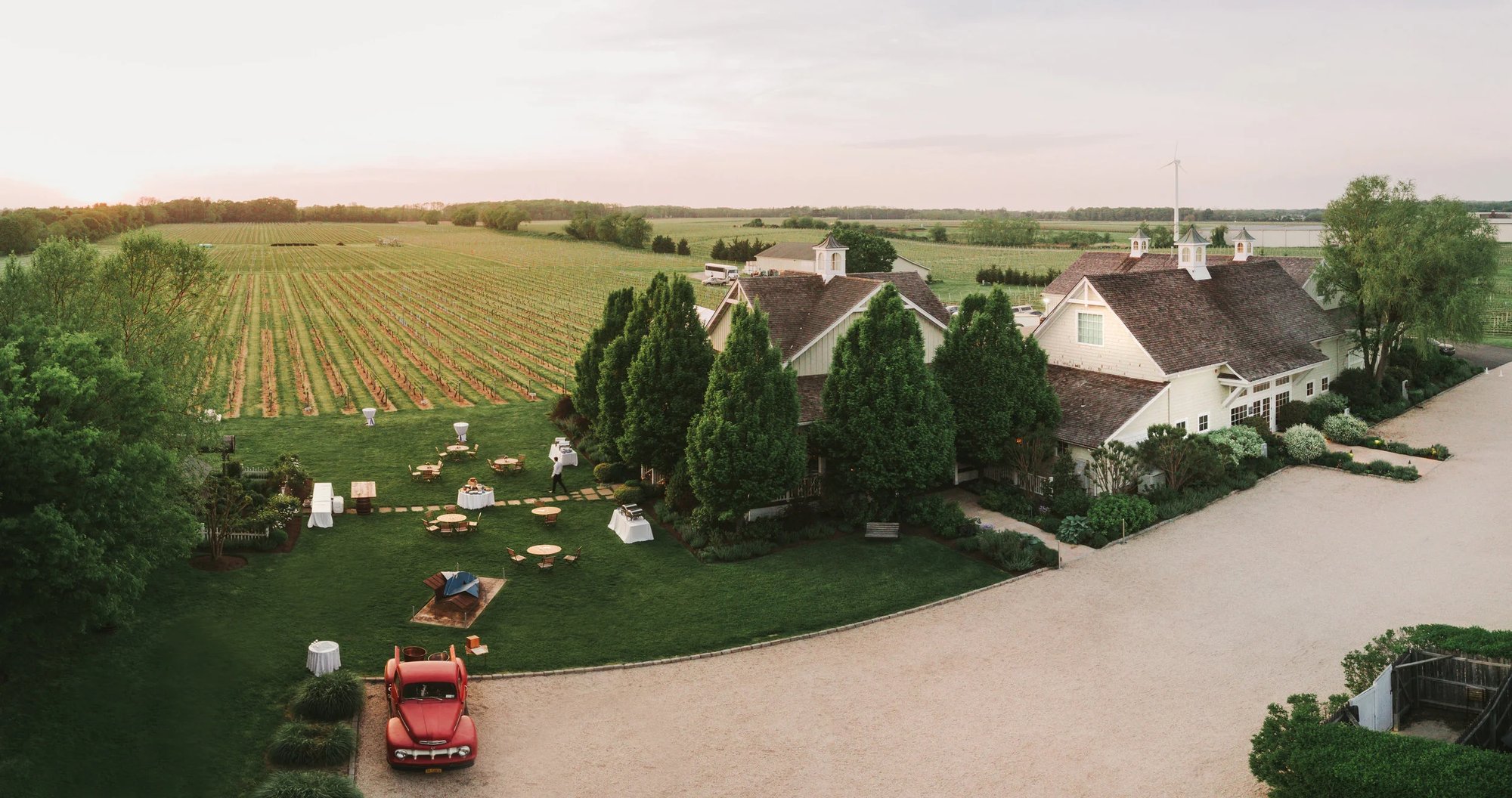
Where Glacial Soil Meets Atlantic Air
The North Fork of Long Island occupies a narrow strip of land where the Long Island Sound and the Atlantic Ocean moderate temperatures in ways that continental American wine regions rarely experience. The result is a growing season defined by slow ripening, reliable maritime cooling, and soils that trace their character to the last ice age: sandy loams, gravel deposits, and glacial till that drain quickly and stress vines into producing concentrated, site-specific fruit. Bedell Cellars, at 36225 Main Road in Cutchogue, sits at the center of this appellation argument, occupying ground that has been shaping the North Fork's wine identity for decades.
Cutchogue itself is the interior heart of the North Fork wine corridor, positioned along Route 25 where the peninsula narrows and vineyard density peaks. The setting approaching the property is less dramatic than Napa's mountain escarpments or Willamette Valley's hillside panoramas — instead, it is flat, agricultural, and deliberately understated, with rows of vines running toward open sky in every direction. That restraint in the landscape is not incidental. North Fork winemaking, at its most considered, has always argued that the work happens in the soil before it happens in the cellar, and the terrain around Cutchogue makes that case quietly but persistently.
The North Fork's Place in American Wine
Long Island wine has spent the better part of four decades attempting to define itself against the gravitational pull of California's dominant narratives. The North Fork appellation — formally recognized in 1986 , has consistently made a case for Merlot as its anchor variety, a position that sets it apart from almost every other premium American region. Where California's Napa focuses on Cabernet Sauvignon, Oregon's Willamette on Pinot Noir, and Washington State on a broader Bordeaux-inflected palette, the North Fork has leaned into the variety that maritime European climates, particularly Pomerol and Saint-Émilion, have proven can thrive in cool, marine-influenced conditions.
That positioning matters when assessing where Bedell Cellars sits in the regional hierarchy. A Pearl 2 Star Prestige rating from EP Club in 2025 places it inside a tier of producers whose work is considered reference-quality for the appellation, not merely competent within it. Across American wine, comparable prestige-tier ratings tend to correlate with producers who have moved beyond appellation novelty into genuine critical conversation about typicity, vintage expression, and cellar discipline. For the North Fork, that conversation is still younger and smaller in volume than California's, which gives producers at Bedell's level a more pronounced role in setting the terms of regional identity.
For context on how other American prestige-tier producers define their appellations, the work at Accendo Cellars in St. Helena, Adelaida Vineyards in Paso Robles, and Adelsheim Vineyard in Newberg all illustrate how site-specific identity gets built over multiple decades. The North Fork is on a similar trajectory, with Bedell among the producers making that argument most clearly.
Terroir Expression on the North Fork
What the North Fork's soil structure actually delivers in the glass is a question that serious wine travelers should approach with some patience. Sandy, well-drained soils produce wines with naturally lower tannin extraction and a tendency toward aromatic precision rather than structural weight. The maritime influence extends the growing season well into October, allowing phenolic maturity to develop at lower sugar levels than warmer inland regions, which keeps alcohol moderate and preserves the kind of acidity that makes wines interesting across time rather than only at release.
Merlot in this context behaves differently than it does in Napa or Washington. The cooler nights draw out savory, herbaceous registers that warmer-climate versions tend to suppress, and the sandy drainage prevents the waterlogging that can flatten fruit character in wet vintages. Bordeaux blends built on this foundation have a structural lightness that some drinkers accustomed to California's extracted, oak-forward style find surprising, but that seriousness is precisely what has earned the appellation sustained critical attention over the long term.
For comparison with how other cool-climate, site-expressive producers work in different American appellations, Alban Vineyards in Arroyo Grande and Andrew Murray Vineyards in Los Olivos demonstrate how Rhône varieties respond to coastal California conditions, while Artesa Vineyards and Winery in Napa shows how Spanish winemaking traditions translate into American appellation logic. Each case reinforces the principle that terroir expression requires both geological specificity and sustained winemaking commitment to become legible.
Planning a Visit to Cutchogue
The North Fork functions leading as a two-day circuit rather than a day trip from New York City, though the Long Island Rail Road connection to Greenport makes a one-day visit feasible for those willing to manage transportation carefully from the eastern terminus. Bedell Cellars sits along the Main Road corridor that forms the spine of the wine trail, making it accessible by car from Riverhead in the west or Southold in the east. The region's tasting rooms tend to draw most heavily on weekends between late May and October, with the harvest months of September and October bringing the added dimension of active vineyard work alongside the usual tasting experience.
The broader Cutchogue area offers additional context for the visit: the surrounding farmland and farm stands give the area an agricultural character that reinforces rather than decorates the wine-country experience. For those extending their time on the North Fork, our full Cutchogue wineries guide covers the complete tasting room circuit, while our Cutchogue restaurants guide, hotels guide, bars guide, and experiences guide provide the full picture for a longer stay.
For international reference points that share something of the North Fork's maritime-influenced, restrained winemaking ethos, Abadía Retuerta in Sardón de Duero demonstrates how older-vine, site-committed production operates in a European continental setting, and Aberlour in Scotland's Speyside offers a parallel case study in how geography and climate define a production identity over generations. The specific geography of production rarely lies.
Why Bedell's EP Club Rating Matters
A Pearl 2 Star Prestige designation from EP Club in 2025 is not awarded on the basis of marketing positioning or cellar-door hospitality alone. Within the EP Club rating framework, Prestige-tier recognition reflects a combination of wine quality, producer consistency, and the capacity to represent appellation character at a level that meaningfully informs how the region is understood by serious collectors and wine travelers. On the North Fork, where the total number of producers at this tier remains small relative to California or Oregon, that recognition carries additional weight as an orientation signal for visitors deciding where to focus their time.
The Alexander Valley Vineyards in Geyserville and Alpha Omega Winery in Rutherford offer useful reference points for how prestige-tier recognition functions in more established California appellations, where the rating cohort is larger and the differentiation between producers more granular. The North Fork's smaller pool means that Bedell's placement at the Prestige level carries a clearer signal: this is a producer whose wines are worth understanding as part of the appellation's case for serious American wine, not merely as a local curiosity worth visiting once for the pastoral setting.
That distinction, between a winery that earns attention because of where it is and one that earns it because of what it produces, is the only one that matters when you are making decisions about where to spend serious time and money on a wine trip.
Frequently Asked Questions
Peer Set Snapshot
These are the closest comparables we have in our database for quick context.
| Venue | Awards | Notes |
|---|---|---|
| Bedell Cellars | Pearl 2 Star Prestige | This venue |
| Robert Mondavi Winery | 50 Best Vineyards #39 (2025); Pearl 3 Star Prestige | Geneviève Janssens, Est. 1966 |
| Jordan Vineyard & Winery | 50 Best Vineyards #13 (2025); Pearl 3 Star Prestige | |
| Brooks Winery | 50 Best Vineyards #35 (2025); Pearl 2 Star Prestige | |
| Aperture Cellars | 50 Best Vineyards #14 (2025); Pearl 2 Star Prestige | |
| Joseph Phelps Vineyards | 50 Best Vineyards #37 (2025); Pearl 4 Star Prestige | Ashley Hepworth, Est. 1973 |
Access the Cellar?
Our members enjoy exclusive access to private tastings and priority allocations from the world's most sought-after producers.
Get Exclusive Access