Zhang Liang Malatang
Zhang Liang Malatang on Immermannstraße sits inside Düsseldorf's densest corridor of Asian dining, bringing the Sichuan-rooted self-serve hot pot format that has reshaped Chinese casual dining across Europe. The chain's pick-your-own-ingredients model keeps the experience immediate and accessible, making it a reliable reference point for the city's broader shift toward regional Chinese cooking beyond the Cantonese default.
Pearl is the En Primeur Club membership app — saves, bookings, and concierge access live there. Same editors, same standards.
- Address
- Immermannstraße 40, 40210 Düsseldorf, Germany
- Phone
- +4921169522963
- Directions
- Get directions
 Saves & bookings on Pearl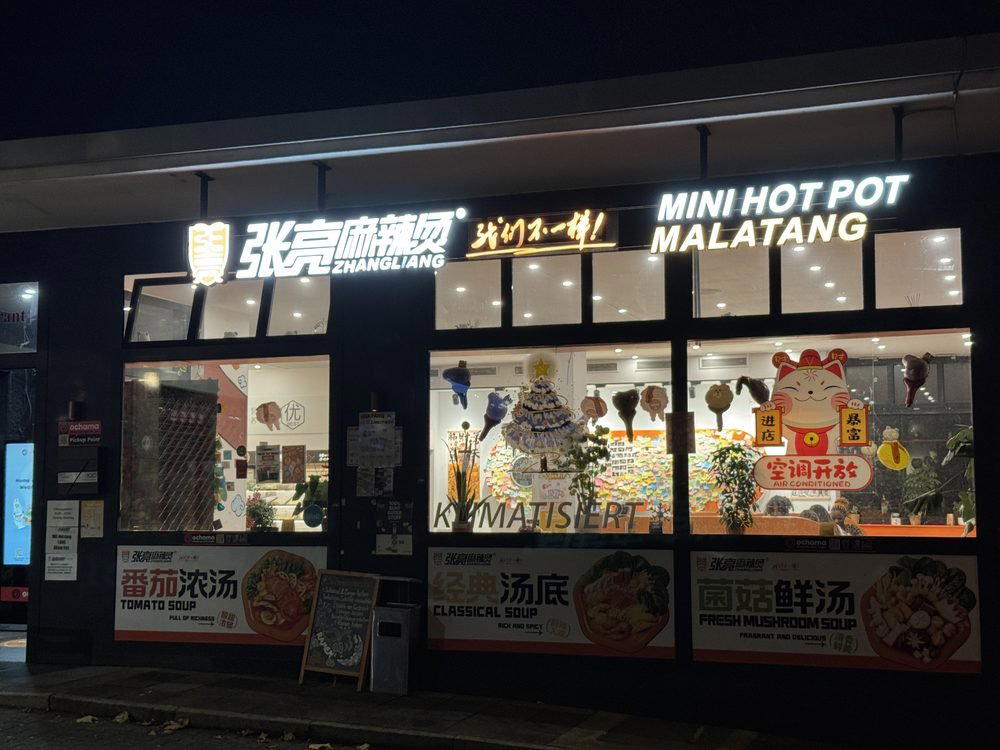
Immermannstraße and the Mainstreaming of Sichuan Spice in Düsseldorf
Düsseldorf's Immermannstraße has long functioned as the geographic centre of one of Germany's most concentrated Japanese and East Asian dining districts, a reputation built primarily around ramen counters, izakayas, and the city's substantial Japanese expatriate community. Over the past decade, however, the street and its immediate surroundings have absorbed a second wave: Chinese regional cooking formats that have little to do with the Cantonese-adjacent menus that once defined European Chinese restaurants. Zhang Liang Malatang is a restaurant serving Chinese Malatang Mini Hot Pot at Immermannstraße 40, 40210 Düsseldorf, Germany.
Malatang as a format originated in Sichuan province and spread rapidly through Chinese cities before franchised versions crossed into Southeast Asia and, eventually, Europe. The model is structurally distinct from hot pot: rather than a communal bubbling pot at the table, diners select raw ingredients from a display, hand them over to be cooked in a spiced broth, and receive a finished bowl. The ma (numbing) and la (spicy) flavour profile comes from the Sichuan peppercorn and dried chilli combination that defines the broader malatang category. Zhang Liang, as a chain, industrialised this format and carried it into markets where the concept was largely unknown before the 2010s.
How the Format Arrived in Germany, and Why Düsseldorf Made Sense
The spread of malatang chains into German cities follows a pattern visible across European capitals with large Chinese student and diaspora populations. Düsseldorf's position as a major trade city with extensive connections to East Asia meant it accumulated the demographic base that makes these formats commercially viable before many comparable German cities did. The Immermannstraße corridor already had the foot traffic, the infrastructure, and a customer base accustomed to reference-level Asian casual dining. A brand like Zhang Liang, recognisable to Chinese nationals educated or working abroad, had a ready audience before it served a single bowl.
That familiarity dynamic matters for understanding how to read the venue. Zhang Liang Malatang operates in a register closer to a Chinese high-street chain than to the independent regional Chinese restaurants that have opened elsewhere in Düsseldorf in recent years. It is not a local chef's interpretation of malatang; it is the exported version of a format that millions of people in China eat in roughly this form weekly. For some diners, that consistency is the point. For others exploring Düsseldorf's Chinese dining more broadly, it functions as a baseline against which independent kitchens can be measured. Nearby, Anfora and Amuni Wein- und Käsebar represent the city's European dining register, while Alanya Döner and 3h's Burger & Chicken sit in the fast-casual tier alongside Zhang Liang in terms of format, if not cuisine type.
The Evolution of Zhang Liang as a Global Chain
Zhang Liang Malatang's trajectory from a regional Chinese chain to an international brand reflects broader changes in how Chinese food culture travels. Earlier waves of Chinese food export to Europe were shaped by adaptation, with kitchens modifying flavours and formats to suit unfamiliar palates. The Zhang Liang model inverts this: it brings an essentially unchanged format and trusts that the audience has shifted enough to meet it. The numbing heat of Sichuan peppercorn, once considered too challenging for mainstream European markets, now draws queues in cities from Amsterdam to Berlin.
That confidence in the unmodified format represents a meaningful evolution in Chinese food's European presence. It also places Zhang Liang in a different competitive position than the generation of Chinese restaurants it follows. It is not competing with the adapted Cantonese-European menus that still fill many European high streets. It is competing with other malatang and hot pot operators, with Chinese regional cuisine restaurants, and increasingly with a generation of diners who have eaten this food in China and want the same thing abroad. Germany's broader fine dining scene operates in a different register: Aqua in Wolfsburg, JAN in Munich, and Schwarzwaldstube in Baiersbronn anchor the country's Michelin tier, while Vendôme in Bergisch Gladbach and Victor's Fine Dining by Christian Bau in Perl represent the sustained investment in classical European cooking that defines Germany's upper dining tier. Zhang Liang occupies none of that territory, it is a different argument about what eating out means entirely.
What the Immermannstraße Location Signals
Placement on Immermannstraße rather than in a peripheral commercial zone says something about how the brand positions itself. This is a high-visibility address in a stretch of the city that attracts both the Japanese community and curious visitors drawn by Düsseldorf's reputation for East Asian dining density. The street functions as a kind of informal quality signal in its own right: venues that cannot sustain themselves here typically do not last. The fact that concepts like Zhang Liang establish themselves on this stretch, rather than in cheaper secondary locations, indicates a degree of commercial confidence that a peripheral address would not require.
For comparison, the format sits in a similar urban niche to the better-known hot pot chain Xiao Long Kan, which has pursued European expansion on comparable high-footfall streets. Both operate in the communal, self-directed eating format that has proven more durable in Europe than many observers expected five years ago. The difference is that malatang, as a bowl-based individual format, has a lower barrier to entry than full table hot pot: it works for solo diners, works at lunch pace, and does not require the extended time commitment of a hot pot session. Germany's other notable Asian food cities offer their own comparisons: CODA Dessert Dining in Berlin and ES:SENZ in Grassau show how far Germany's dining range now extends, from experimental tasting menus to imported chain formats like this one.
Internationally, the malatang format sits at a significant remove from the precision cooking at venues like Le Bernardin in New York City or Atomix in New York City, but it operates in the same global conversation about what authenticity means when a cuisine travels. The same question applies in Hamburg, where Restaurant Haerlin and Schanz in Piesport address it from the European fine dining side. Waldhotel Sonnora in Dreis and Arca Alacati round out Düsseldorf's wider dining options for those whose visit extends beyond the Immermannstraße corridor.
Know Before You Go
- Address: Immermannstraße 40, 40210 Düsseldorf, Germany
- Format: Self-serve pick-your-ingredients malatang, cooked to order and typically priced by weight
- Neighbourhood: Immermannstraße, Düsseldorf's primary East Asian dining corridor, walkable from Düsseldorf Hauptbahnhof
- Leading for: Solo diners, quick weekday lunches, and those familiar with Sichuan spice profiles who want a consistent chain-format reference point
- Phone / Website / Hours:
Side-by-Side Snapshot
Comparable venues nearby, for context on price, style, and recognition.
| Venue | Cuisine | Price | Notes |
|---|---|---|---|
| Zhang Liang MalatangThis venue — the venue you are viewing | Chinese Malatang Mini Hot Pot | $$ | Not listed |
| Hashi, petite chinoiserie | Modern Chinese-French Fusion | $$ | Flingern Nord |
| Duck & Dumplings | Peking Duck and Dumplings | $$ | Flingern Nord |
| Sannin | Authentic Lebanese | $$ | Stadtmitte |
| ATAWICH | American Smashed Burgers | $$ | Düsseltal |
| XoXo Buddha Bowls Uerdinger Straße | Vietnamese Buddha Bowls | $$ | Golzheim |
Continue exploring
More in Düsseldorf
Restaurants in Düsseldorf
Browse all →
Bars in Düsseldorf
Browse all →
At a Glance
- Cozy
- Trendy
- Casual Hangout
- Group Dining
- Open Kitchen
Current opening hours
- Monday
- 12–9 PM
- Tuesday
- 12–9 PM
- Wednesday
- 12–9 PM
- Thursday
- 12–9 PM
- Friday
- 12–9 PM
- Saturday
- 12–9 PM
- Sunday
- 12–9 PM
Hours can change for holidays and private events. Last verified .
Cozy and inviting atmosphere ideal for casual dining with a focus on interactive hot pot preparation.