Hashi, petite chinoiserie
On Ackerstraße in Düsseldorf's Flingern district, Hashi, petite chinoiserie occupies the smaller, more considered end of the city's Asian dining spectrum. The name signals both the Japanese word for chopsticks and a French framing of Chinese culinary aesthetics, placing it at an unusual intersection of references. For a city with one of Europe's most established Japanese communities, that kind of precise cross-cultural positioning deserves attention.
Pearl is the En Primeur Club membership app — saves, bookings, and concierge access live there. Same editors, same standards.
- Address
- Ackerstraße 182, 40235 Düsseldorf, Germany
- Phone
- +4921168789908
- Website
- hashi-duesseldorf.de
- Directions
- Get directions
 Saves & bookings on Pearl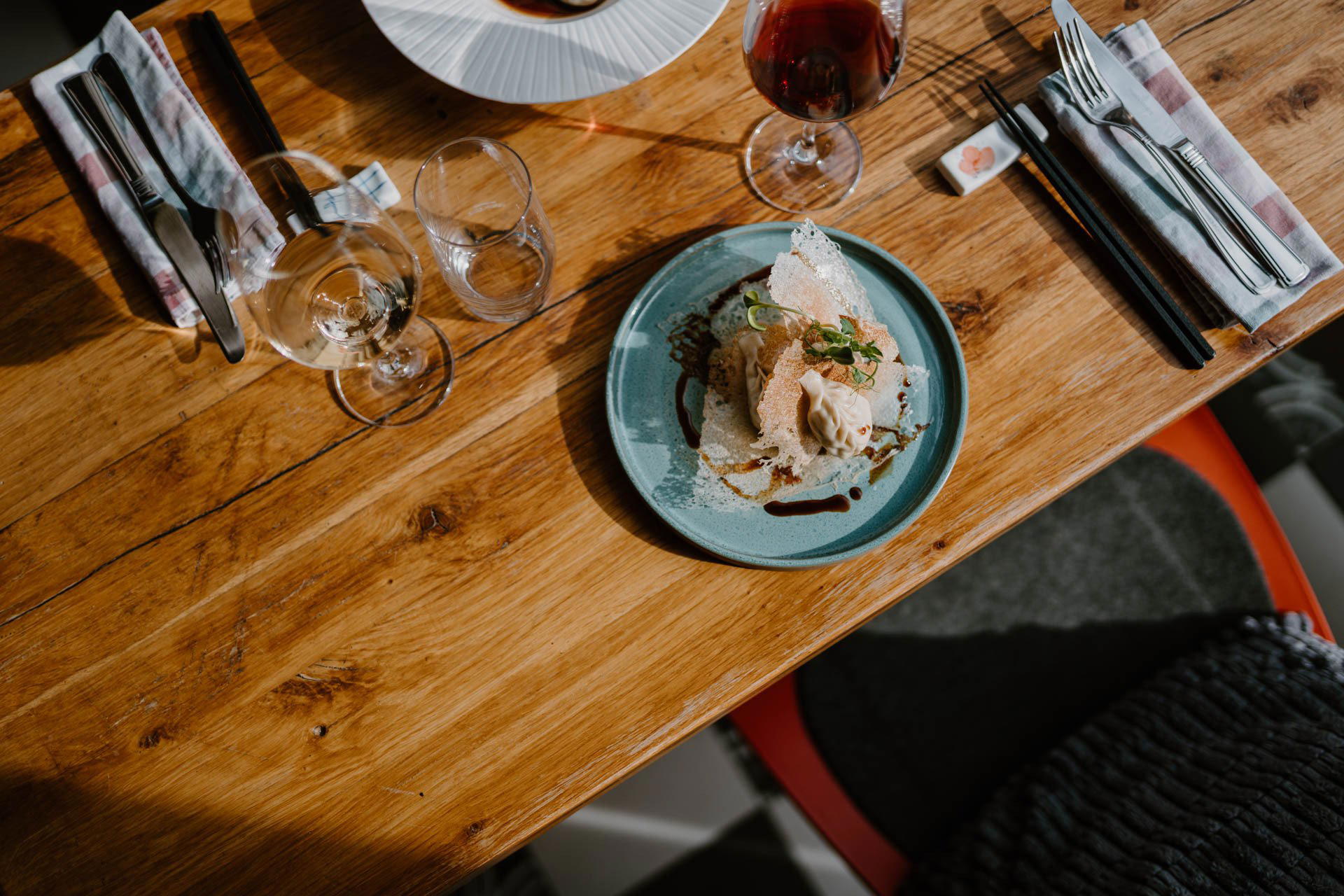
Where Flingern's Dining Character Meets Cross-Cultural Precision
Düsseldorf's Flingern district has developed a dining identity distinct from the polished Altstadt circuit or the Japantown corridor along Immermannstraße. The streets here attract the kind of small, independent operations that prioritise a specific culinary position over broad appeal, and Ackerstraße 182 fits that pattern. Hashi, petite chinoiserie announces its intent through its name alone: hashi, the Japanese word for chopsticks, paired with a French descriptor for a delicate, ornamental take on Chinese aesthetics. That layering of references, before you have even stepped inside, signals something more considered than a neighbourhood takeaway or a pan-Asian menu built for volume.
The cross-cultural framing is worth taking seriously. Düsseldorf's Asian dining scene operates on two distinct registers. The first is the well-documented Japanese community concentration, which makes this city home to more authentic Japanese restaurants per capita than almost any other German city outside the capital. The second, less discussed tier comprises smaller operations drawing on Chinese, Korean, and Southeast Asian traditions, often serving a more local, less tourist-directed clientele. Hashi positions itself somewhere between these registers, using French vocabulary to frame a Chinese culinary sensibility, a move that places it in conversation with a broader European tradition of cross-cultural fine dining rather than with the Immermannstraße sushi counters.
The Logic Behind the Name
In European cities with substantial East Asian dining scenes, the most interesting recent development has not been the expansion of high-volume Chinese restaurants or the proliferation of bubble tea formats, but the emergence of smaller operations that apply French structural thinking to Chinese or Japanese ingredients and techniques. Paris has seen this most visibly, but the pattern extends to Hamburg, Berlin, and increasingly Düsseldorf. The petite chinoiserie framing at Hashi belongs to this moment: it suggests intimacy of scale, attention to presentation, and a curatorial approach to the menu rather than the encyclopaedic listing typical of larger Chinese restaurants in German cities.
That curatorial impulse, when it works, depends heavily on the relationship between the kitchen and the front of house. At smaller operations in this format, the team dynamic matters more than at larger restaurants where kitchen and floor can operate as separate departments. The most successful examples in this register, from CODA Dessert Dining in Berlin to JAN in Munich, demonstrate that a tightly coordinated team, where the floor communicates dish context and the kitchen responds to the room's pace, produces a meaningfully different experience from kitchens that operate in isolation from their guests. Hashi's scale, implied by its address in a residential stretch of Flingern rather than a high-traffic commercial zone, suggests a format where that kind of close collaboration is at least structurally possible.
Düsseldorf's Asian Dining Context
To understand where Hashi sits in this city, it helps to map the broader Asian dining tiers. At the upper end, Düsseldorf's Japanese restaurants serve a community of approximately 8,000 Japanese residents, many associated with the trading companies and banks that have maintained offices here since the 1970s. That community sustains a level of authenticity and price expectation that keeps the Immermannstraße corridor largely self-referential. Below that, a diffuse middle tier of pan-Asian and Chinese restaurants serves the broader city, often competing on price and portion rather than on specificity of regional cuisine.
Hashi's positioning, with a French-inflected name and a descriptor that implies restraint and precision, places it outside both of those categories. It is not competing with the Japanese community restaurants, nor with the volume-driven Chinese operations. The closest European analogues are the small Sino-French or Sino-European hybrids that have appeared in cities like Lyon and Amsterdam over the past decade, where a Chinese culinary base is filtered through a European fine-dining sensibility without becoming fusion in the dismissive sense of that word. Compared to other Düsseldorf operators at this intersection, including the more straightforwardly positioned Anfora or the casual register of Alanya Döner, Hashi is attempting something with more specific ambition.
For context on where Germany's most decorated dining operates, houses like Aqua in Wolfsburg, Schwarzwaldstube in Baiersbronn, and Vendôme in Bergisch Gladbach define the country's formal fine-dining ceiling. Hashi is not in that bracket, nor does it appear to be reaching for it. Its register is closer to what you might call the considered neighbourhood specialist, a category that has proven durable in cities like Hamburg, where Restaurant Haerlin anchors the formal end while smaller independents fill the space beneath it. In Düsseldorf, that middle tier of serious, independent, format-specific restaurants is thinner than in Berlin or Munich, which gives operations like Hashi more room to define their own category.
Planning a Visit
Hashi is located at Ackerstraße 182, 40235 Düsseldorf, in the Flingern Nord quarter, a short distance from the Flingern S-Bahn station and accessible from the city centre in under fifteen minutes by public transport. Given the small-format positioning implied by the petite descriptor, walk-in availability on weekend evenings is likely limited; contacting the venue directly before visiting is advisable.
For those building a broader Düsseldorf dining itinerary, our full Dusseldorf restaurants guide maps the city's dining character across neighbourhoods and price tiers. Nearby independents worth pairing with a visit to this part of Flingern include Amuni Wein- und Käsebar for wine-focused follow-ups, and Arca Alacati for a contrasting Turkish-Mediterranean perspective on the neighbourhood's independent dining. For those whose travel extends to comparing Düsseldorf's Asian dining positioning against international benchmarks, Atomix in New York City represents the most developed version of the cross-cultural fine-dining model that Hashi appears to be working within, albeit at a considerably different scale and price point.
How Hashi, petite chinoiserie Düsseldorf compares with similar nearby venues.
| Venue | Cuisine | Price |
|---|---|---|
| Bistro Fatal | French | €€ |
Continue exploring
More in Düsseldorf
Restaurants in Düsseldorf
Browse all →
Bars in Düsseldorf
Browse all →
Hotels in Düsseldorf
Browse all →

Wineries in Düsseldorf
Browse all →

At a Glance
- Cozy
- Elegant
- Intimate
- Sophisticated
- Date Night
- Special Occasion
- Private Dining
- Extensive Wine List
Current opening hours
- Monday
- Closed
- Tuesday
- 6–10 PM
- Wednesday
- 6–10 PM
- Thursday
- 6–10 PM
- Friday
- 6–10 PM
- Saturday
- 6–10 PM
- Sunday
- Closed
Hours can change for holidays and private events. Last verified .
Stylish and cozy atmosphere with a casual setting that creates a feelgood feeling, enhanced by personal service.
Know Before You Go
- Getting there
- Ackerstraße 182, 40235 Düsseldorf, Germany