Jeon Ju Korean Bibimbap Restaurant
Jeon Ju Korean Bibimbap Restaurant on West Olympic Boulevard brings the regional cooking traditions of Jeonju — South Korea's designated food capital — to the Koreatown dining corridor. The kitchen anchors its menu around bibimbap, the layered rice-and-vegetable bowl that the city of Jeonju has spent generations refining. For Angelenos tracking how Korean regional cuisine reads in an American context, this address is a considered reference point.
- Address
- 2716 W Olympic Blvd Ste #101, Los Angeles, CA 90006
- Phone
- +1 213 386 5678
- Directions
- Get directions
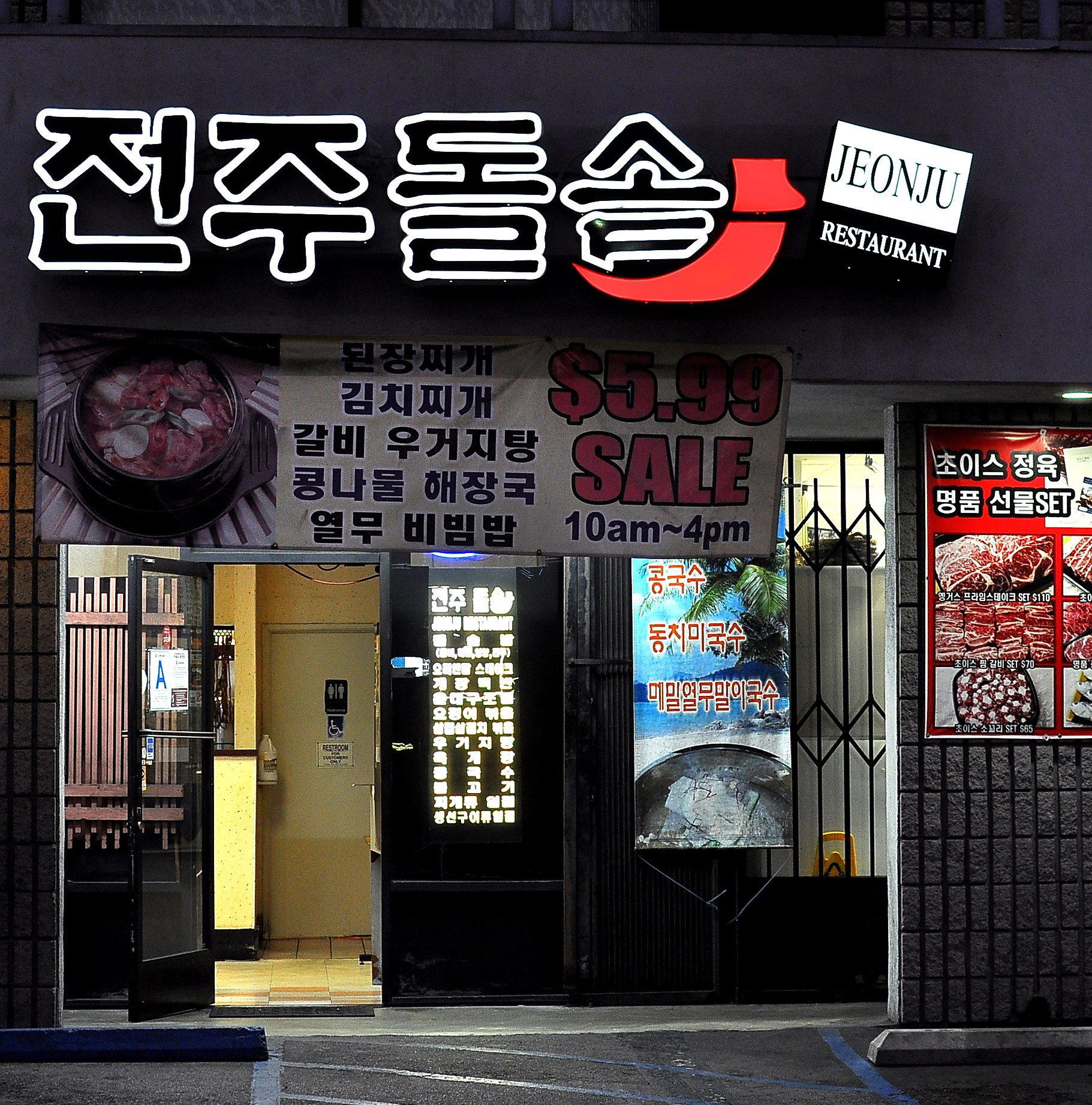
Koreatown's Regional Korean Argument
Los Angeles has one of the largest Korean communities outside the Korean peninsula, and Koreatown's restaurant density reflects that. The stretch of Olympic Boulevard running west through the neighbourhood carries dozens of Korean restaurants at every price point — from late-night barbecue spots charging by the cut to weekend-only pojangmacha-style operations running on regulars alone. Within that field, Jeon Ju Korean Bibimbap Restaurant at 2716 W Olympic Blvd takes a narrower, more deliberate position: it names itself after Jeonju, the city in North Jeolla Province that South Korea officially recognises as its food capital, and it centres the menu on bibimbap rather than spreading across the broader Korean canon. That kind of specificity, in a strip of restaurants where menus routinely span thirty items, is itself a curatorial statement.
Bibimbap as a category has suffered from dilution in the American restaurant market. The dish — rice topped with seasoned vegetables, a protein, gochujang, and typically a fried or raw egg, served either in a heated dolsot stone bowl or at room temperature, has become so standard across fast-casual and grocery-deli formats that its regional depth rarely registers. Jeonju-style bibimbap is a specific variant with documented culinary history: the city's version traditionally uses a beef broth-cooked rice base, raw beef (yukhoe), and a wider array of namul (seasoned vegetable side preparations) than most approximations manage. It is the version most cited when Korean culinary historians discuss the dish's origins, and it is the version after which this restaurant names itself. Whether the kitchen executes fully to that specification, the framing alone places it in a different conversation than the bowl you'd pick up from a food-court counter.
How the Address Has Positioned Itself Over Time
Korean dining in Los Angeles has moved through several distinct phases over the past four decades. The first wave of Koreatown restaurants in the 1970s and 1980s operated primarily for the Korean-American community, with little crossover expectation. By the 2000s, mainstream food media had discovered Korean barbecue, and the neighbourhood became a destination for non-Korean Angelenos for the first time at scale. The 2010s brought a third shift: younger Korean-American chefs began translating the cuisine into fine-dining formats, placing Korean techniques and fermentation traditions inside tasting-menu structures at restaurants like Atomix in New York City and, locally, within LA's broader contemporary Asian dining cohort that includes Kato (New Taiwanese, Asian).
Jeon Ju sits outside that fine-dining arc, and that positioning is where its evolution is worth reading carefully. In a market increasingly drawn to elaborate Korean-inflected tasting menus and chef-driven reinvention, a restaurant that holds to the Jeonju regional bibimbap format represents a counter-argument: that specificity within a traditional format carries its own authority. The restaurant's address on West Olympic places it within the working Koreatown corridor rather than the more visible, tourist-facing stretch of the neighbourhood, which shapes the room it operates in and the regulars it serves.
What Koreatown's Dining Tiers Tell You About This Room
To understand where Jeon Ju lands, it helps to map LA's Korean dining tiers briefly. At the highest point of the category locally, you have restaurants competing on technique, sourcing, and format with the broader LA fine-dining field, venues like Hayato (Japanese) or, at the top of the non-Korean contemporary tier, Somni (Molecular) and Providence (Contemporary Seafood). Below that, mid-range Korean restaurants compete on volume, consistency, and familiarity. At the community-anchored end, smaller operations like Jeon Ju serve regulars who are evaluating the food against a specific regional standard rather than against the broader restaurant market.
That last tier is frequently the most instructive for understanding what a cuisine actually tastes like at its source. The same pattern holds in other American cities: the restaurants doing the most accurate regional work often operate in the least-decorated rooms, at prices that reflect the community they serve rather than the attention they could command elsewhere. This dynamic is visible across American dining cities, from the community-rooted Italian American tables that predate the chef-driven wave represented by Osteria Mozza (Italian), to the neighbourhood anchors that exist in parallel to destination restaurants like Le Bernardin in New York City, Lazy Bear in San Francisco, or The French Laundry in Napa.
Planning a Visit
Jeon Ju Korean Bibimbap Restaurant is located at 2716 W Olympic Blvd, Suite 101, Los Angeles, CA 90006, a West Olympic Boulevard address that sits in the denser residential and commercial band of Koreatown. Parking in this section of the neighbourhood runs easier than on the main Wilshire or 6th Street corridors, though street spots thin out during peak evening hours. Price range data is similarly unconfirmed, but independent bibimbap-focused restaurants in the Koreatown mid-range typically run well below the $$$$ tier occupied by destination restaurants at the scale of Addison in San Diego, Smyth in Chicago, or Blue Hill at Stone Barns in Tarrytown.
For visitors building a broader LA itinerary, Koreatown is roughly central to the city's east-west axis, which makes it a practical base for reaching the Westside dining corridor or Downtown without excessive travel. EP Club's full Los Angeles restaurants guide maps the full range of the city's dining options across neighbourhoods and price tiers, including the farm-driven and tasting-menu formats represented regionally by places like Single Thread Farm in Healdsburg, Frasca Food & Wine in Boulder, and The Inn at Little Washington in Washington, all of which represent a very different register from Koreatown's community-restaurant tier, but together illustrate the range of American dining that exists outside the obvious coastal fine-dining canon. For a point of comparison closer to Jeon Ju's own regional-specificity argument, the cooking at Emeril's in New Orleans and Atelier Moessmer Norbert Niederkofler in Brunico each demonstrate how regional identity, held with conviction over time, creates its own authority in markets that otherwise reward novelty.
Cuisine-First Comparison
| Venue | Cuisine | Price | Awards |
|---|---|---|---|
| Jeon Ju Korean Bibimbap RestaurantThis venue — the venue you are viewing | This venue | Not listed | Not listed |
| Kato | New Taiwanese, Asian | $$$$ | Michelin 1 Star |
| Hayato | Japanese | $$$$ | Michelin 2 Star |
| Vespertine | Progressive, Contemporary | $$$$ | Michelin 2 Star |
| Holbox | Mexican Seafood, Mexican | $$ | Michelin 1 Star |
| Sushi Kaneyoshi | Sushi, Japanese | $$$$ | Michelin 1 Star |
Continue exploring
More in Los Angeles
Restaurants in Los Angeles
Browse all →
Bars in Los Angeles
Browse all →

Hotels in Los Angeles
Browse all →


Wineries in Los Angeles
Browse all →
At a Glance
- Classic
- Casual Hangout
Casual Koreatown spot with simple, no-frills atmosphere focused on authentic Korean comfort food.
Know Before You Go
- Getting there
- 2716 W Olympic Blvd Ste #101, Los Angeles, CA 90006