Hanbat Sul Lung Tang
Our verdict
Hanbat Sul Lung Tang on 5th Street sits inside Koreatown's most utilitarian dining tradition: the sul lung tang house, where beef bones simmer for hours and broth arrives white, clean, and uncompromising. This is the kind of place that rewards regulars and indifferent to trends. For anyone tracking Los Angeles's Korean dining depth beyond the barbecue circuit, it belongs on the itinerary.

Pearl is the En Primeur Club membership app — saves, bookings, and concierge access live there. Same editors, same standards.
- Address
- 4163 5th St, Los Angeles, CA 90020
- Phone
- (213) 383-9499
- Hours
- Mon–Sat 7 AM–9 PMSun Closed
- Website
- hanbatsullungtang.net
- Directions
- Get directions
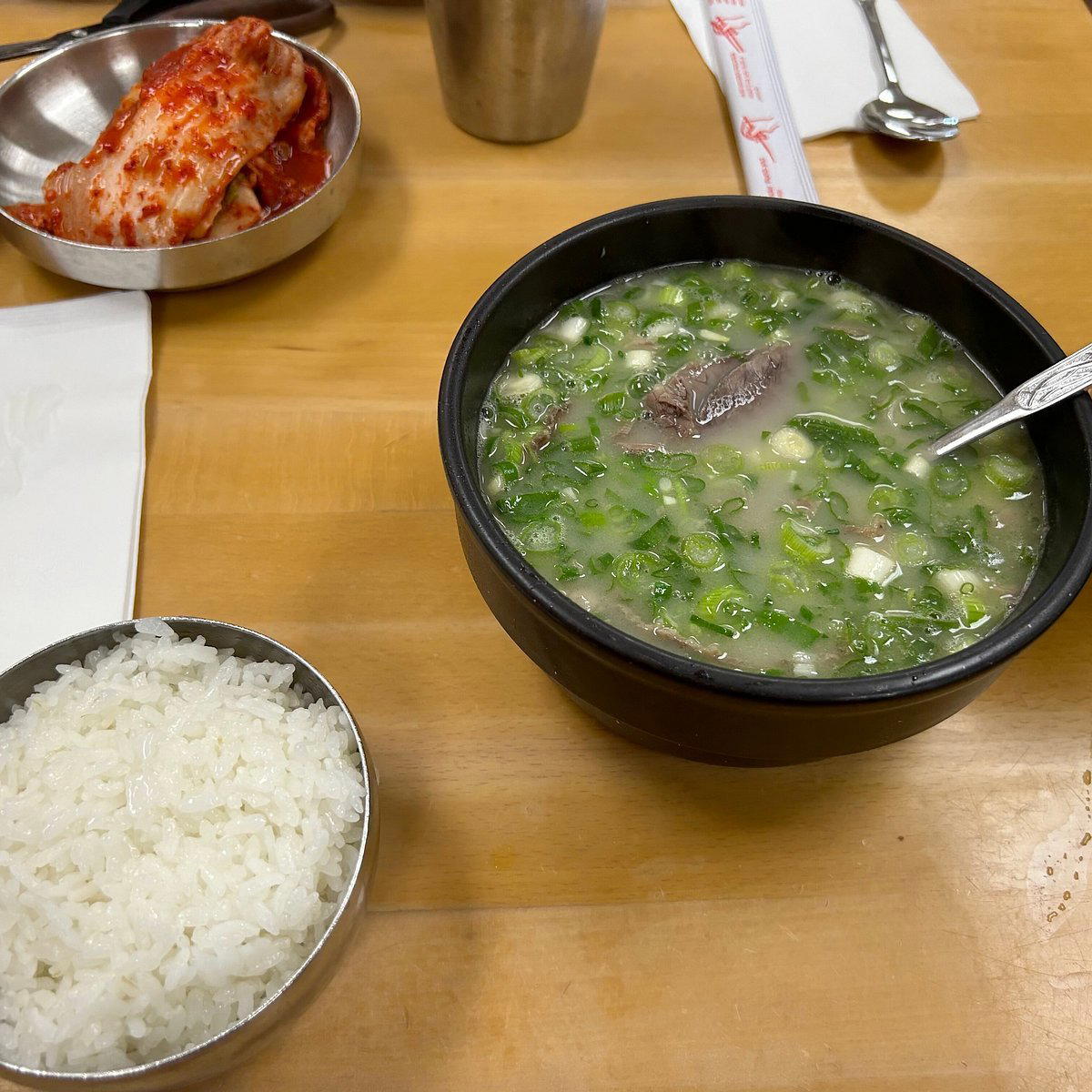
The Broth Tradition Behind the Bowl
Sul lung tang occupies a specific and demanding place in Korean culinary history. The dish, a milky white beef bone broth served with rice, glass noodles, and thin slices of brisket or tendon, has been a Seoul breakfast institution for centuries. Its preparation requires sustained, high-heat simmering of ox leg bones, knuckles, and brisket over many hours, sometimes through the night, until the collagen and marrow fully emulsify into the signature opaque stock. The result carries no soy, no gochujang, no sweetness. The diner seasons it themselves at the table with salt, scallion, and black pepper. That transfer of control is not modesty on the kitchen's part. It is the discipline of the form.
Hanbat Sul Lung Tang at 4163 5th Street, in the heart of Los Angeles's Koreatown, operates inside that tradition without modification. Koreatown itself represents one of the densest Korean dining corridors outside the Korean peninsula, and within it, sul lung tang houses occupy a distinct register: low-ceremony, high-frequency, technically specific. These are not restaurants built around occasion. They are built around repetition and consistency, qualities that matter more in a broth-based kitchen than almost anywhere else in Korean cooking.
What the Sourcing Question Means for a Broth-Forward Kitchen
The editorial angle on any sul lung tang house is ultimately an ingredient question. The broth's character, that white opacity and clean bovine depth, depends almost entirely on the quality and cut composition of the bones used. Unlike a sauce-driven kitchen where seasoning can compensate for variable raw material, sul lung tang is essentially a reduction of its source protein. There is nowhere for inferior bones to hide.
Los Angeles's Koreatown has access to a competitive supply chain for Korean-style beef processing, with several regional distributors serving the corridor's restaurants. The question of whether a given sul lung tang house uses knuckle-heavy or leg-heavy bone ratios, how long it runs its simmer, and whether it refreshes bones mid-cycle affects the final bowl in ways that any regular visitor can identify over time. These are not variables typically flagged on a menu. They are the institutional knowledge of the house, accumulated across years of service.
This matters because sul lung tang is one of the few Korean dishes where the cooking process is the entire value proposition. There is no elaborate garnish to distract from a thin broth. There is no marinade complexity to compensate for shortened simmering time. The bowl announces itself quickly, and experienced eaters read it accurately. That transparency is what makes consistent sul lung tang houses acquire loyal followings among Korean and non-Korean diners alike in Los Angeles.
Koreatown's Dining Spectrum and Where Broth Houses Fit
Los Angeles's Koreatown draws a different visitor than the city's fine-dining circuit does. Venues like Kato, which repositions Taiwanese and pan-Asian reference points through a high-precision lens, or Hayato, which runs formal kaiseki in a reservation-driven format, operate in the fine-dining register and price accordingly. The comparison set for Hanbat Sul Lung Tang is entirely different. It belongs to the working-kitchen tier of Koreatown, alongside the jjigae specialists, the naengmyeon houses, and the twenty-four-hour pojangmacha-style establishments that define the neighbourhood's culinary backbone.
That tier is not a consolation prize. In a city where Los Angeles's broader dining conversation tilts toward tasting menus and chef-driven concepts, the specialists who do one dish well over decades are performing a different kind of excellence. It is the same logic that separates the aged omakase counter from the broiled-fish teishoku spot in Tokyo: different registers, both defensible on their own terms.
For those navigating Los Angeles's wider dining geography, our full Los Angeles restaurants guide maps the city across formats and price points. The fine-dining comparison set includes Providence for contemporary seafood, Somni for molecular work, and Osteria Mozza for Italian. None of those comparisons are relevant here. Hanbat sits in a different conversation entirely.
The Room and the Rhythm
Sul lung tang houses in Koreatown share a recognizable physical grammar: fluorescent lighting, laminate tables, metal chopsticks, and a service tempo calibrated to turnover rather than lingering. These rooms are not designed for extended occupation. They are designed for a bowl, a side of kimchi or radish, and a seat that returns to circulation quickly. That is not a criticism. It is a description of the format's logic, which runs on volume and repetition rather than margin per cover.
Arriving at Hanbat on 5th Street, the address itself is a locator within Koreatown's grid rather than a destination address in the design-hotel sense. The street sits a short distance from the commercial density of Wilshire and Western. Parking, as with much of Koreatown, requires patience or a willingness to walk from a side-street space. The room rewards neither lingering nor ceremony. It rewards showing up, ordering correctly, and letting the bowl do its work.
How This Fits a Broader American Broth Moment
Sul lung tang's profile in the United States has grown alongside broader interest in long-cooked bone broths. That culinary category attracted significant attention through the 2010s across wellness and restaurant contexts, with venues from Blue Hill at Stone Barns to Single Thread Farm in Healdsburg foregrounding nose-to-tail sourcing and long-process cooking. Korean broth traditions predate that trend by centuries, but the cultural moment created new audiences for a dish that had previously circulated almost entirely within Korean-speaking communities in cities like Los Angeles.
The result is that sul lung tang houses now serve a wider cross-section of diners than they did a generation ago. That shift has not changed the dish. The preparation remains what it was. But it has changed the context in which newcomers encounter it, often arriving with more framework for understanding why the broth looks the way it does and why the seasoning arrives separately. Other American cities with comparable Korean populations have seen similar pattern shifts in cities like New York, where Atomix represents the fine-dining end of the Korean dining conversation, while the outer boroughs continue to anchor the everyday specialist tier.
Planning a Visit
Hanbat Sul Lung Tang does not maintain a published website or reservation system based on available information, which places it squarely in the walk-in, counter-order tradition of Koreatown's specialist houses. Given that sul lung tang kitchens often operate through early morning hours to capture the traditional breakfast trade, arriving between opening and mid-morning tends to offer both the freshest broth draw and the shortest wait. Koreatown's lunch window sees high volume from the surrounding residential and office population, so midweek off-peak timing is worth considering for anyone sensitive to wait times.
Pricing at sul lung tang houses in Los Angeles generally sits at the accessible end of the city's dining range, well below the tasting-menu register of venues like The French Laundry in Napa or Le Bernardin in New York, and closer in format and cost to the everyday-specialist model. No allergy menu or dietary accommodation information is publicly documented. Diners with specific dietary requirements should contact the restaurant directly before visiting, as sul lung tang by definition involves beef bone and beef protein throughout the cooking process, with no direct substitution available in the traditional preparation.
Frequently asked questions
Where exactly is Hanbat Sul Lung Tang?
Hanbat Sul Lung Tang is located at 4163 5th St, Los Angeles, CA 90020, Los Angeles.
Is Hanbat Sul Lung Tang open 24 hours like some Koreatown broth houses?
Several sul lung tang houses in Koreatown operate extended or overnight hours given the dish's reputation as a late-night and restorative meal, but confirming Hanbat's specific schedule requires contacting the restaurant directly or visiting in person.
What's the must-try dish at Hanbat Sul Lung Tang?
Sul lung tang is the singular focus here: a milky white beef bone broth, produced through hours of simmering, served with rice, glass noodles, and thinly sliced beef. At a broth house on 5th Street in Koreatown, there is no hedging the order — the bowl is the point, seasoned tableside with salt and scallions to personal preference.
Should I book Hanbat Sul Lung Tang in advance?
Hanbat Sul Lung Tang does not operate a reservation system or publish a booking channel, which means walk-in is the only way in. Arriving during off-peak hours — mid-morning or mid-afternoon, if the kitchen's hours allow — is the practical strategy for avoiding a wait at this Koreatown address.
What's Hanbat Sul Lung Tang best at?
The kitchen's focus is sul lung tang executed without distraction — a broth-forward format that prioritizes long cook times and bovine depth over menu breadth. In Koreatown, where this dish has a concentrated peer group, a venue that commits entirely to a single preparation tends to produce a more consistent bowl than one splitting attention across a broad menu.
How does Hanbat Sul Lung Tang handle allergies?
Sul lung tang is a beef-forward dish by definition — the broth, the protein, and the bone are all bovine, making this an unsuitable venue for anyone avoiding red meat or beef derivatives.
In Context: Similar Options
Comparable venues nearby, for context on price, style, and recognition.
| Venue | Cuisine | Price | Notes |
|---|---|---|---|
| Hanbat Sul Lung TangThis venue — the venue you are viewing | Traditional Korean Sul Lung Tang | $10–20 | Not listed |
| Jeon Ju Korean Bibimbap Restaurant | Korean Bibimbap Specialist | Not listed | Pico-Union |
| Kyochon Chicken | Korean Fried Chicken | $20–30 | Wilshire Center |
| Eight Korean BBQ | Modern Korean BBQ | Not listed | Koreatown |
| Master Ha | Korean Seafood | Not listed | Harvard Heights |
| BCD Tofu House | Korean Soon Tofu House | $20–30 | Wilshire Center |
Continue exploring
More in Los Angeles
Restaurants in Los Angeles
Browse all →
Bars in Los Angeles
Browse all →

Hotels in Los Angeles
Browse all →

Wineries in Los Angeles
Browse all →
Details
- Cozy
- Classic
- Casual Hangout
- Family
- Sake Program
- A La Carte
- Gluten Free Options
Current opening hours
- Monday
- 7 AM–9 PM
- Tuesday
- 7 AM–9 PM
- Wednesday
- 7 AM–9 PM
- Thursday
- 7 AM–9 PM
- Friday
- 7 AM–9 PM
- Saturday
- 7 AM–9 PM
- Sunday
- Closed
Hours can change for holidays and private events. Last verified .
Casual, cozy hole-in-the-wall atmosphere with efficient table service and a homey feel.