
Yoshoku Musha Musha sits in the everyday end of Japan’s yoshoku tradition: Japanese-style Western cooking with a compact room, counter seating, table seating, terrace seats and a price band that keeps the meal casual. Its selection for Tabelog 100 Yoshoku WEST 2025 gives the restaurant a useful signal in a category where reputation often travels through local regulars rather than formal fine-dining markers.
Pearl is the En Primeur Club membership app — saves, bookings, and concierge access live there. Same editors, same standards.
- Address
- 兵庫県西宮市高松町16-22
- Phone
- +81798311788
- Website
- mu-sya.com
 Saves & bookings on Pearl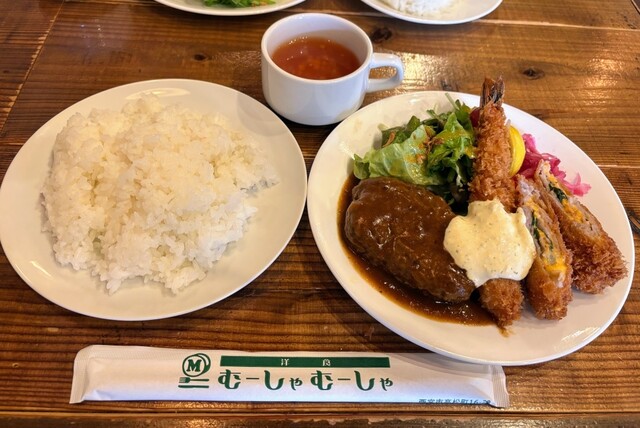
Approach the room and the first cue is scale, not spectacle: a small yoshoku address built for regular traffic, solo diners, families and quick counter decisions. That matters. Japanese-style Western cooking, at its strongest, is not a luxury import category but a daily restaurant language shaped around rice plates, sauces, fried cutlets, omelette rice, hamburger steak and other Western-derived forms Japanese kitchens have made their own for more than a century. The appeal is not ceremony; it is clarity, warmth and a menu edited around repeat habits.
Yoshoku Musha Musha belongs to that tradition, not the tasting-menu economy. Its Tabelog 100 Yoshoku WEST 2025 recognition places it in a curated regional group for the category, yet pricing remains JPY 1,000 to JPY 1,999 at both lunch and dinner. That combination says much about yoshoku in western Japan: prestige can attach to modest rooms and everyday dishes, not only chef counters, luxury produce or wine-heavy dining rooms. Compared with Yoshoku to Wine no Omise Tsukushien in Takamatsu, which sits in a higher dinner band, this is the more casual expression of the form.
A yoshoku menu works when the structure is tight
The useful way to read a yoshoku restaurant is through its architecture. The genre depends on categories rather than long narrative menus: fried items, stewed items, rice-centered plates, clearly defined sauces and side dishes that ground the meal. A kitchen need not announce ambition if the structure moves diners quickly between comfort and precision. Here, the public category is simply yoshoku, and that restraint is the point. The restaurant is not blurring itself into French bistro, café dining or hotel grill-room formality.
That menu logic makes the price band significant. At JPY 1,000 to JPY 1,999, yoshoku must satisfy without the padding of higher-budget Western-Japanese dining: long wine lists, elaborate plating or extra courses that pull the meal from its weekday roots. Wine is useful, but it does not redefine the format. The stronger signal is the small capacity: 24 seats across counter, tables and terrace. A room that size can keep the menu close to the kitchen’s rhythm, so diners should expect a compact, practical experience, not a sprawling session.
Western Japan’s yoshoku scene is more diverse than outsiders often assume, spanning family restaurants, station-area lunch counters and specialist rooms with enough local loyalty to reach regional award lists. A Tabelog 100 selection in 2025 does not make the category fine dining; it marks the restaurant as a serious example within a popular field. That matters for travelers building a food itinerary beyond sushi, kaiseki or ramen.
Why this kind of address belongs in a Kansai food itinerary
The address is in Nishinomiya Kitaguchi, which works differently from the destination-dining neighborhoods of Kyoto, Osaka or Kobe. Station proximity, residential patterns and repeat customers shape the restaurant culture. Here, yoshoku plays a practical role: a familiar meal with enough craft to justify a detour, while staying accessible for solo meals and family dining. The no-smoking policy, take-out service and children-welcome positioning reinforce that everyday function.
For travelers using Takamatsu as a broader editorial frame, this contrasts usefully with Sanuki udon culture. Takamatsu eating is often discussed through speed, wheat, broth and self-service formats, and the city’s restaurant map rewards low-friction meals as much as formal reservations. For that side of the itinerary, Chikusei Honten, Furukawa Udon and Furusato Udon show why udon remains the local benchmark. Fumiya Okonomiyaki Honten and Azuma add context for casual Japanese formats where repetition and speed do not mean a lack of seriousness.
Against that pattern, Yoshoku Musha Musha reads as another comfort-food study: less regional identity than udon, more hybrid history; less speed-counter culture than self-service noodles, more sit-down structure. It also fits beside other compact, category-led Japanese restaurants. The appeal of [Curry Senmon Ten] Maruyama Kyoju. in Sapporo, (Shoku) Vietnam in Kawasaki.know in Kumamoto and.cafe in Osaka follows the same principle: the category tells diners how to behave before the first order.
Plan around a compact room, not a drawn-out occasion
The practical reading is simple: this is a small restaurant with no private rooms, no private-use option, cashless limits that exclude credit cards and electronic money, and QR payment support through PayPay. Parking is not attached, though coin parking is nearby. Those details define the experience more accurately than inflated restaurant language would. A 24-seat room with counter, table and terrace seating rewards flexible timing and a short list of priorities.
Opened in 2017, the restaurant belongs to a newer generation of yoshoku addresses, not an inherited postwar dining room trading on age alone. Its 2025 Tabelog 100 Yoshoku WEST selection is the strongest external trust signal here, while the 3.50 score suggests enough local and category recognition to matter without luxury pricing. For a wider trip, use Our full Takamatsu restaurants guide alongside Our full Takamatsu hotels guide, Our full Takamatsu bars guide, Our full Takamatsu wineries guide and Our full Takamatsu experiences guide to balance casual meals with the rest of the itinerary.
The broader lesson for Japan dining plans: not every serious meal announces itself through rarity, chef biography or high spend. Particularly instructive rooms are plain in format and mixed in audience. For comparison across category-led dining, look at -Grilled beef Sukiyaki- KAMAKURA TANUKIAN 鎌倉 たぬき庵 in Kamakura. 鮪と炭火焼き うお炭 秋葉原店 in Tokyo, Jōdo Saké Bar in Los Angeles and Onigiri Time in Pasadena. Yoshoku Musha Musha sits in that conversation as a compact, affordable example of how a familiar format can carry real editorial weight.
Comparable Spots
Comparable venues by cuisine and price in the same metro.
| Venue | Cuisine | Price | Notes |
|---|---|---|---|
| Yoshoku Musha MushaThis venue — the venue you are viewing | Casual Yoshoku (Japanese Western-style) | $$ | Not listed |
| Yoshoku to Wine no Omise Tsukushien | Yoshoku (Japanese‑style Western) & Wine | $$ | Nishinomiya Kitaguchi |
| Honetsukidori Ikkaku Takamatsu ten | Kagawa honetsukidori & izakaya-style chicken dishes | $$ | Takamatsu |
| Honkaku Teuchi Udon Menmusubi | Traditional Sanuki Udon | $ | Takamatsu |
| Sushi Nakagawa | Traditional Sushi Omakase | $$$ | Takamatsu |
| Teuchi Udon Shimizuya | Sanuki udon & tempura | $ | Takamatsu |
Recognition history
Dated appearances from independent guides and award organizations, with the underlying list record or original source where available.
Tabelog 100 #69 · No. 69
Tabelog · Tabelog 100 - Yoshoku - WEST - 2025
Continue exploring
More in Takamatsu
Restaurants in Takamatsu
Browse all →




Bars in Takamatsu
Browse all →



Hotels in Takamatsu
Browse all →



Wineries in Takamatsu
Browse all →
At a Glance
- Cozy
- Classic
- Solo
- Family
- Casual Hangout
- After Work
- Standalone
A relaxed, neighborhood yoshoku spot with a homely, unpretentious atmosphere that focuses on comforting plates rather than design, likely with a casual bustle at lunchtime.