.png)
A long-running Ningde institution on Jiaocheng North Road, Xiao Dong Men Niu Rou Shui Fen Lao Dian has built its reputation on a single discipline: beef rice noodle soup. The broth carries meaty and herbal depth, the rice noodles are slippery and yielding, and the offal soups, from bouncy tripe to tender ox tongue, confirm this is a kitchen that takes the whole animal seriously.
 Discover on Pearl
Pearl is the En Primeur Club membership app — saves, bookings, and concierge access live there. Same editors, same standards.
Where the Bowl Comes First
Second-floor dining rooms above street-level retail are a common format in Fujian's smaller cities, and the setup at Xiao Dong Men Niu Rou Shui Fen Lao Dian, above a commercial block on Jiaocheng North Road in Ningde's Jiaocheng District, follows that pattern. The staircase up is unremarkable; what you encounter at the leading is a room shaped entirely around a single culinary proposition: beef rice noodle soup. There is no broad menu to parse, no seasonal tasting format, no theatrical plating. The kitchen has committed to a narrow repertoire, and that narrowness is the editorial point worth sitting with. In an era when many Chinese regional restaurants have widened their menus to capture more spending occasions, a place that anchors its identity to one dish category and builds depth within it represents a deliberate structural choice.
The Logic of a Single-Discipline Menu
Ningde sits on Fujian's northeastern coast, a prefecture-level city with a food culture shaped by proximity to the sea and by inland mountainous terrain that defines much of the province's agricultural output. Beef noodle soup, in its various regional forms, is one of the most deeply embedded comfort formats in Chinese urban dining. What distinguishes venues in this category is not the concept itself but the execution within it: the quality and complexity of the broth, the texture calibration of the noodles, and the range of protein cuts available. Xiao Dong Men Niu Rou Shui Fen Lao Dian operates squarely inside that framework, and its menu architecture reflects a kitchen that has spent its operational life refining a narrow set of variables rather than expanding into adjacent categories.
The broth is described as carrying meaty and herbal aromas, a pairing that reflects the broader Fujian tendency to layer animal-derived depth with dried herbs and aromatics rather than relying on chilli heat or fermented pastes as primary flavour drivers. This positions the restaurant's cooking closer to the gentle, layered broth traditions of Fujian and parts of Zhejiang than to the more aggressively spiced beef noodle formats of Sichuan or the tomato-fortified variants found in parts of northern China. For context on how Fujian's approach to refined broth-led cooking can translate into a fine-dining register, the work being done at places like Xin Rong Ji (Xinyuan South Road) in Beijing and Ru Yuan in Hangzhou illustrates how seriously the regional canon is now being treated at a national level. Xiao Dong Men occupies a different tier entirely, but the underlying respect for technique in broth construction is a shared characteristic.
Reading the Menu: Noodles, Offal, and Meatballs
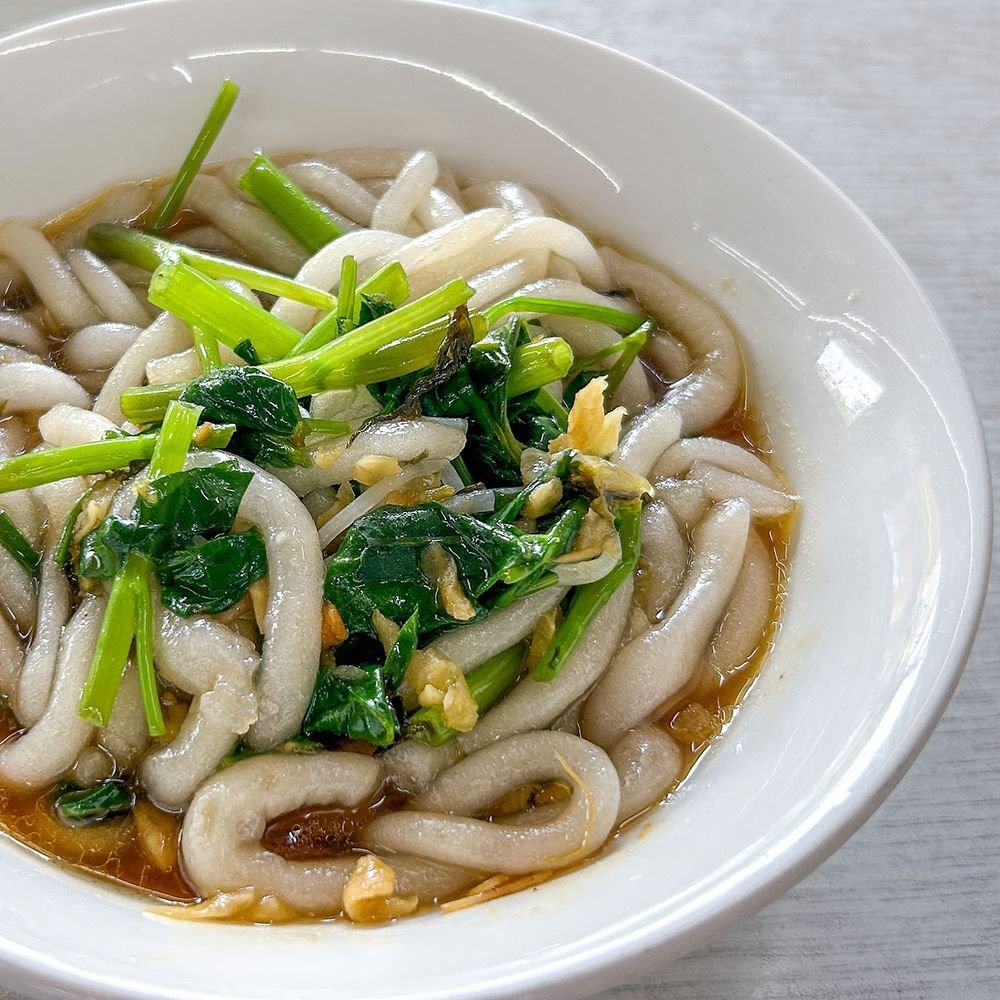
The menu at Xiao Dong Men Niu Rou Shui Fen Lao Dian divides into three principal formats, each telling a slightly different story about how a single protein can be extended across a full dining offer. The flagship bowl pairs the rice noodles with sliced beef and pickled mustard greens. The mustard greens carry acidity and a mild fermented sharpness that cuts through the richness of the broth, and the interplay between the slippery texture of the noodles and the chew of the beef is the technical core of the dish. This kind of textural counterpoint, where the noodle and the protein are calibrated to work against each other rather than harmonise, is a sophisticated construction even when it appears in an informal setting.
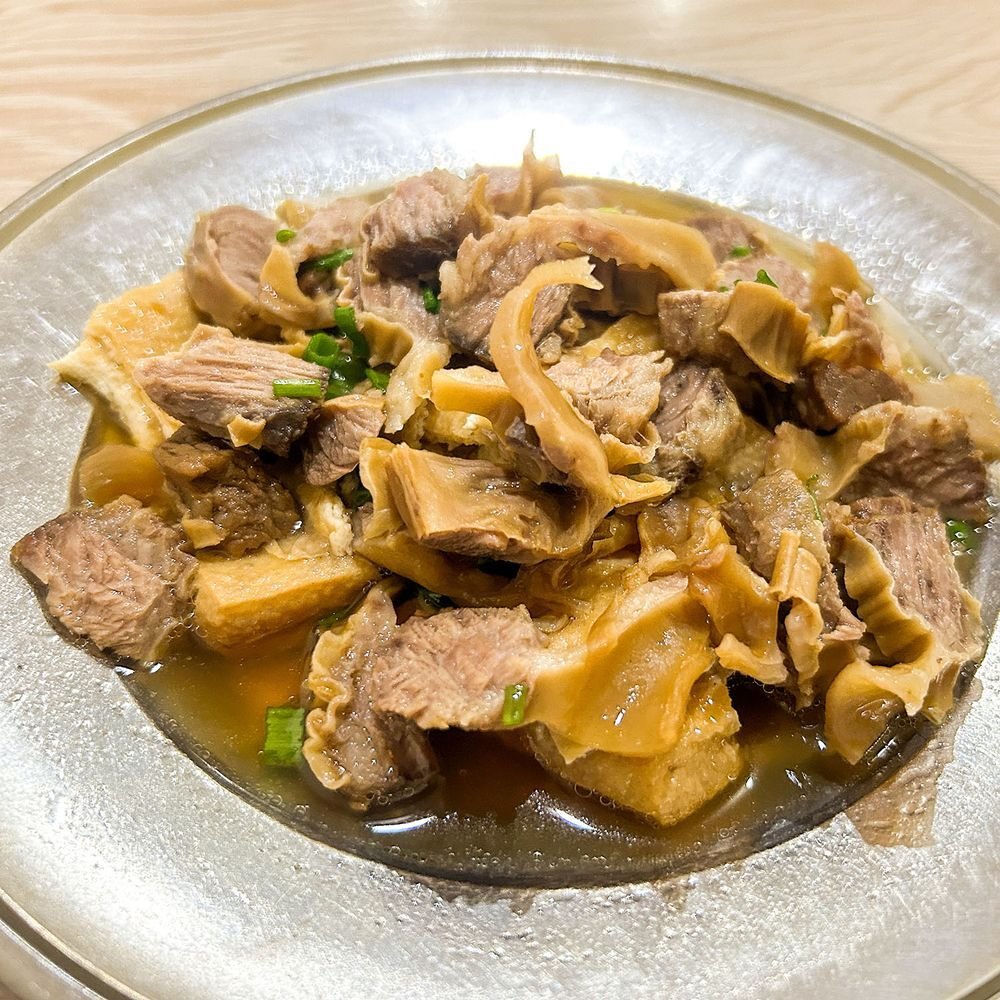
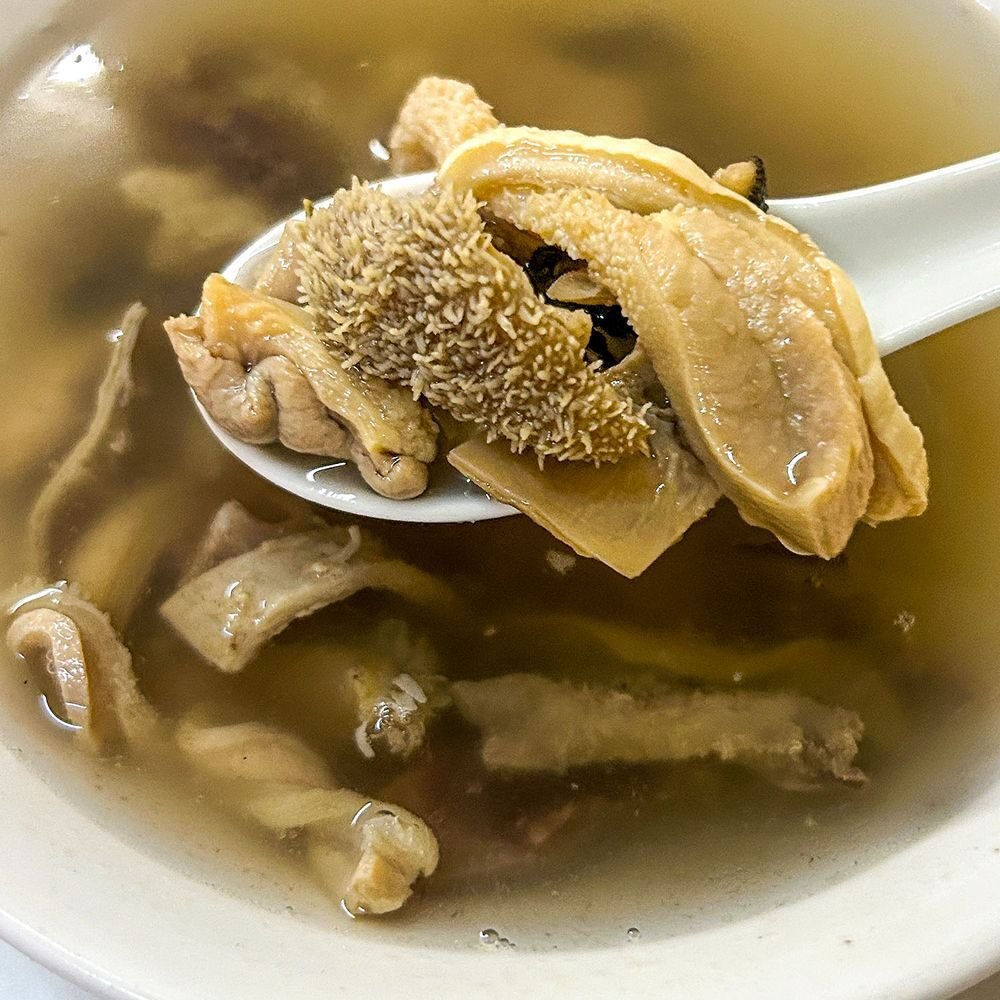
Offal soup extends the repertoire into more demanding territory. Tripe and ox tongue are the featured cuts, and their inclusion signals a kitchen committed to whole-animal utility. Tripe demands careful preparation to achieve the bouncy, yielding texture described here; undercooked, it is unpleasant, and overcooked, it collapses. Ox tongue, when handled correctly, is among the most tender and flavourful cuts available from a beef carcass, with a fat content that enriches the surrounding broth. The presence of these cuts as named best-sellers rather than as obscure additions confirms that the restaurant's regular clientele has grown up eating offal as a normal part of this category, which speaks to the depth of the local food culture.
Beef meatball soup completes the trio. Meatballs in the Fujian tradition are typically hand-pounded to achieve a springy, bouncy bite rather than the soft, yielding texture more common in Western preparations. The hand-pounding process creates a tighter protein structure, and in a bowl of clear broth, the contrast between the firm ball and the slippery noodle is again about textural dialogue. Nearby, the noodle and dumpling specialists at Fu Ding Zheng Zong Bian Rou (Jianxin Road) and Hu Yu Zhong Wu Qu Bian Rou work in adjacent traditions, while Ning Chuan Zu Yao Yu Wan and Shou Ning Mi Gao represent the broader spectrum of Ningde's casual dining economy. Xiao Dong Men occupies a specific niche within that local ecosystem: the committed single-protein specialist with a long operating history.
Ningde's Casual Dining Context
Ningde does not draw the volume of food-focused tourism that Xiamen, Fuzhou, or Quanzhou attract, and that relative obscurity shapes how restaurants here operate. There is no incentive to perform for outsiders or to adapt menus toward greater accessibility. Places like Xiao Dong Men have been built by and for a local constituency, and that alignment between kitchen and customer produces a directness that more tourist-oriented cities sometimes lose. The lack of an official website and the absence of English-language presence are consistent with this orientation. This is a restaurant that has grown through word of mouth among Ningde residents, and its continued operation in that context is the most credible endorsement available. For broader orientation across the city's dining options, the EP Club Ningde restaurants guide maps the full picture. The Ningde hotels guide, bars guide, wineries guide, and experiences guide round out the city's coverage for visitors planning a broader stay.
For reference, the contrast between this kind of embedded local specialist and the formal fine-dining register is sharp. Venues like Chef Tam's Seasons in Macau, Imperial Treasure Fine Chinese Cuisine in Guangzhou, or Dai Yuet Heen in Nanjing operate in a categorically different tier, as do internationally recognised addresses like Le Bernardin in New York City and Atomix in New York City. Closer to the spirit of Xiao Dong Men, in terms of regional specialisation and local loyalty, are the noodle and rice-based specialists clustered across Fujian's smaller cities. 102 House in Shanghai and Xin Rong Ji in Chengdu represent how regional cooking can translate into more metropolitan contexts, but the original material often has its most concentrated expression at the source.
Planning Your Visit
Xiao Dong Men Niu Rou Shui Fen Lao Dian is located on the second floor of the Diyuan Building at 6 Jiaocheng North Road, Jiaocheng District, Ningde, Fujian (邮政编码: 352199). No website or phone number is publicly listed in the available records, which means walk-in is the practical approach. Given the venue's long-standing local reputation and its identity as a neighbourhood staple, peak meal times, particularly morning and midday, are likely to see high demand from regulars. Arriving slightly outside the main lunch rush is the practical adjustment worth making. The format, informal, noodle-focused, single-protein, means the experience moves quickly once you're seated.
Reputation First
A short peer set to help you calibrate price, style, and recognition.
| Venue | Awards | Cuisine | Notes |
|---|---|---|---|
| Xiao Dong Men Niu Rou Shui Fen Lao Dian | This well-established, down-to-earth joint specialises in beef rice noodle soup… | This venue | |
| Fu Ding Zheng Zong Bian Rou (Jianxin Road) | |||
| Hu Yu Zhong Wu Qu Bian Rou | |||
| Ning Chuan Zu Yao Yu Wan | |||
| Shou Ning Mi Gao |
Continue exploring