.png)
Tucked into an alley off Jianxin Road in Ningde's Jiaocheng district, this well-regarded local shop is the address Fujian residents point to for bian rou done correctly: thin-skinned pork wontons served in sour-spicy broth with laver and pork cracklings, or fried crisp. House-made xiaolongbao and marinated pork diaphragm round out a short menu built entirely around the snack traditions of coastal Fujian.
 Discover on Pearl
Pearl is the En Primeur Club membership app — saves, bookings, and concierge access live there. Same editors, same standards.
An Alley, a Broth, and the Logic of Fujian Street Food
Ningde does not announce itself loudly on China's dining circuit. The prefecture-level city on Fujian's northeastern coast sits between the better-documented food cultures of Fuzhou to the south and the Zhejiang border to the north, and most visitors who pass through are there for the Taimu Mountain scenery or the container port, not a meal. That relative obscurity has kept its street-food economy honest. The shops that survive here do so because local regulars return daily, not because a travel article sent a wave of curious outsiders through the door. Fu Ding Zheng Zong Bian Rou on Jianxin Road operates squarely within that logic.
The address itself is instructive. The shop occupies a lane position rather than a main-street frontage, the kind of placement that, in Chinese cities of this scale, almost always signals that the customer base is entirely neighbourhood-driven. You find it because someone who lives nearby told you to, or because you were already walking that block. That dynamic shapes everything from the price point to the pace of service to the menu's deliberate narrowness.
What Bian Rou Actually Is, and Why Fuzhou's Version Differs from Ningde's
Bian rou is Fujian's answer to the wonton, though calling it that undersells how different the wrapper is. In the regional tradition, the pork filling is beaten and stretched into an almost translucent sheet that serves as its own casing, producing a dumpling with a texture closer to fish maw or hand-pulled noodle than to the thicker wheat skins found in Cantonese or Shanghainese versions. The wrapper is, in effect, made from the filling itself, which means ingredient quality at the protein level determines whether the dish works at all.
Across Fujian, the format splits into two main service modes: braised or fried. The broth version at shops like this one uses a sour and spicy base, finished with laver (dried seaweed, a coastal Fujian staple) and pork cracklings that provide both fat and crunch against the silky wrapper. The fried version sacrifices the broth's complexity for a different textural register, the skin blistering and crisping in oil until the whole parcel becomes a snack closer in character to a spring roll. Both versions are on offer here, which is a practical acknowledgment that regulars have preferences and the kitchen should not force a choice.
For broader context on how bian rou fits into Ningde's snack geography, Hu Yu Zhong Wu Qu Bian Rou offers another point of comparison within the city, while our full Ningde restaurants guide maps the wider picture.
The Sourcing Logic Behind a Short Menu
A menu this short, three principal items across two preparations, only sustains a loyal following if the sourcing decisions behind each dish are made carefully and consistently. The pork that goes into the bian rou wrapper is also the pork in the house-made xiaolongbao, which the kitchen steams to order rather than pre-batching. That decision reflects a production discipline common to smaller Fujian snack shops that take their xiaolongbao seriously: the dough relaxes differently once filled, and a dumpling held even twenty minutes past steaming loses the snap of its skin. The filling here carries mushroom and scallion aromatics, a combination that reads as distinctly northern Fujian in character, different from the cleaner, ginger-forward pork blends common in Shanghai-style xiaolongbao at places like 102 House in Shanghai.
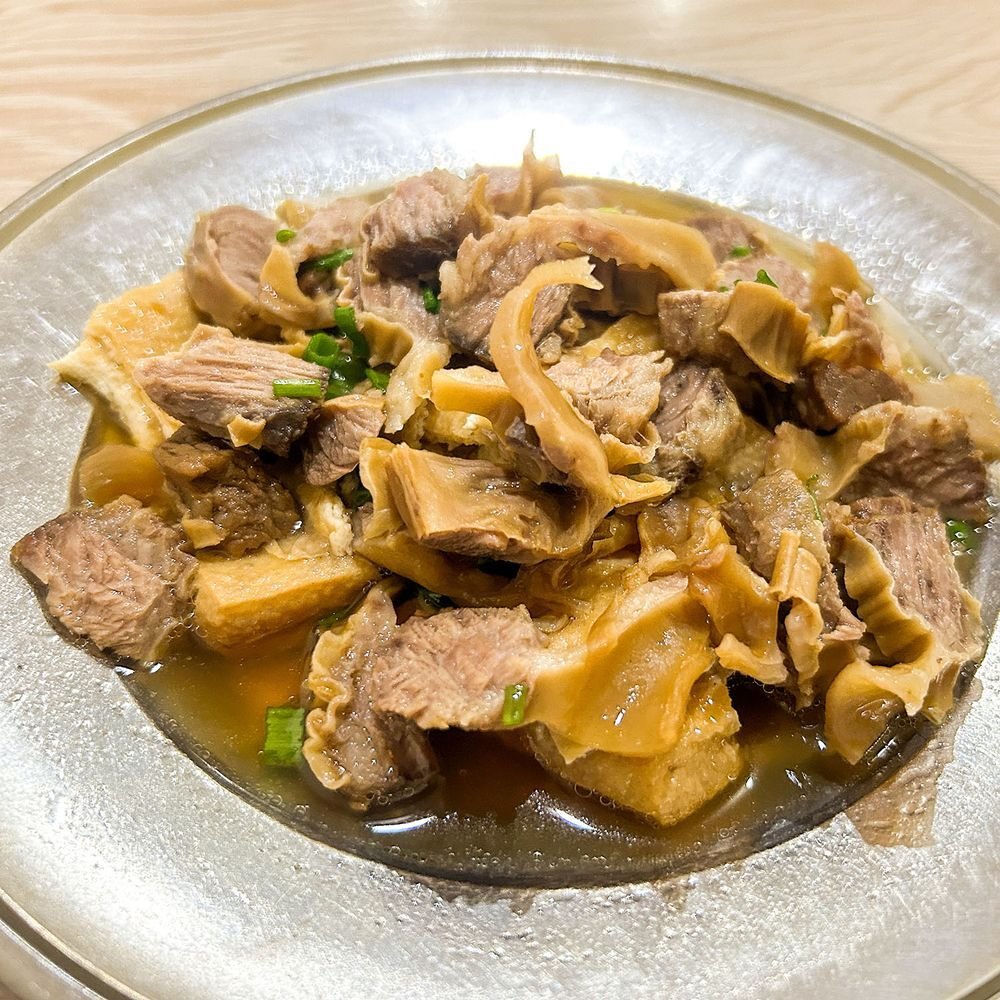
The marinated pork diaphragm completes the menu. Diaphragm is an offal-adjacent cut that most casual dining operations avoid because it requires precise marinade time and temperature to move from tough to genuinely chewy without crossing into rubbery. The fact that it appears here, and that locals specifically return for it, suggests the kitchen has worked out a consistent process. Meaty flavour and deliberate chew are the intended result, not tenderness in the Western sense.
This is Fujian coastal cooking at its most ingredient-direct: no sauces built to mask protein quality, no garnish complexity to distract from the wrapper. Contrast that with the elaborated presentations at Chef Tam's Seasons in Macau or the refined Zhejiang register of Xin Rong Ji in Beijing, and the distance between street-snack Fujian and the country's fine-dining tier becomes clear. The logic is entirely different: here, there is nowhere for a mediocre ingredient to hide.
Ningde's Snack Culture in Context
Ningde's food scene is shaped by geography in ways that are still underappreciated outside Fujian. The city sits on a drowned coastline of narrow inlets and offshore islands, which historically made fresh seafood accessible but land-based agriculture harder to scale. The result is a snack culture that relies heavily on preserved proteins, dried marine ingredients, and pork in its various processed forms. Laver, the dried seaweed sheet that appears in the bian rou broth, is harvested from these coastal waters and used here with a casualness that marks it as a genuine local staple rather than a decorative flourish.
Other addresses worth knowing in Ningde's snack circuit include Ning Chuan Zu Yao Yu Wan for fish ball traditions, Shou Ning Mi Gao for the rice cake formats common in the mountainous Shouning county, and Xiao Dong Men Niu Rou Shui Fen Lao Dian for beef and rice noodle work. Together, these shops represent the range of Ningde's street-food vocabulary far better than any single address could. If you are building a broader itinerary, our Ningde hotels guide, bars guide, and experiences guide cover the surrounding infrastructure.
Planning a Visit
Fu Ding Zheng Zong Bian Rou operates as a neighbourhood walk-in shop on Jianxin Road in Jiaocheng district, postal code 352101. No phone number or website is listed, which is standard for this category of Fujian snack operation; visiting without a reservation is the expected mode, and the format does not support advance booking in any meaningful sense. Go at local meal times, mid-morning for breakfast or just before noon, when the kitchen is at full output and the xiaolongbao are steamed freshest. Arriving later in the afternoon risks finding certain items sold out, as small shops at this tier rarely prep beyond what the morning crowd demands. The shop's alley position means it is leading reached on foot from the surrounding residential blocks; asking a local on Jianxin Road to point you toward it is more reliable than GPS in a dense lane network.
For readers whose China itinerary extends beyond Ningde, the editorial range on EP Club covers the full spectrum from this kind of neighbourhood snack counter to Ru Yuan in Hangzhou, Xin Rong Ji in Chengdu, Imperial Treasure Fine Chinese Cuisine in Guangzhou, and Dai Yuet Heen in Nanjing. The distance between those rooms and this alley shop is enormous in format and price, but the sourcing discipline that underpins good Chinese cooking connects them at a foundational level.
How It Stacks Up
These are the closest comparables we have in our database for quick context.
| Venue | Cuisine | Price | Awards | Notes |
|---|---|---|---|---|
| Fu Ding Zheng Zong Bian Rou (Jianxin Road) | Beloved by the locals, this simple shop hidden in an alley ticks all the boxes i… | This venue | ||
| Hu Yu Zhong Wu Qu Bian Rou | ||||
| Ning Chuan Zu Yao Yu Wan | ||||
| Shou Ning Mi Gao | ||||
| Xiao Dong Men Niu Rou Shui Fen Lao Dian |
Continue exploring
More in Ningde
At a Glance
- Hidden Gem
- Rustic
- Cozy
- Casual Hangout
Simple, unpretentious alley shop atmosphere cherished by locals.