On Rue Beautreillis in the Marais, Vins des Pyrénées occupies a space where the wine-bar tradition of southwestern France meets the informal dining culture of Paris's fourth arrondissement. The address places it within walking distance of Place des Vosges, drawing a neighbourhood crowd that treats it as a reliable anchor rather than a destination event. It is one of the more characterful addresses in a part of the city where restaurant options span every price tier.
Pearl is the En Primeur Club membership app — saves, bookings, and concierge access live there. Same editors, same standards.
- Address
- 25 Rue Beautreillis, 75004 Paris, France
- Phone
- +33142726494
- Website
- vinsdespyrenees.com
- Directions
- Get directions
 Saves & bookings on Pearl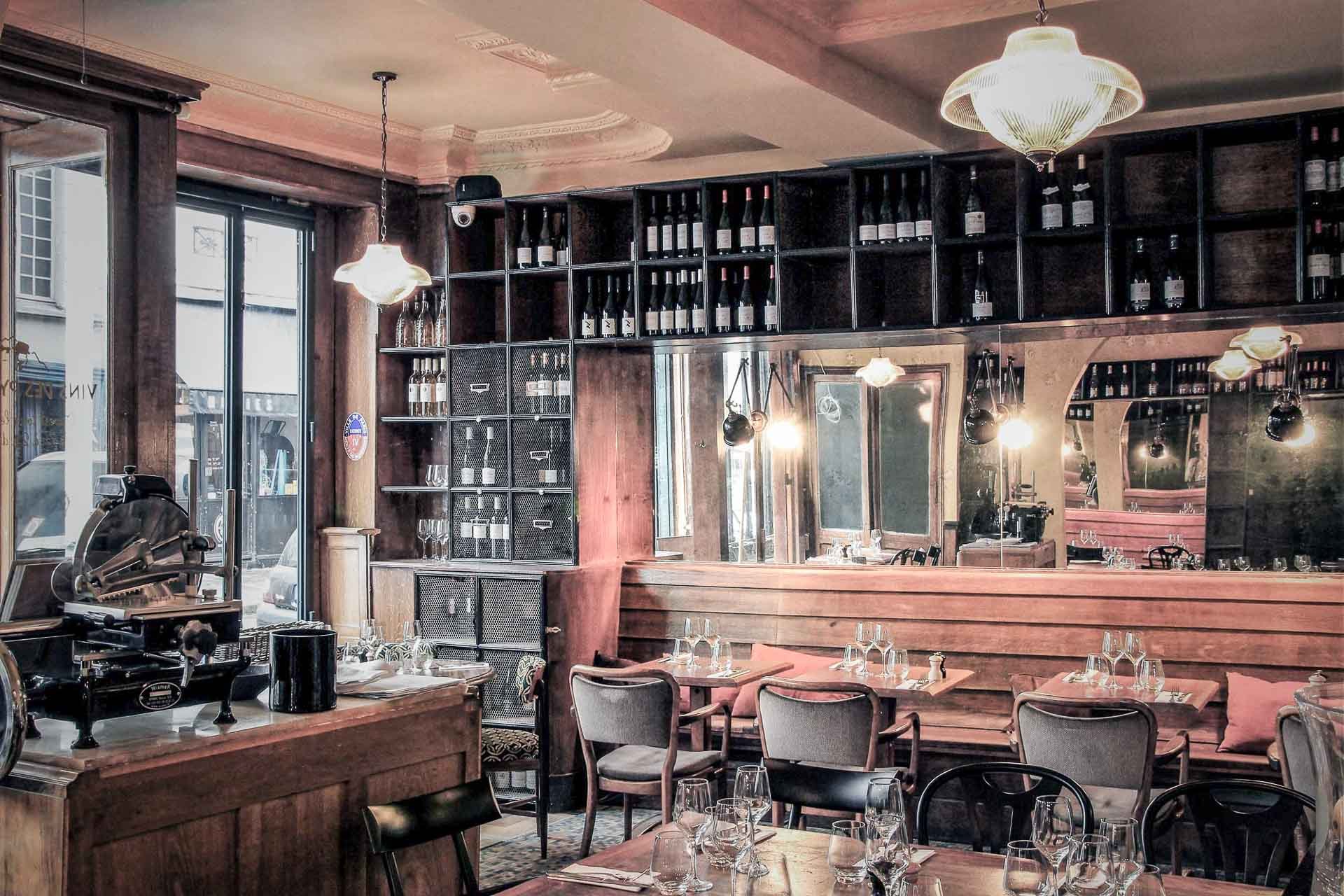
A Corner of the Southwest, Fixed in the Fourth
Rue Beautreillis runs quietly between Rue Saint-Antoine and the Seine in the fourth arrondissement, a stretch of the Marais that retains a residential pace despite its proximity to the more trafficked tourist circuit around Place des Vosges. The buildings are old and mostly narrow, the street itself unassuming. Arriving at Vins des Pyrénées in this context, the address at number 25 reads as exactly the kind of wine-anchored bistro that the Marais used to be full of before the neighbourhood's demographic shift pushed rents high enough to make that format commercially tenuous. That tension — between the persistence of the traditional Parisian neighbourhood bar à vin and the economic pressure that has thinned their numbers — is part of what gives an address like this one its weight.
The Pyrénées as a culinary reference point occupies a specific and underappreciated position in French regional cooking. Southwestern France, which the mountain range frames along its northern approach, has produced a canon of dishes built around duck fat, cured meats, earthy legumes, and wines from Madiran, Irouléguy, and Jurançon: appellations that remain far less familiar internationally than Bordeaux or Burgundy despite producing some of France's most characterful bottles. That relative obscurity is partly geographical, the region draws fewer foreign visitors than the Médoc or Dordogne, and partly a function of how French wine culture exports itself, which tends to prioritise the internationally legible over the locally specific. A Parisian wine bar that grounds its identity in this tradition is not making a commercially obvious choice.
The Wine-Bar Format in the Marais, Then and Now
The bistrot à vins format that Vins des Pyrénées represents has been under pressure across Paris for the better part of two decades. Rising property costs in central arrondissements have made the low-margin, high-volume model of the neighbourhood wine bar difficult to sustain without either raising prices toward brasserie territory or simplifying the offer until the point of differentiation disappears. Several addresses that once defined the category in the third and fourth arrondissements have closed or converted. Those that remain, including this one on Rue Beautreillis, function as something closer to cultural institutions than commercial formats: places where the logic of the offer (a serious wine list, a short food menu calibrated to accompany rather than compete) is its own argument.
For context, the higher end of Paris dining in this part of the city operates at a very different register. L'Ambroisie on Place des Vosges, a few hundred metres from Rue Beautreillis, represents the apex of classical French cuisine in the fourth arrondissement, at price points and formality levels that occupy an entirely separate category. Further afield in Paris, addresses like Arpège, Alléno Paris au Pavillon Ledoyen, Le Cinq at the Four Seasons Hôtel George V, and Kei represent the city's formal tasting-menu tier. Vins des Pyrénées operates in a different register entirely, where the measure of quality is not the ambition of the kitchen but the coherence of the wine-and-food pairing logic and the authenticity of the regional reference.
Pyrénéen Cuisine and What It Actually Means
The cultural significance of Pyrénéen cooking lies partly in its resistance to trend cycles. While Parisian restaurant culture has moved through successive waves, nouvelle cuisine in the 1970s, bistronomie in the 1990s and 2000s, natural wine and small-plate formats through the 2010s, the cooking of the southwest has remained structurally stable. Its anchors are preserved and cured proteins, slow-cooked legume dishes, and a preference for wines with genuine tannin and body rather than the lighter extraction that has become fashionable in natural wine circles. Madiran, produced from the Tannat grape in the foothills of the Pyrénées, is one of the most tannic red wines in France and pairs specifically with the fat-rich proteins of the regional table in ways that require no critical apparatus to understand: the food and the wine resolve each other.
This is distinct from the kind of regional French cooking represented by, for example, Bras in Laguiole, which operates at three Michelin stars and has transformed Aubrac terroir into a high-concept fine dining language, or Auberge du Vieux Puits in Fontjoncouse in the Languedoc, another three-star address rooted in southern French produce. The Pyrénéen tradition that Vins des Pyrénées references is less about elevation through technique and more about the integrity of the tradition itself: a format where the wine is the organizing principle and the food exists to extend the drinking.
Other regions with strong culinary identities are well represented across France's dining circuit. Auberge de l'Ill in Illhaeusern anchors Alsatian tradition; Au Crocodile in Strasbourg operates in the same cultural zone. Assiette Champenoise in Reims and Flocons de Sel in Megève each embed themselves in regional produce logic at the fine dining level. At the bistrot scale, the Pyrénéen reference point is rarer and consequently more specific when it appears.
Planning a Visit: Rue Beautreillis in Context
The fourth arrondissement is accessible from multiple metro lines, with Saint-Paul (Line 1) the most direct approach from central Paris. Rue Beautreillis is a short walk from the station. The neighbourhood functions as a genuine mixed-use district rather than a purely tourist zone: residents, office workers, and visitors occupy the same blocks, which affects the rhythm of the restaurants and bars on the street. Midweek evenings tend to be quieter than weekends, when foot traffic from the Place des Vosges circuit increases significantly.
| Venue | Style | Price Tier | Arrondissement | Booking Pressure |
|---|---|---|---|---|
| Vins des Pyrénées | Bistrot à vins / Regional | Mid-range | 4th | Moderate |
| L'Ambroisie | Classic French | €€€€ | 4th | High (weeks ahead) |
| Kei | Contemporary French | €€€€ | 1st | High |
| Arpège | Creative / Vegetable-forward | €€€€ | 7th | Very high |
For a broader survey of Paris dining across all price tiers and styles, see our full Paris restaurants guide. For international comparisons at the level of ingredient-driven cooking, Mirazur in Menton and Troisgros in Ouches represent how regional French produce logic operates at the highest formal level. Outside France, Le Bernardin in New York City and Atomix in New York City offer useful reference points for how European culinary traditions translate and transform across different contexts. Within France, AM par Alexandre Mazzia in Marseille and Paul Bocuse in Collonges-au-Mont-d'Or each represent how distinct regional identities anchor themselves in the national fine dining circuit.
How Vins des Pyrénées Paris compares with similar nearby venues.
| Venue | Cuisine | Price |
|---|---|---|
| L'Ambroisie | French, Classic Cuisine | €€€€ |
Continue exploring
More in Paris
Restaurants in Paris
Browse all →
Bars in Paris
Browse all →
Hotels in Paris
Browse all →




At a Glance
- Classic
- Romantic
- Cozy
- Elegant
- Well Known
- Date Night
- Casual Hangout
- After Work
- Late Night
- Group Dining
- Rooftop
- Terrace
- Wine Cellar
- Historic Building
- Live Music
- Extensive Wine List
- Craft Cocktails
- Sommelier Led
- Local Sourcing
Current opening hours
- Monday
- 8:30 AM–12 AM
- Tuesday
- 8:30 AM–12 AM
- Wednesday
- 8:30 AM–12 AM
- Thursday
- 8:30 AM–12 AM
- Friday
- 8:30 AM–1:45 AM
- Saturday
- 8:30 AM–1:45 AM
- Sunday
- 8:30 AM–12 AM
Hours can change for holidays and private events. Last verified .
Warm, inviting atmosphere dominated by rich dark wood, copper accents, vintage postcards, Chesterfield sofas, and antique furnishings; soft lighting creates an intimate, old-world charm with modern touches.
Know Before You Go
- Getting there
- 25 Rue Beautreillis, 75004 Paris, France